Desert Online General Trading LLC
Dubai, United Arab Emirates
Desert Online General Trading LLC
Dubai, United Arab Emirates
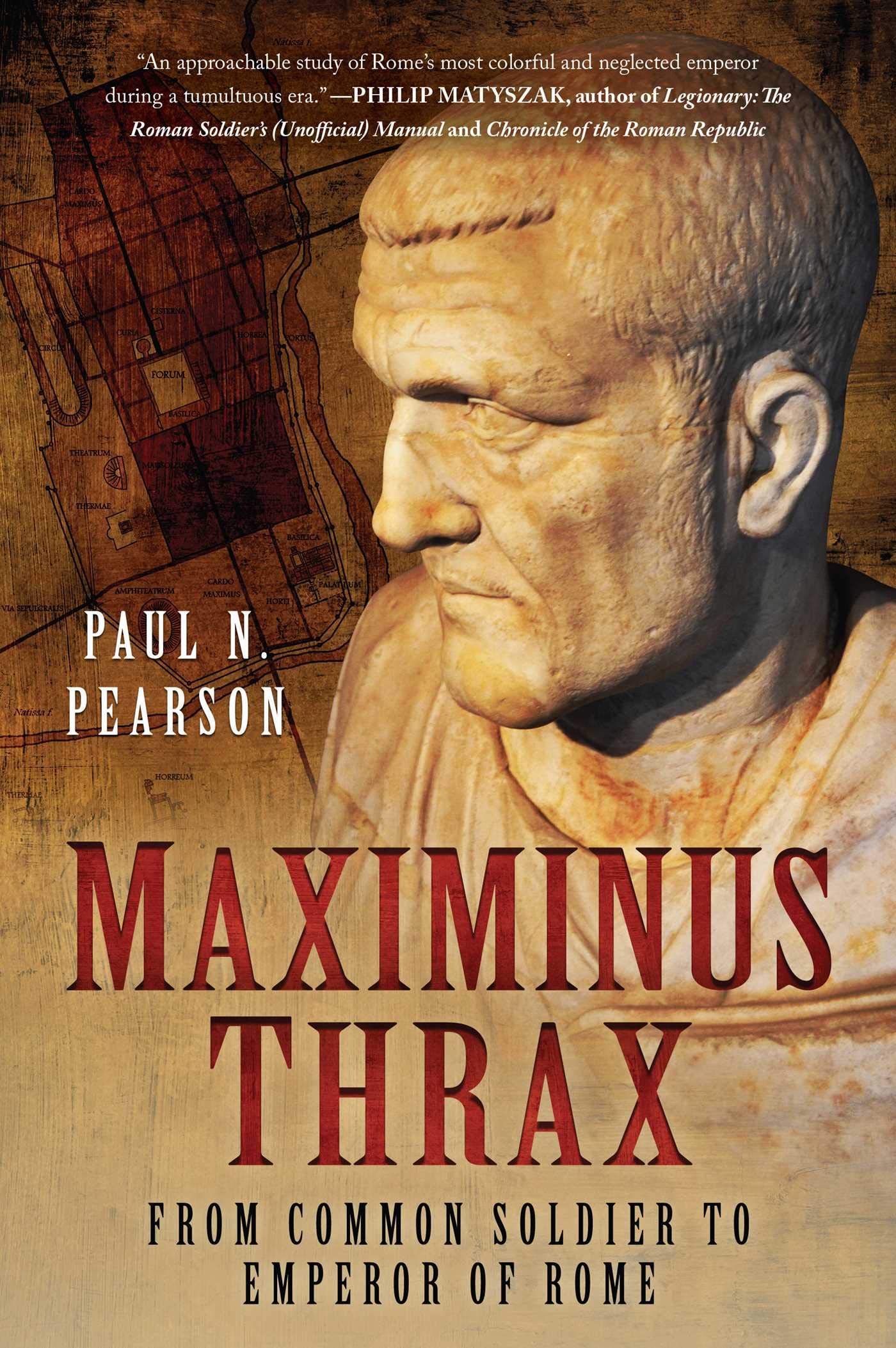
Maximinus Thrax: From Common Soldier to Emperor of Rome
D**H
Was this Emperor cause or symptom of the Decline?
Maximinus Thrax is the stuff of legend, the 8-foot tall giant who overthrew the Severan dynasty, he was a kind of evil supervillain in Roman historiography. But folks who know the historians of this era understand that they are largely unreliable. What are modern people who are attempting to piece together a picture of the Roman Crisis of the Third Century supposed to think about this reviled emperor? Paul N. Pearson’s new book offers a narrative biography of a man who is largely the object of odium of the ancient historians, but was revered by the men he led into battle. His brutal reign was only ended in the sorry spectacle of a year of six Caesars in 238 CE.Recently, Oxford historian and novelist Harry Sidebottom has fictionalized the reign of Maximinus in his Iron and Rust: Throne of the Caesars: Book 1 (Throne of Caesars) Trilogy and in his afterword promoted this then yet unpublished book. Given the fragmentary and unreliable nature of ancient sources, it is nearly impossible to have an objective account of the reign of Maximinus, however, archaeology has given us much to ponder in recent years. Michael Speidel’s book on the Imperial Horse Guard, Riding for Caesar: The Roman Emperors' Horse Guard, also gave a tantalizing clue that Maximinus was a member of that elite unit. Pearson has done a lot of homework with the literary evidence (beyond what you can find in the Penguin and Loeb imprints) and educated guesswork as well as epigraphy and numismatics.Two real standouts in terms of new material on Maximinus are Pearson’s description of a relatively recent archaeological find in Harzhorn, Germany; where evidence of a major Roman vs. German battle has been unearthed dating to a period no earlier than the reign of Severus Alexander. Pearson posits that this findsite is the physical evidence of a Roman army, likely from the era of Maximinus, extricating itself from a Germanic ambush while returning from battle deep in German territory. The full tale of the shovel of this site has yet to be told, but Pearson whets the appetite of historians and Roman history aficionados. Let’s just say that the topography and vegetation of the site makes comparisons to the opening of the movie Gladiator unavoidable. Also, a few statements made by Herodian and the dodgy Historia Augusta that were thought to be fantastic have now been verified with physical evidence.Another interesting conjecture Pearson makes is that the heroically scaled bronze at the Met, commonly considered a nude portrait of Trebonianus Gallus, is in fact a life-sized portrait of Maximinus Thrax. Pearson gives a good line of reasoning for his supposition. Although this book is more of a popular and narrative biography (a modern scholarly biography of this fascinating emperor has yet to be written in English to the best of this reviewer’s knowledge) it is well footnoted with a good chapter describing and evaluating the sources. Although Gibbon and most modern historians echo the hatred that the ancients had for Maximinus, Pearson reflects that Maximinus could have had a very rational policy in terms of wanting to conquer Germanic tribes and shorten the Roman frontiers, we cannot make any anti-historical arguments, other than to say the reversal of his gains was followed some three decades later by a flood of Germanic invasions across the Rhine, Danube and Black Sea.I have to add that Pearson has also done readers a favor by keying comments in the text to specific relevant pages in the photos, a trend I hope future authors will follow.Although this book could not possibly answer the question as to whether Maximinus was the cause or a symptom of the Crisis of the Third Century, it is the best and most up-to-date review of his career as an extraordinary footsoldier who became the most powerful man in the known world during his age. This book was long overdue. I can only hope that Pearson or someone of similar caliber produces a similar biography of Valerian and Gallienus in the near future.
D**R
4 1/2 Stars
A great book, written as if a biographical text book for a course on the Roman Empire, although somewhat abridged, focusing a little known Roman emperor, Maximinus Thrax of the 3rd century who was a barbarian (Thrace) that started as a common soldier. Evidently based on historical data he was inflicted with gigantism and in his case fortuitously so as his imposing stature, strength and military training/background got him to where no other such person of his "lowly" birth could possibly hope to rise, that being undisputed emperor of the Roman Empire. Now I love history and have always been enamored with the Roman Empire for as long as I can remember. I also took two years of Latin in HS when I thought for a hot minute I'd perhaps be a doctor. So I'm predisposed to like this book - loved it actually. It's written more in the manner of historical textbook covering Maximinus' life, his time and events both, before during and after his short three year reign. If you like history, the military, Ancient Rome and the like, you'd likely enjoy this book!
M**Y
Excellent Biography of a Roman Soldier Raised to Roman Emperor
This is a very well written biography of the soldier turned Emperor Maximinus Thrax. With his military background, Maximinus put the Roman military at the head of his administrative programs. With some military success, his somewhat severe administration, coupled with his lack of noble background caused resentment among some elements of the military and Senate. His diversion of public funds and public grain supply for military matters caused great resentment among many of the Roman citizenship. These factors led to his murder, which was becoming a very popular way to dispose of disappointing Roman Emperors.Many consider the murder of Emperor Maximinus Thrax to usher in the "Age of Chaos" in the Roman Empire. This is a fast, easy read and very interesting book. The author has a very good sense of humor, which he sometimes interjects into his narrative. Highly recommended.
M**N
Excellent and detailed
Well written, fair and detailed history of a fascinating and little known period of Roman history. Balanced and well documented.
C**N
I learned a great deal from this book
I learned a great deal from this book. However, I always had the feeling that there was something lacking -- a sense that there were parts to the story that I wasn't hearing.
Trustpilot
3 weeks ago
1 month ago