🌟 Transform Your Mind, Transform Your Life!
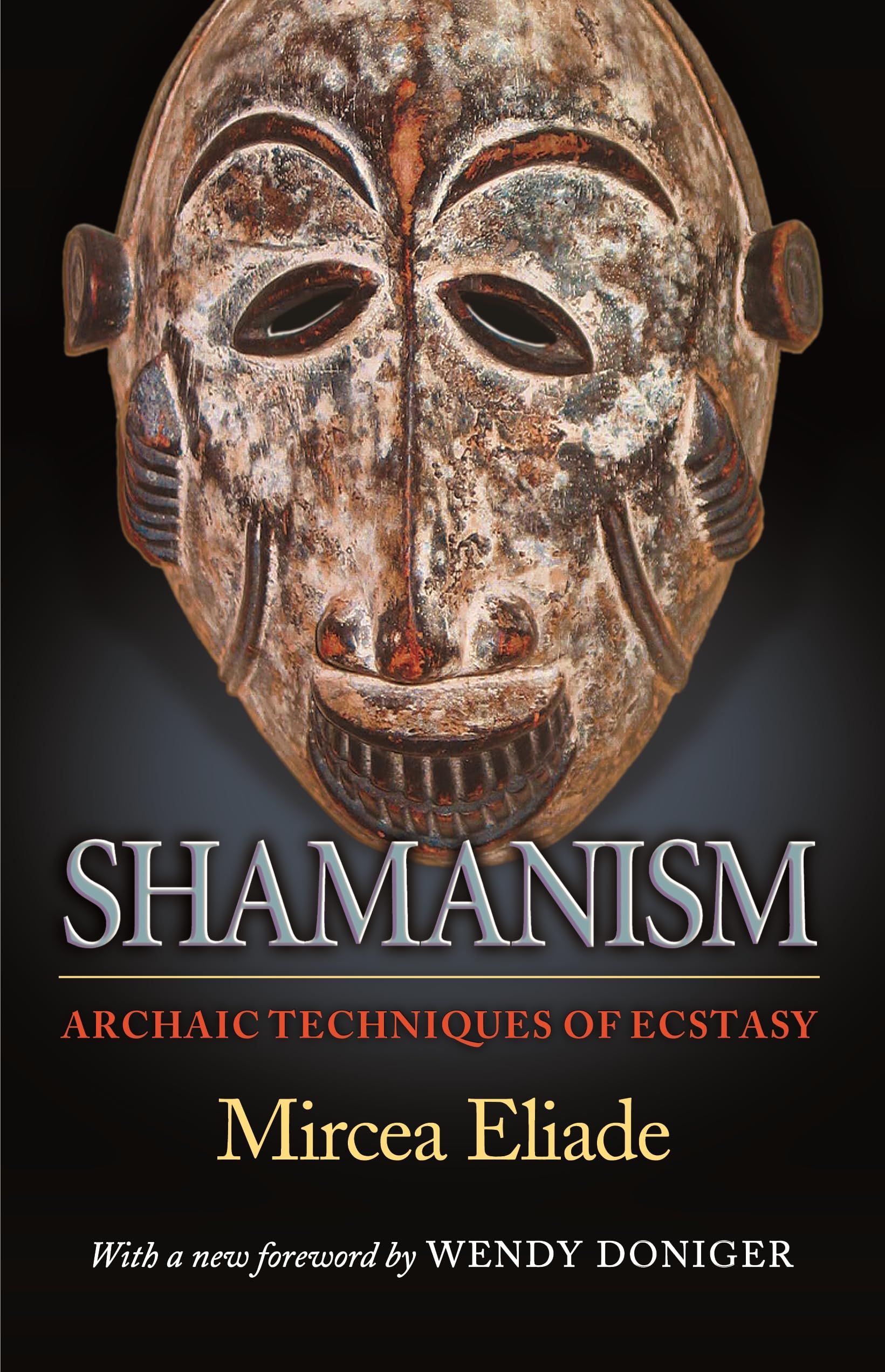
Shamanism: Archaic Techniques of Ecstasy is a comprehensive guide that delves into the ancient practices of shamanism, offering over 300 pages of rich insights, practical techniques, and cultural context to help readers explore altered states of consciousness and enhance their spiritual journey.
S**R
Solid Work on Religious Basis of Shamanism
I'm not sure why indie musicians are, by and large, such uninteresting people. Maybe it has something to do with the fact that they all think that they are interesting people and therefore spend no time learning about new things or thinking about new ways to make themselves interesting to others. It's not like everyone has to be interesting: I don't expect a gas station attendant to engage me in sparkling conversation, but it seems that if one is going to create art/culture that this person would go out of their way to learn about new things, try new experiences, etc. Such is clearly NOT the case, here in San Diego, or anywhere else, for that matter. The indie music world often seems about as interesting to me as junior high. I don't have any truck with the social world of junior high, with it's cliques and posturing, but, simply put, it's a boring world. It's the same thing with the indie music world: Like junior high, but with bands. I was super excited to read Shamanism: Archaic Techniques of Ecstasy after seeing the citation in the Shape of Ancient Thought. I was even more excited when I realized that Wendy Doniger, my favorite scholar/professor, was mentored by this guy (Mircea Eliade is a Romanian, and a man, not a chick.) Shamanism was originally published in English (from the French) in 1951, but the book I have is a 2004 re-print with a new foreword by Doniger. Eliade's scholarship is a leetle out of date 50 years on, but that doesn't detract from the fact that this book was the first comprehensive approach to Shamanism that treated it as something other then a "degraded" "uncivilized" object of scorn. In fact, Shamanism appears to be the basis of all religious thought everywhere, showing up not only in the civilized religions of the Near East, West and East, but also in the indigenious peoples of Australia, New Guinea, Polynesia and North and South American. Shamanism is the closest things humans have to a "universal" religion prior to the emergence of the great world religions of Christianity, Islam and Buddhism (sorry Hindus!!!!) So what is Shamanism? Eliade defines Shamanism as religious practice governed by the reaching of non-conscious ecstatic states by the Shaman. During this state, the Shaman travels to the sky or the underworld and rescues the souls of the sick/ill etc. That is Shamanism in a nut shell, but it's the description of the ritual ascents and descents that I found most interesting. I don't want to spoil the joys of the world tree, the soul egg and the bridge for those who might actually read this book, but suffice it to say that Shamanism: Archaic Techniques of Ecstasy, contains enough food for thought to keep the reader thinking for months. Also, all the quoted sources are in Russian or German, so you don't have to worry about follow up reading.
T**N
Not the Most Accurate Research; Theories Largely Abandoned
As I read other reviews, I am alarmed by the large number praising Mircea Eliade's work as thorough, detached, and scientific. The past forty years in the field of Comparative Religion (or,as Eliade founded it, "The History of Religion[s]") has done everything to disprove Eliade's work and the work of other modernists (though, I did my thesis in defense of Eliade's paradigm for the religious).However, as a student of religion, the study of religion has lost its humor - many are too afraid to admit that patterns exist. Mircea Eliade and all of his work is a product of its time. While 'incorrect' and relying on bad data (due primarily to his armchair anthropology and bad translations), Eliade sought to prove the existence of a universal religious at a time when humanity had all but lost its faith in goodness.This is certainly not one of my favorite pieces by Eliade as it is one of the least poetic (and, after all, Eliade's enterprise was admittedly poetic). If you are looking for a good introduction to Eliade's overarching theory, I encourage readers to consult his "The Sacred and the Profane" (a shorter version of "Patterns in Comparative Religion"). Eliade boldly asserted that all humanity is religious. Unfortunately, his route for achieving that conclusion was flawed.
S**Y
An excellent resource book
Ultimate encyclopedic reference book on shamanism around the world. As others have noted, it is not a primary source, but a secondary source that organizes and assesses all the primary source studies available, which allows the author to write about the cross-cultural similarities especially among cultures that have never encountered each other. Some knowledge of the time period during which the author was writing must be taken into account to explain any colonialist/etc. undertones, but the author clearly has a respect for the various magical and spiritual traditions and this shows.
M**C
Excellent
I am reading this book as a prerequisite for a two-week shamanic healing intensive course beginning Sept 6. It's a bit thick and extraordinarily well-footnoted, and Eliade says of himself in the preface that he is a religious historian, not an anthropologist. Nevertheless, this book is an excellent resource. I removed one star simply because the index clings to archaic terms even though this particular edition isn't that old. "Invert"? as opposed to "homosexual"? You have to ferret out things a bit here, but it's still worth it. Not that it's the be-all, end-all; as I mentioned above, he's a religious historian, and all of this work is based on secondary sources. By all accounts, Eliade did no field work himself. Despite that and despite my minor grumbles about the index, he nails it.
C**A
academic, repetitive
Eliade brings a scientist's detachment and skepticism to this broad work on ubiquitous Shamanic practices and techniques; but, he lacks the framework of James's radical empiricism, which might be a more useful approach. I would prefer that the subject be treated with the openness of Benny Shannon's "Antipodes of Mind." But, it is what it is, the product of the 1950s, and an outstanding specimen of that era. A profitable read, although unnecessarily repetitive, in my opinion. Eliade could have condensed this into 200 pages. I don't like diarrhea of the mouth.
S**R
Shamanism: Archaic Techniques of Ecstasy
I bought this book to enlarge my education in Shamanism
R**B
Do NOT buy the Kindle version.
Do not get the Kindle version if you can afford the print copy. The navigation is non-existent (not even a hyperlinked TOC). Some lines don't render correctly, presumably due to poor/not formatting after digitization, and have carriage returns in weird places, paragraphs broken and sliced, and random bolding and italics. I can't even review the content as I haven't been able to read it.
B**E
Scholarly work
I don't normally write reviews for books but felt the one review giving one star for this book to be so unjust that it deserved a more balanced addition.This book is a scholarly meticulously researched study of the various practises of shamanism throughout the world. It does not provide you with a description of the techniques of how to be a shaman, nor how to have an ecstatic journey, nor how to have an out of body experience, which is presumably what the one star reviewer was looking for. Instead it provides a detailed description of shamanism as it was and is practised.There are over 50 pages of reference works on which Eliade drew in order to provide this summary, which groups his findings by region as well as by certain common practises - parallel myths symbols and rites.There are descriptions of the 'rebirth' experiences of shamans [the genuine near death experiences, not the common interpreation now used of born again]; the practises of healing, the travels of the shaman in out of body experiences, their roles as psychopomp and their practise of healing via 'soul retrieval'. He also describes 'soul loss' and what it means to each group.The amount of carefully researched detail that is provided is astonishing, it is almost a life's work but carefully organised into this relatively compact volume. It draws on the work of anthropologists and the better and more serious researchers of religions, as such it is also reliable in its findings.Personally I found this book to be a treasure house of information - but then I bought the book knowing what it contained and what I was going to use it for.To summarise - an invaluable scholarly work on shamanic practises throughout the world over the ages .
D**5
Thorough, well-written text on Shamanism. Still the classic.
This is a substantial work on Shamanism, most particularly in Central Asia and including specific nuances in tribes and variations of, also extending to other regions.Eliade's text remains the classic. Although written some years ago now, it is very thorough and well-referenced, gathering together much ethnographic material.My only issue with it is Eliade's bias / judgment of the use of entheogens which Eliade regards as a less "pure" form of Shamanism amongst ancient tribes, than the use of pure sensory deprivation, sweat houses and drumming and dancing as a means of achieving the ecstatic state. To this end, Vitebsky's text is a useful balance.Highly recommended for any scholar researching shamanism.
B**Y
Great Piece of Work
This is probably the most comprehensive amalgamation of shamanism there is. This is a vast and broad subject that has been tackled very well and is a great piece of scholarship.Anyone who has even a passing interest in what shamanism is all about should really read this piece of work. Needless to say there are many books out there that possess the the concept of shamanism in the title but they generally tend to err towards a ideological meaning and skirt around the real content of what shamanism is essentially about.A great piece of work for people interested in society, psychology, religions origins and anthropology. The only area it seems to be lacking in is a neurological view of shamanism (which is understandable given the date of the book).
E**A
Ancient Lore
This is in fact a great book. It teachs us what is a shaman , what's his roll within his tribe. We learn here what were their 'practices' in Europe, Asia, America and Australia. Africa is not mentioned, because (in my opinion), there was a clash , a mixure of cultures, myths and 'sorceries', that made african shamans lose its true meaning. The writer is very precise and logic, I loved it.
A**R
Five Stars
Serious academic book
Trustpilot
1 month ago
2 months ago