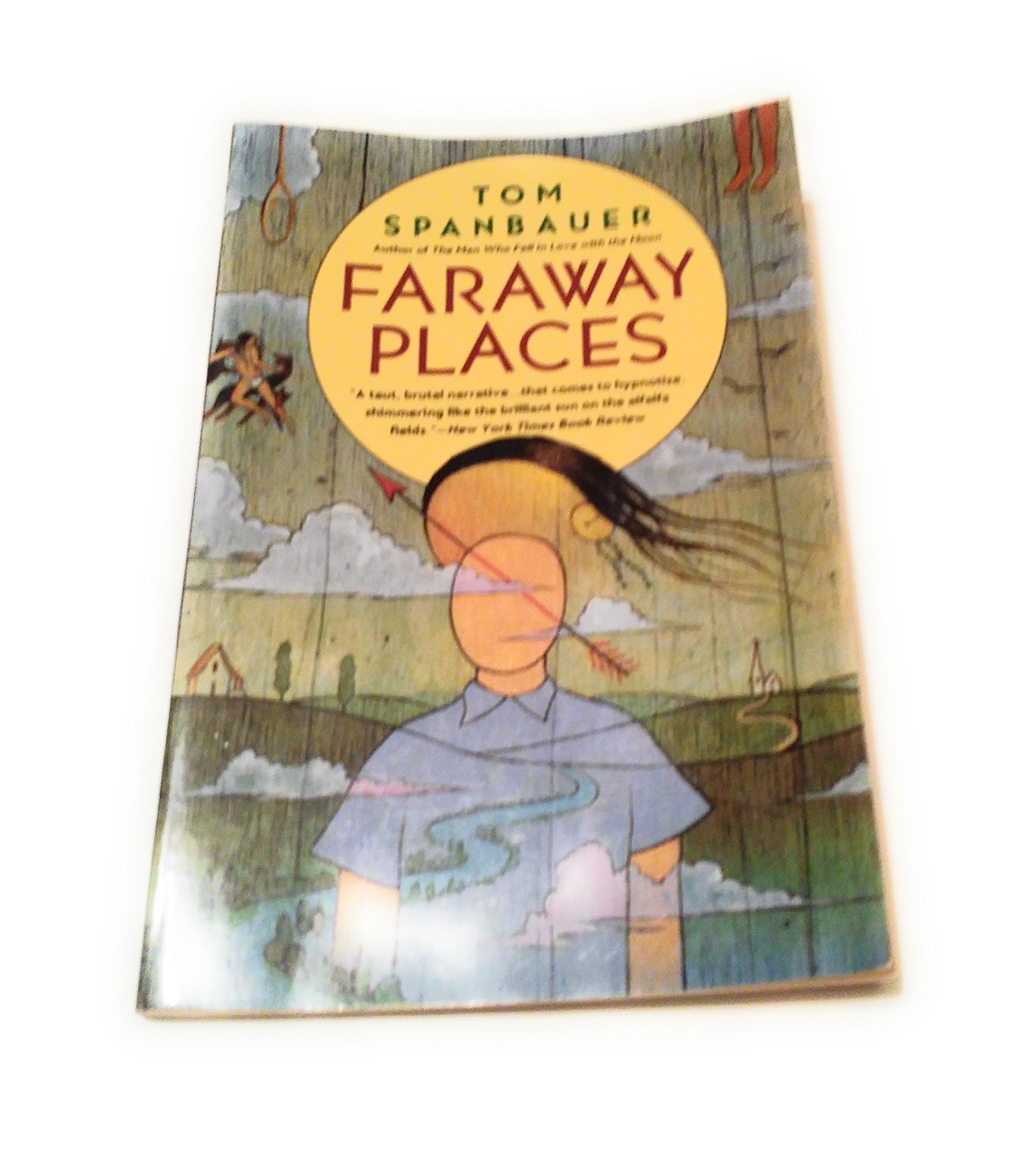
Faraway Places [Spanbauer, Tom] on desertcart.com. *FREE* shipping on qualifying offers. Faraway Places Review: A Moving Coming Of Age Novel - In Tom Spanbauer's short first novel, the narrator is Jacob Joseph Weber who is thirteen and enters junior high about half way through the story. He and his parents live on a farm in Wind River, Idaho, a farm that the evil Harold Endicott , holder of the mortgage on their land, forecloses on in October of the year (early 1950's?)after the Chinook ("the name for the strangae wind blowing") struck in February. The Weber family's life is grim as they are fettered by both poverty and the shackles of a severe Catholic Church; they are not nearly as bad off, however, as "that woman Sugar Babe," an Indian woman and the black man who lives with her. While Spanbauer notifies the reader early on, through the voice of Jacob, as to the multiple tragedies that happen, the narrator, as you would expect from a youngster recalling such events, skips from here to there until his story is finally told. Jacob is a youngster grappling with his budding sexuality-- he nightly "yellows" his shorts and of course has to confess his sins to "Monsignor Canby about every occasion." His transgressions, however, are miniscule compared to the violence and evil, even murder, that he confronts at such an early age. One of my favorite passages is Jacob's account of his family's going to the state fair when every year his parents picked that day to be mad at each other--"be mad and stay mad. . . What got different when my mother and my father were mad at each other was the world; everything and everybody else was a little off--a touch cantankerous, and full of bother. . . Everybody drove like they were from Utah." Surely every child has experienced something similar when his parents are angry with each other. FARAWAY PLACES-- the title comes from a Perry Como song-- is extremely well-written with not one wasted word, a harbinger of what is to come from this fine writer. Review: Where Tom began - I first read Spanbauer's MAN WHO FELL IN LOVE WITH THE MOON 10 years ago and fell in love with him, especially his unique voice. Recently, to prepare to take his famous "Dangerous Writing" workshop, I ordered FARAWAY PLACES, his first novel, really a novella, reissued in a gorgeous edition. The story explores themes of racism, rural poverty, identity, and family-imposed secrets and shame. Like all four of his novels, the central character is an outsider in plain site, in this case, an Idaho farm near Pocatello... which is similar to all of Tom's novels, except THE MAN WHO FELL IN LOVE... There are echoes of Steinbeck in the elegiac relationship to a changing rural landscape, the reverence for nature. Characters are sharply drawn, and Tom crafts sentences like sacred objects. This first novel only begins to hint at the scale of Spanbauer's narrative ambitions, realized successively in the three novels that follow, all of which are more complex, more panoramic in scope. But thematically and stylistically, this is where it begins. Highly recommended. In the context of the contemporary struggle over race in American life, this brings us back to the brutal reality of our history, which is pretty strong medicine, as well.
| Best Sellers Rank | #1,913,904 in Books ( See Top 100 in Books ) #9,381 in Coming of Age Fiction (Books) #45,985 in Literary Fiction (Books) #68,742 in American Literature (Books) |
| Customer Reviews | 4.4 4.4 out of 5 stars (29) |
| Dimensions | 5.25 x 0.5 x 8 inches |
| Edition | Reprint |
| ISBN-10 | 0060975520 |
| ISBN-13 | 978-0060975524 |
| Item Weight | 4 ounces |
| Language | English |
| Print length | 124 pages |
| Publication date | January 1, 1993 |
| Publisher | HarperCollins |
F**N
A Moving Coming Of Age Novel
In Tom Spanbauer's short first novel, the narrator is Jacob Joseph Weber who is thirteen and enters junior high about half way through the story. He and his parents live on a farm in Wind River, Idaho, a farm that the evil Harold Endicott , holder of the mortgage on their land, forecloses on in October of the year (early 1950's?)after the Chinook ("the name for the strangae wind blowing") struck in February. The Weber family's life is grim as they are fettered by both poverty and the shackles of a severe Catholic Church; they are not nearly as bad off, however, as "that woman Sugar Babe," an Indian woman and the black man who lives with her. While Spanbauer notifies the reader early on, through the voice of Jacob, as to the multiple tragedies that happen, the narrator, as you would expect from a youngster recalling such events, skips from here to there until his story is finally told. Jacob is a youngster grappling with his budding sexuality-- he nightly "yellows" his shorts and of course has to confess his sins to "Monsignor Canby about every occasion." His transgressions, however, are miniscule compared to the violence and evil, even murder, that he confronts at such an early age. One of my favorite passages is Jacob's account of his family's going to the state fair when every year his parents picked that day to be mad at each other--"be mad and stay mad. . . What got different when my mother and my father were mad at each other was the world; everything and everybody else was a little off--a touch cantankerous, and full of bother. . . Everybody drove like they were from Utah." Surely every child has experienced something similar when his parents are angry with each other. FARAWAY PLACES-- the title comes from a Perry Como song-- is extremely well-written with not one wasted word, a harbinger of what is to come from this fine writer.
N**O
Where Tom began
I first read Spanbauer's MAN WHO FELL IN LOVE WITH THE MOON 10 years ago and fell in love with him, especially his unique voice. Recently, to prepare to take his famous "Dangerous Writing" workshop, I ordered FARAWAY PLACES, his first novel, really a novella, reissued in a gorgeous edition. The story explores themes of racism, rural poverty, identity, and family-imposed secrets and shame. Like all four of his novels, the central character is an outsider in plain site, in this case, an Idaho farm near Pocatello... which is similar to all of Tom's novels, except THE MAN WHO FELL IN LOVE... There are echoes of Steinbeck in the elegiac relationship to a changing rural landscape, the reverence for nature. Characters are sharply drawn, and Tom crafts sentences like sacred objects. This first novel only begins to hint at the scale of Spanbauer's narrative ambitions, realized successively in the three novels that follow, all of which are more complex, more panoramic in scope. But thematically and stylistically, this is where it begins. Highly recommended. In the context of the contemporary struggle over race in American life, this brings us back to the brutal reality of our history, which is pretty strong medicine, as well.
R**S
Real gem
Read it in two days. Short, but jam-packed.
S**W
Fantastic Prose!
This is pure lit-fic. Spanbauer has done a fantastic job taking the reader on a world-weaving journey through the eyes of a young boy during a moment in time that can be a life of PTSD for others. Although I think the book could have been a little lighter than 107 pages, Tom did a great job with what little parchment he used. The witness of a crime and the subsequent fallout of events afterward. The plight of the poor, working-class family used as the backdrop and political overlay for choices that were made, regrettable and never to be refined. How true to life that is for so many.
L**R
Nothing is what it seems to be. . .
This book is for just about any only child growing up in the 1950s on a small farm in the middle of nowhere. It captures the inner world of a boy entering adolescence, with a strong religious upbringing, no extended family or friends, four miles from the road to town, with nothing but a drying-up river running nearby and flat land in all directions. Jacob, the central character of this short novel, spends his days alone with his wondering mind and vivid imagination, poised between his dreamy mother and his rough father. As if to fill the void of the family's routine, isolated existence, in which a trip to the Idaho state fair is a highlight of the year, an intense and violent melodrama unfolds around them and draws them all into its vortex. The title is from a Perry Como recording of the period, and that softly romantic song and singer represent the untroubled surface of a time marked also by McCarthyism, racism, and social hypocrisy. Spanbauer pulls out all the stops as his young hero discovers both the fierce ugliness and the hidden beauty beneath his schoolboy illusions. In the end, after bloody fistfights, hard drinking, domestic abuse, bestiality, killings, a lynching, and arson, a very different song, the Ventures' rock and roll classic "Walk, Don't Run" is playing loudly on a car radio. Finally, the reader is left to wonder how much this coming-of-age story is itself an illusion filling the fevered imagination of a lonely farm boy. I recommend this one for anyone who believes that nothing is what it seems to be.
J**S
Gran ópera prima de Spanbauer.
P**A
Le premier roman de Spanbauer et tout est déjà là ; la puissance de la narration, le désespoir et l'humour. Ce n'est que le deuxième roman que je lis de lui et la seule chose qu'il me reste à faire, je le sais, c'est de les lire tous.
Trustpilot
4 days ago
1 week ago