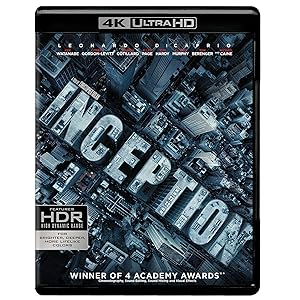
Dom Cobb (Leonardo DiCaprio) is a skilled thief, the absolute best in the dangerous -art of extraction: stealing valuable secrets from deep within the subconscious during the dream state when the mind is at its most vulnerable. Cobb’s ability has made him a coveted player in this treacherous new world of corporate espionage, but it has also made him an international fugitive and cost him everything he has ever loved. Now Cobb is being offered a chance at redemption. One last job could give him his life back if he can accomplish the impossible— inception. Instead of the perfect heist, Cobb and his team of specialists have to pull off the reverse; their task is not to steal an idea but to plant one. If they succeed, it could be the perfect crime. But no amount of careful planning or expertise can prepare the team for the dangerous enemy that seems to predict their every move. An enemy that only Cobb could have seen coming. Review: Science fiction, fantasy, drama, mystery or adventure? - This is an excellent film. It's a daring film too. Like another film, The Usual Suspects, it starts in the present with a scene between an old man and a young one. The old man asks him what he wants and the young man struggles to recall what he wants from the old man. It leads to the start of the story in the past and an extraction job on the train to Kyoto, Saito's offer to Cobb, the assembly of the team, putting together their game plan for putting an idea into a financial rival's mind, the dream shared aboard the jet, onto the opening scene again when the young man why he's here then onto the final scene. The plot is superb. One man, Cobb, wants to find his way home to his family while another one, Saito, is willing to pay a fortune to change the outcome of events with a rival business firm through the inception of an idea into his rival's mind. The cast is also superb. It took more than Leonard DiCaprio to pull this story off. In this case there was some strong writing. Something closer to six or seven characters were needed for the development of the plot. Is it too complicated or just too intriguing? I really enjoy watching a good film again and again and have truly enjoyed Inception. Dreaming by itself was no basis for a story but to the credit of Inception it introduced dream-sharing by way of a new technology. In view of the developments over the past 60 years viewers will find it quite easy enough to suspend their disbelief. Cobb and his wife, Mal, put the learning to use by way of extracting ideas by people. Once they began building dreams within dreams extraction was easier but time moves at a different and slower pace at various levels of a dream. It can also become difficult to distinguish a dream from reality and they finally lose their way into the sub-conscious. After fifty years down there Cobb tries inception on Mal and plants an idea in her mind which leads to their return but Mal suspects that she's still dreaming and wants Cobb to return to reality. One night she tries to blackmail Cobb by informing the police that she suspects her husband will kill her. Dreams can be usually brought to an end when the dreamer runs out of time on the machine or is killed. After she kills herself Cobb leaves the country to avoid arrest but he's still deeply filled with regret and guilt about Mal who is constantly trying to keep him with her. It's interesting how one storyline is affecting the other one and the characterization which results from it. Ken Watanabe plays Mr. Saito. He's heard about extraction and rumours about conception. He's convinced that he will be financially ruined by his rival, Mr. Fischer. Now he's heard rumors about Cobb's skill but before he asks Cobb he wants to make sure that he's talking to the right mind. So he arranges an audition for Cobb's crew under tough conditions with himself as the target. Cobb extracts the information but he realizes that Saito has known all along about the job from start and asks why? Saito was never interested in the extraction but the level of Cobb's skill. While Cobb extracted the information, Saito wasn't impressed with the level of skill that Cobb showed. His opinion of Cobb quickly rises when he realizes that he's still dreaming. Cobb placed him in a dream inside a dream. In the following scene Saito makes an offer to Cobb of financial reward and a safe return to America if he can succeed in planting an idea in his rival's mind. Money is no problem with Saito. So Cobb finds a top-notch crew who will work for him and his partner, Arthur. DiCaprio clearly dominates the first crew but when Saito tells him to put together a better team he becomes part of the team. Michael Caine puts in a strong appareanance as Cobb's father-in-law who finds him another architect in dream-sharing, Ariadne played by Ellen Page. Then it's onto Africa for an interview with an old friend, Eames played by Tom Hardy, who's a skillful thief and forger and introduces Cobb to Yusuf, the Chemist played by Dileep Rao. Fischer, played by Cillian Murphy, puts in another good performance as Saito's rival. What's really interesting are all the contributions everybody makes towards the development of the story. It is a well written story and well performed one. You'll also appreciate the quick pace. While the dream starts on the jet. The levels of the dream can always be identified. The first level of the dream can always be identified by the rain in a city downtown. The primary development is the appearance of projections from Fischer's mind into dream who will defend him against any attempt at extraction. On this level Saito is shot and dying but on the lower levels it will take longer for him to die. Eames attempts to kill him and end the dream but the sedative taken demands their return to consciousness in a particular fashion. If they die they are lost in a sub-consciousness of the dreamer. So they must go onto the next level of the dream inside a van that Yusuf is driving. The second level of the dream is found in an expensive hotel where Cobb plays a figure on this level known as Mr. Charles and poses as one of the projections sent to guard Fischer. Mr. Charles gains Fischer's trust and convinces him that a corporate figure in his father's company is betraying him and the only way to learn the truth is entering a third level of the dream. The third level takes place in winter and the mountains where Fischer fights to learn the truth and the team plants an idea in him.In the meantime Saito dies during the assault. The scenes in the sub-conscicous take place in beautiful weather on the seaside. The final beach scene leads you to an earlier scene from the start of the film: an old man asks Cobb what he wants. The old man is Saito who was killed and has been lost for years. Cobb now remembers the audition for Saito, the inception and his confrontation with Mal. He urges Saito, now an old man filled with his regrets and guilt to come back with him and be young again. Well, the next scene tells you what happen he finds himself waking aboard the jet with Fischer, Saito and his crew. Saito places a call to set things in motion which will clear the way for Cobb's return home. I've seen this film on numerous occasions over the past few years. It just keeps getting better. It only proves the importance of good writing and acting to one another as well as editing and directing. Suspense simply is not a factor. Yet the story constantly grips you. You simply don't realize the length of the film by its quick pace of the story. Review: Non, je ne regrette rien... - Christopher Nolan may be the most brilliant, unconventional mainstream director working in Hollywood today, crafting intricate stories where narrative forms are stretched and twisted. Nowhere is this more obvious than "Inception," which turns into a multi-level Möbius strip -- worlds within worlds, dreams within dreams. Nolan delights in being able to conjure strange worlds that could never exist in real life, but he crafts a very heartfelt, powerful story for those visuals -- a story of love and loss, ambition and power, and a broken man haunted by guilt that constantly chases him through every dream. In the not-too-distant future (next Sunday A.D.), the military has created a technology that allows artificial shared dreaming. Within multi-leveled dreams, architects can create elaborate worlds, and special "extractors" can get information from a sleeping subject's brain. Oh, and there are several layers of dreaming, each with a different period of time passing. The movie opens with Dom Cobb (Leonardo DiCaprio) and his partner Arthur (Joseph Gordon-Levitt) trying to extract some information from tycoon Saito (Ken Watanabe). It turns out that this was actually an elaborate audition by Saito, who wants to hire them for an "inception" -- to plant a new idea in someone's head. Cobb isn't interested until Saito offers to clear him of the murder of his wife, which would allow him to return to his young children. Their target: Robert Fischer (Cillian Murphy), who has just inherited a massive energy conglomerate from his cold, callous father. Saito wants the company dissolved before it can become too powerful, so he wants the idea incepted into Robert's head. So Cobb gets together a gang of the best: clever forger Eames (Tom Hardy), dream-chemist Yusuf (Dileep Rao), and the new architect Ariadne (Ellen Page). But only Ariadne sees how troubled Cobb is, and that the memory of his dead wife Mal (Marion Cotillard) is deliberately sabotaging every mission he undertakes. As the team weaves their elaborate web of deception and dreams around Robert, Cobb finds that his demons are threatening their mission. You have to give it to Christopher Nolan: he doesn't dumb down his movies for the masses. "Inception" is a hard movie to even summarize because it's constantly growing more complicated -- the team is spread out over different dream levels, with different time periods passing and different perils attacking them simultaneously. It's half heist caper and half sci-fi meta-thriller... if that even makes sense. And while Nolan sculpts a strange Escheresque dream-world of labyrinths and never-ending stairs, he also crafts some powerful subplots about love and loss. As the plot unwinds, he intertwines Cobb and Fischer's personal issues with the main story of inception. Suddenly the constant firefights, explosions and free-falling elevators/vans aren't the only reason we're invested -- the audience is truly left wanting to see both men work out their issues and find some measure of inner peace. It also has spectacularly good special effects, particularly Arthur's battle in the hotel -- he scampers across the walls and ceilings, grappling with projections as he floats through empty halls. Not to mention the scene where Ariadne turns a whole city upside-down... literally. Honestly, the biggest problem with the movie is that the dreams sometimes make too much sense. Why do Fischer's projections have to actually TRAVEL to attack the team instead of... I don't know, materializing inside the building? Nolan also populates "Inception" with a lot of actors that he's cast in other projects, especially "The Dark Knight Rises." In fact, I can't help but wonder if DiCaprio's role was originally offered to Christian Bale, because we've also got Cotillard, Hardy, Watanabe, Murphy, Gordon-Levitt and Michael Caine. There are actually only a couple major actors who haven't worked with Nolan elsewhere. But this is one of DiCaprio's best roles, even if he's not very convincing as a father -- his Cobb is riddled with guilt and numb sorrow, and it's only prodding from Ariadne that finally gets him to confront his issues. All the other actors give lovely performances as well -- Cotillard is particularly wrenching as a strange shallow shade of a madwoman, as is Murphy as the downtrodden son of a powerful man. "Inception" is the kind of movie that we desperately need more of -- a wild Möbius strip of complex ideas, brilliant direction and powerful acting. This is truly a one-of-a-kind film, and not one to be missed.
| Contributor | Chris Brigham, Christopher Nolan, Cillian Murphy, Dileep Rao, Elliot Page, Emma Thomas, Joseph Gordon-Levitt, Ken Watanabe, Leonardo DiCaprio, Marion Cotillard, Michael Caine, Thomas Tull, Tom Berenger, Tom Hardy Contributor Chris Brigham, Christopher Nolan, Cillian Murphy, Dileep Rao, Elliot Page, Emma Thomas, Joseph Gordon-Levitt, Ken Watanabe, Leonardo DiCaprio, Marion Cotillard, Michael Caine, Thomas Tull, Tom Berenger, Tom Hardy See more |
| Customer Reviews | 4.7 out of 5 stars 17,428 Reviews |
| Format | 4K |
| Genre | Action & Adventure, Science Fiction & Fantasy |
| Initial release date | 2017-12-19 |
| Language | English |
D**L
Science fiction, fantasy, drama, mystery or adventure?
This is an excellent film. It's a daring film too. Like another film, The Usual Suspects, it starts in the present with a scene between an old man and a young one. The old man asks him what he wants and the young man struggles to recall what he wants from the old man. It leads to the start of the story in the past and an extraction job on the train to Kyoto, Saito's offer to Cobb, the assembly of the team, putting together their game plan for putting an idea into a financial rival's mind, the dream shared aboard the jet, onto the opening scene again when the young man why he's here then onto the final scene. The plot is superb. One man, Cobb, wants to find his way home to his family while another one, Saito, is willing to pay a fortune to change the outcome of events with a rival business firm through the inception of an idea into his rival's mind. The cast is also superb. It took more than Leonard DiCaprio to pull this story off. In this case there was some strong writing. Something closer to six or seven characters were needed for the development of the plot. Is it too complicated or just too intriguing? I really enjoy watching a good film again and again and have truly enjoyed Inception. Dreaming by itself was no basis for a story but to the credit of Inception it introduced dream-sharing by way of a new technology. In view of the developments over the past 60 years viewers will find it quite easy enough to suspend their disbelief. Cobb and his wife, Mal, put the learning to use by way of extracting ideas by people. Once they began building dreams within dreams extraction was easier but time moves at a different and slower pace at various levels of a dream. It can also become difficult to distinguish a dream from reality and they finally lose their way into the sub-conscious. After fifty years down there Cobb tries inception on Mal and plants an idea in her mind which leads to their return but Mal suspects that she's still dreaming and wants Cobb to return to reality. One night she tries to blackmail Cobb by informing the police that she suspects her husband will kill her. Dreams can be usually brought to an end when the dreamer runs out of time on the machine or is killed. After she kills herself Cobb leaves the country to avoid arrest but he's still deeply filled with regret and guilt about Mal who is constantly trying to keep him with her. It's interesting how one storyline is affecting the other one and the characterization which results from it. Ken Watanabe plays Mr. Saito. He's heard about extraction and rumours about conception. He's convinced that he will be financially ruined by his rival, Mr. Fischer. Now he's heard rumors about Cobb's skill but before he asks Cobb he wants to make sure that he's talking to the right mind. So he arranges an audition for Cobb's crew under tough conditions with himself as the target. Cobb extracts the information but he realizes that Saito has known all along about the job from start and asks why? Saito was never interested in the extraction but the level of Cobb's skill. While Cobb extracted the information, Saito wasn't impressed with the level of skill that Cobb showed. His opinion of Cobb quickly rises when he realizes that he's still dreaming. Cobb placed him in a dream inside a dream. In the following scene Saito makes an offer to Cobb of financial reward and a safe return to America if he can succeed in planting an idea in his rival's mind. Money is no problem with Saito. So Cobb finds a top-notch crew who will work for him and his partner, Arthur. DiCaprio clearly dominates the first crew but when Saito tells him to put together a better team he becomes part of the team. Michael Caine puts in a strong appareanance as Cobb's father-in-law who finds him another architect in dream-sharing, Ariadne played by Ellen Page. Then it's onto Africa for an interview with an old friend, Eames played by Tom Hardy, who's a skillful thief and forger and introduces Cobb to Yusuf, the Chemist played by Dileep Rao. Fischer, played by Cillian Murphy, puts in another good performance as Saito's rival. What's really interesting are all the contributions everybody makes towards the development of the story. It is a well written story and well performed one. You'll also appreciate the quick pace. While the dream starts on the jet. The levels of the dream can always be identified. The first level of the dream can always be identified by the rain in a city downtown. The primary development is the appearance of projections from Fischer's mind into dream who will defend him against any attempt at extraction. On this level Saito is shot and dying but on the lower levels it will take longer for him to die. Eames attempts to kill him and end the dream but the sedative taken demands their return to consciousness in a particular fashion. If they die they are lost in a sub-consciousness of the dreamer. So they must go onto the next level of the dream inside a van that Yusuf is driving. The second level of the dream is found in an expensive hotel where Cobb plays a figure on this level known as Mr. Charles and poses as one of the projections sent to guard Fischer. Mr. Charles gains Fischer's trust and convinces him that a corporate figure in his father's company is betraying him and the only way to learn the truth is entering a third level of the dream. The third level takes place in winter and the mountains where Fischer fights to learn the truth and the team plants an idea in him.In the meantime Saito dies during the assault. The scenes in the sub-conscicous take place in beautiful weather on the seaside. The final beach scene leads you to an earlier scene from the start of the film: an old man asks Cobb what he wants. The old man is Saito who was killed and has been lost for years. Cobb now remembers the audition for Saito, the inception and his confrontation with Mal. He urges Saito, now an old man filled with his regrets and guilt to come back with him and be young again. Well, the next scene tells you what happen he finds himself waking aboard the jet with Fischer, Saito and his crew. Saito places a call to set things in motion which will clear the way for Cobb's return home. I've seen this film on numerous occasions over the past few years. It just keeps getting better. It only proves the importance of good writing and acting to one another as well as editing and directing. Suspense simply is not a factor. Yet the story constantly grips you. You simply don't realize the length of the film by its quick pace of the story.
E**S
Non, je ne regrette rien...
Christopher Nolan may be the most brilliant, unconventional mainstream director working in Hollywood today, crafting intricate stories where narrative forms are stretched and twisted. Nowhere is this more obvious than "Inception," which turns into a multi-level Möbius strip -- worlds within worlds, dreams within dreams. Nolan delights in being able to conjure strange worlds that could never exist in real life, but he crafts a very heartfelt, powerful story for those visuals -- a story of love and loss, ambition and power, and a broken man haunted by guilt that constantly chases him through every dream. In the not-too-distant future (next Sunday A.D.), the military has created a technology that allows artificial shared dreaming. Within multi-leveled dreams, architects can create elaborate worlds, and special "extractors" can get information from a sleeping subject's brain. Oh, and there are several layers of dreaming, each with a different period of time passing. The movie opens with Dom Cobb (Leonardo DiCaprio) and his partner Arthur (Joseph Gordon-Levitt) trying to extract some information from tycoon Saito (Ken Watanabe). It turns out that this was actually an elaborate audition by Saito, who wants to hire them for an "inception" -- to plant a new idea in someone's head. Cobb isn't interested until Saito offers to clear him of the murder of his wife, which would allow him to return to his young children. Their target: Robert Fischer (Cillian Murphy), who has just inherited a massive energy conglomerate from his cold, callous father. Saito wants the company dissolved before it can become too powerful, so he wants the idea incepted into Robert's head. So Cobb gets together a gang of the best: clever forger Eames (Tom Hardy), dream-chemist Yusuf (Dileep Rao), and the new architect Ariadne (Ellen Page). But only Ariadne sees how troubled Cobb is, and that the memory of his dead wife Mal (Marion Cotillard) is deliberately sabotaging every mission he undertakes. As the team weaves their elaborate web of deception and dreams around Robert, Cobb finds that his demons are threatening their mission. You have to give it to Christopher Nolan: he doesn't dumb down his movies for the masses. "Inception" is a hard movie to even summarize because it's constantly growing more complicated -- the team is spread out over different dream levels, with different time periods passing and different perils attacking them simultaneously. It's half heist caper and half sci-fi meta-thriller... if that even makes sense. And while Nolan sculpts a strange Escheresque dream-world of labyrinths and never-ending stairs, he also crafts some powerful subplots about love and loss. As the plot unwinds, he intertwines Cobb and Fischer's personal issues with the main story of inception. Suddenly the constant firefights, explosions and free-falling elevators/vans aren't the only reason we're invested -- the audience is truly left wanting to see both men work out their issues and find some measure of inner peace. It also has spectacularly good special effects, particularly Arthur's battle in the hotel -- he scampers across the walls and ceilings, grappling with projections as he floats through empty halls. Not to mention the scene where Ariadne turns a whole city upside-down... literally. Honestly, the biggest problem with the movie is that the dreams sometimes make too much sense. Why do Fischer's projections have to actually TRAVEL to attack the team instead of... I don't know, materializing inside the building? Nolan also populates "Inception" with a lot of actors that he's cast in other projects, especially "The Dark Knight Rises." In fact, I can't help but wonder if DiCaprio's role was originally offered to Christian Bale, because we've also got Cotillard, Hardy, Watanabe, Murphy, Gordon-Levitt and Michael Caine. There are actually only a couple major actors who haven't worked with Nolan elsewhere. But this is one of DiCaprio's best roles, even if he's not very convincing as a father -- his Cobb is riddled with guilt and numb sorrow, and it's only prodding from Ariadne that finally gets him to confront his issues. All the other actors give lovely performances as well -- Cotillard is particularly wrenching as a strange shallow shade of a madwoman, as is Murphy as the downtrodden son of a powerful man. "Inception" is the kind of movie that we desperately need more of -- a wild Möbius strip of complex ideas, brilliant direction and powerful acting. This is truly a one-of-a-kind film, and not one to be missed.
N**E
A hood movie for sure !!
Best movie ever !!
A**T
You can’t go wrong with Christopher Nolan
One of my favorite movies of all time. Truly a masterpiece from Nolan, and with an amazing musical score as well. Every time I watch it (and I’ve watched it like 25 times now) I notice details I’ve missed. If you haven’t seen this, what are you waiting for?? Same with other Nolan movies like Interstellar, Tenet, Memento and Dunkirk
D**P
Christopher - Johnathan can be done. A response.
I don't usually like to write reviews, but very few flicks caught my eye this year, Inception being one of them. This won't be a full-fledged review but rather, a few words shared to those who weren't fond of the movie, with some discussion on those that loved it. Whilst not perfect, the film is solid in the fact that all the elements have come together into what makes films well...films. Think about it. The groundwork is there, it clearly has careful planning. The plot revolves around the interaction between the dream world and reality, the actors are engaged in various sequences and instances to help support said plot, and the special effects assist in viewing pleasure, supporting the actors. It's as if we were writing an essay, with a main idea/theory, supporting and minor details to back it up: Well-rounded. Even if you disliked the film, it shouldn't be difficult to realize that all the elements were in place, and throughout the movie, scenes were implemented with care. When Joseph Gordon-Levitt was trapped in that second instance of the ending dream sequence, trying to get that kick in order for them to wake up in that moment...they kept the physics intact. You see, Nolan managed to bend the rules of physics without breaking them. No gravity, bombs used on an elevator to get the kick, it was truly brilliant. Think outside the box here. It's not a matter of attempting to be intelligent or being too serious/dramatic, whatever you believe the film to be. It's more-so regarding the science fiction bits and pieces placed in the film, and extending beliefs with ideas and experiments (again, without breaking reality's laws). Nothing seemed too out of place in this film, as long as we paid attention, we knew what was the dream and what was the reality. We also knew the extent of these dreams were, how far people realized they were in a dream, that current setting placed, etc.. The only bit that wasn't thoroughly explained was the device used to place everyone within someone's dream. I imagine a Matrix effect here. It's just plugging into the same database/server, through use of a wired device, heh. But that's where the Sci-Fi part comes into play again. I'll agree that the lines were quite intelligently spoken and some parts were rather dramatic, but they believe in this world, in this dream-controlling instance. They are highly indulged in it, which I find to be the best part of the film. You have your try-hard teams such as in The Matrix, all the riddles spoken, etc., when people only gave a damn about the action. You have your try-not teams like with Twilight, piss-poor dialogue, lots of frequent pausing, and a laughable showcase to actors who actually had some talent. Then you have something like Inception come along, make-believe team. Sounds cheesy from the get-go, true, but that's what they did. They tried their best to make us believe their world, and whilst some things could have been explained further, such as the device, there was still that sense of realism involved in the film, as mentioned with the zero gravity sequence, keeping science intact. That's just how I look at the film. Most of you have your personal preferences and biased opinions, which is ultimately fine, but if you're trying to force your thoughts onto others, that's where these reviews start to get out-of-hand. I wish most would include both pros and cons with this film (and all films for that matter), but I look at the five-star ratings and the one-star ratings noticing the mass amount of bias. It's either "best film ever" or "overrated film," respectively. But what people don't realize is that...best film ever only applies to you, overrated film only applies to you in a sense. People who claim things to be overrated...it's as if you lack the ability to accept others opinions. Something becomes popular, you want to see what all the fuss is about (without a clear head, mind you, you're likely not interested going in because of the set bandwagon), and begin to nit-pick beyond belief. It's amazing yet depressing how this race reacts sometimes. Yes the film is "seemingly intelligent-sounding" to the point where the actors talk in a persuasive manner, but that's the vibe of the film. I honestly didn't see it as half-assed, I saw it as supporting the main idea more than anything. I admit some bits seemed to try too hard in explanation, but overall no one ended up being really confused. That's another piece to divulge into. The fact that this was more of an 'everyman' film. What do I mean by that? Simple, it wasn't difficult to follow, tried to go into as much detail as possible in order to help anyone understand, from casual movie-goers to the huge fans of the sci-fi/thriller genres. But the latter tends to this film as too easy, the "trying to be intelligent" argument is immediately thrown in for attempting to appeal to everyone. It's understandable. But I mean, Shutter Island, a great psychological thriller, wasn't entirely well-received because it was more for fans of that genre, the everyman wasn't into it overall, they couldn't decipher it. I've had many debates involving that film this year, good ones discussing the plot and it's ending, but only to those that really understood Shutter Island. With Inception, I wasn't limited to my discussion on the film, for those that saw it can reflect back and better understand the movie. If I seem too harsh on you, well then I apologize for hurting your opinion in any way, but that shouldn't happen because...at the end of the day, this is for entertainment purposes. Films, music, games, it's all entertainment, and we each have different tastes and preferences. I'm not starting a war on you, believe me that's the last thing I want to do, I really just wanted to explain the film's style and goals. Yes, I have my opinion as well and did favor the film, but I know it's far from perfect. Want an example? Fine by me. I wasn't sure what the architect's role really was at first. I thought they could have explained how that person manipulated another's dream world, but I eventually assumed that they were there to keep the person within their dream...to keep their conscious on low-priority. They tried to make the dream seem like a reality as best as possible, and I believe that the device used to put them in the same dream world also had to do with the architect. Still, would have loved a more clearer analysis shown in the film, but I suppose that, like the unclear ending, is up to us. In regards to my title of the review. All of you screaming Prestige, Memento, etc., must know that Christopher's brother, Johnathan Nolan, was not involved in this film. Most also believe that it's because of that, that the film fell flat on it's face, but I think otherwise. I think this film showed what Chris could do without John, and the end-product turned out to be something special. Sure Memento was more engaging, The Dark Knight was highly entertaining, etc., but this film had elements that mixed well together, too, and we need to realize this before ripping it apart. One scene in particular comes to mind that blends in nicely: When DiCaprio was talking to Murphy about the dreams, I thought that was brilliant...why? Because you could see DiCaprio struggling to maintain his feelings and emotions, and the dream sequence coming to realization of his actions the moment he was slipping. It's what I like to call the human side effect, a human flaw in films to show that...even though it's a film that has many possibilities, it's goes on without showing a Superman move. You have films such as Accepted where Long is everything, and I really disliked the film for that. He's a rock star, a motivational speaker, deceiver, etc.. He barely had any bad moment, which we all know is impossible in the real world, heh. All in all, I just wanted to get a few responses out because...I'm seeing the same exact arguments being re-worded with each extreme-rated review. I'd rather look at films and judge their core. Some films focus more on the action whilst the acting and story are sub-par (which I felt Matrix was). Some films spend more time on the special effects, with everything else seeming tacked on (Avatar, to me, fits this bill). Then there are those that keep the story as it's central focus, though the acting simply doesn't live up to it's standards. To me, this is a more well-rounded film, again the plot is the main idea, with the actors being the supporting detail, the score and special effects being the minor details. The little touches were carefully put in, which I commend Nolan for.
J**Y
Christopher Nolan's Masterpiece - A Long Time In The Making
I suppose many people have written at length about the DVDs (and/or Blu-ray) discs and all its "bells and whistles" that come with it. For me, I will say this: This film has been a long time in the making. As an artist in several mediums, film included, I can relate to some simple thoughts for those wondering about the movie "Inception" itself. I met Christopher Nolan last century (weird to say) at an international film festival when "Memento" was first screened. I thought that movie was brilliantly presented and unique - as was his less successful, but still intriguing, previous venture "Following". The movie "Inception" was something that was on Nolan's mind for quite a long time. His problem: The trouble with creative ideas, especially when involving such a semi-uncharted realm of "dreams" as your grounded subject matter, is hard for one to convey such unique, fresh ideas into a visually physical and presentable piece. However, Nolan finally succeeded with "Inception". As technology (CGI) had increased exponentially for creative potentials such as bringing artists' dreams into something visceral and presentable, this film became more and more "do-able" for him as a project. In this century, as the art (almost seemingly lost amongst so many writers and directors lately) seems to have turned into massively (almost mindless) "action"-packed, substance-lessness groups of movie re-makes, comic books and consumer entities turned into trite-made-flesh "movies", and the seemingly endless amount of sequels (which most should have ended a few sequels back) and, along with that, the upsurge in "prequels" (have we really started running out of originality?),I personally find it more difficult to even "want" to see a movie in the theater unless its something with possible unique potential as something fresh, new and (at some point in the past) even "unthinkable" as a premise for a movie. Afterall: 2 people seeing a movie these days is a major financial investment at $10-$12+ per ticket... and gods help you if either one of you wants something edible, even simply a $5 bottle of water! And even though I'm only in my later 30s, yes, seriously kids: things were much different - and cheaper - in the 80's and 90's as a movie-going enthusiast. I suppose that's why, when you pay less for something, if it was a "crappy movie", the let down wasn't that bad. Nowadays, if something doesn't impress you, the "investment" you put into hoping to see a movie becomes something that could backfire and "depress" you. So I was very glad to be even moreso impressed than I was expecting when I saw "Inception". It is a fresh story which is artisticly and meticulously woven into a high-quality film which presents the idea of a world (whose time period we aren't really told, but we come to accept as either a future or a possible reality of the "near-present day" realm) where the most precious commodities that exist that we would like to think are not in another's grasp: an idea... a thought... a dream... could become something of a tangible commodity to others with an ulterior interest. The movie presents you with the "what if" premise that some of your most gaurded, personal thoughts and ideas, buried inside your own mind which may emerge in your own dreams, could actually be visited, viewed, experienced... and stolen. It's a disturbing thought on one hand. On the other hand, it makes for something fresh and incredibly imaginative to be explored and presented in a cinematic format. I won't go in depth and throw spoilers and such about the movie, because this is one of those rare movies that I personally wanted to know very little about beforehand... and walk into the theater (of for those of you now: to be able to rent or buy this film) knowing not much about what you are about to see. And that's why I enjoyed it so much when I saw it in the theaters. It is a fresh concept, a movie in this time of regurgitated cinema sparkle and fodder which kept me so engaged. The ideas were new, fresh and imaginative. The premises and layers (literally) of thought involved in this piece that echoes a famous line from Edgar A. Poe's writings: "All that we see or seem, is but a dream within a dream." From start to finish, this may not be a movie some people will be able to fully absorb and comprehend all its beauitfully creative details and uniquities, as its pace doesn't waver to do a "time-out" for the viewing audience to try and explain it all to you - and some people may find that an irritation indemic of the "I want to know everything explained to me now" generation/group of impatient "movie-goers". However, what makes "Inception" unique is that we find ourselves somehow going along for its ride, like the finality of beginning a long roller coaster ride which, once seated, you are in for many unexpected twists, turns, and thrilling experiences along the way. You find yourself accepting things momentarily as if: "that's ok... this is a dream anyway... right?" You may even find yourself falling deeper into accepting these realms with all their ideas and concepts that defy what we assume are constants - like, oh, the laws of physics, gravity and logic. But hey it's just about a dream ...right? Well hang on, because you most likely will find yourself becoming pulled into the film, catching yourself momentarily uttering, silently, "Whoa, I did not see this coming," and futher down the rabbit hole you go. As with most of Nolan's original works of the 90's, "Inception" is, in my opinion, his shining jewel. And it should be, considering how many years upon years he kept this movie as a work-in-progress in his mind (and a journal or two). Luckily, so far his guarded thoughts weren't something easily up to be stolen while he slept. It's a rewarding experience that deserves to be taken in - because honestly, how often do you see something unique in movies and say to yourself (either during or after the end credits) "I never saw or thought of something like that before... in my life... and I just saw it on screen" ...? It's also an experience that deserves to be watched again, because once you've seen it (like taking the red pill in "The Matrix"), there is no going back. Therefore moving forward is the only option you have. Rewatching it helps you take in more of the concepts: It is truly an amazing feat of accomplishment to bring the realm of thoughts and dreams out with ideas not oft (if ever) explored in past films that somehow work incredibly well together here. The visual beauty of the work of the cinematic art in its entirity (and all its little details). Nolan insisted continually through this movie to physically film things visually in the real-life recording moments themselves as much as humanly (and safely) possible, only ending with astoundingly artiful merging of additions and touch-ups with the usage of CGI to blend in what couldn't be physically filmed in real life... and trust me, some of the things you see make you feel a sense of accepting the unlimited possibilities that can be explored in the future of movies, stories, etc involving the subject matter of our consciousness... and our sub/unconsciousness. And on an extra note (as a person who works in the music industry): the sound engineering was amazing and its accolades and awards were justified - exceeding (and shocking) my own expectations. The Blu-ray 2-disc edition is what I purchased, and I found it to be rewarding enough to see how many of the visually stunning scenes were created and even how the sound engineering was accomplished! It was also shocking to see how many of the scenes were shot - including what I thought was CGI which turned out to be real... etc etc. This would be one of the few movies I own whose "extras" I found myself interested in watching entirely. I believe there is an option to "interrupt" the movie momentarily to view "how they did that scene you just watched" during the movie, but they are just as easily accessible as parts to watch on their own. Again, this movie will inevitably beg for you to watch it again... and you don't want to be interrupting it every 10 or 15 minutes to see some behind the scenes moment DURING the movie. Maybe save that for the 3rd+ time you've seen it, if you're into that. Because hands down, this was one of those rare movies I said to myself: "Finally! Something original, creative, beautiful, imaginative and not wavering and bending over backwards to 'meet' or 'fit' into the seemingly typical Hollywood format of what Hollywood considers the 'proper format' of how a movie 'has to be' in order to make money." Because it worked fine all on its own. I believe the Oscar awards spoke up on their own earlier this year as well. Jason Kraley
J**L
A movie of dreams, a dream of movies
I have been reluctant to comment on Inception; there seemed little I could add to the already extensive commentary. My initial sense was that Inception, while it was a welcome relief to standard summer fare, possessed enough flaws and precedents to render its claims to greatness suspect. I gave it 8 stars over my first viewing and let it go at that. Now, having watched Inception twice since then and having read the screenplay (see the excellent, Inception: The Screenplay), I have changed my mind. Inception is worthy of the praise given it. Without reservation I now give it a 10. This is the first occasion in which I have changed my verdict on a film following my initial viewing. Why? Because Inception is easily the best film of the decade in terms of sheer intelligence, the best film I would argue since The Truman Show. Moreover, its plot of obsessive love, fear of falling, and frightening dreams, makes it worthy of comparison to Vertigo. As good as Vertigo? The fact that Inception can be mentioned without blanching in the same sentence with Hitchcock's masterpiece tells you something. I came to love the movie but I was desperate to say something new. I wanted to comment on the richness of the world of Inception, and give the viewer a bit more of an understanding of what underlies it. In the near future, a drug has been discovered that enables people to share a common dream. Viewed by many as a fascinating opportunity for creativity, one danger is that a dreamer's mind can be invaded by an intruder and unless the victim has been trained to resist these "extractor(s)," he can be tricked into revealing his innermost secrets (visualized as being within a symbolic dream "safe"). The battle between a trained mark and one or more skilled extractors can be harrowing. This technology can be described as a form of controlled lucid dreaming. Until this discovery, all experience had been that lucid dreams cannot be controlled; anything could happen. Since most people have had them, you know what I mean. But using this drug and its delivery system (termed PASIV in the screenplay book), lucid dreams can be controlled. These shared lucid dreams, however, are still subject to external conditions and the dreamer's own internal state. Note: the idea of entering into people minds while they are dreaming is not new. See the movie "Dreamscape (1984)," which has dream specialists invading the mark, as protectors or attackers. But there are some remarkable new angles in Inception's approach. First, the dreams can be recursive. There can be dreams within dreams within dreams, though at each additional level the dream state becomes increasingly unstable, requiring the addition of powerful sedatives to maintain control. Second, the recursive levels cannot be extended indefinitely. They terminate in a state called "Limbo," i.e. "unconstructed dreamspace." Limbo may be infinite in expanse. Little is known of it, though according to the movie's math, time moves roughly 8000 times faster in Limbo relative to reality. Third, the minds of the participants, particularly if there is an emotional involvement between them, can find their dream "waves" have become blended or entangled. There are profound metaphysical dangers in this, ontological and psychological. Foremost is the loss of one's sense of what is real, over time being increasingly unable to distinguish between the dream state and reality. Then there is the loss of one's sense of self. Where the dreamers are emotionally involved, e.g. in love, their minds can begin to merge to such an extent that it is a difficult for them to determine where "I" begins and the other takes over, who is dreaming what in other words. There are mechanisms, "totems" for keeping track of where one is in these dream spaces, but the problem is unsolved. Into this world strides Dom Cobb, one of the best "extractors," a disturbed, troubled man, with overwhelming feelings of guilt towards is dead wife, Mal. Cobb is desperately seeking an escape, and return home to the only happiness he has ever known. Inception is strikingly original not only in that it introduces a new technology but a new terminology as well. A shoe-in for multiple nominations, it is brilliantly edited with a superb score, special-effects, and a wonderfully, attractive and likable cast. Nolan's meticulous screenplay pursues its sober and somber plot (you may smile/chuckle a few times but that is it) with grace and high-intelligence. I wish I could sum up the meaning of the movie, but I can't. One possibility is that Inception is an allegory of the movie experience, a dream of movies if you will. There is a strong overlap in what Cobb and his team are pursuing with the movie experience itself as a shared dream in which we share our emotional secrets. Nolan plays on this, but the idea of a movie as reflexive of and subversive to one's life has been often done and it is unclear if Inception adds much. Another is that Inception should be taken as a movie of dreams, i.e. on its own terms; that it works best if one simply accepts what is being shown on the screen and goes with it. Admittedly, for most, multiple viewings will be required to enable them to get to the heart of the movie's emotions but they will be amply rewarded if they do. The central vision in Inception of life's tragedy is compelling. Whether in the dream state or in reality, we cannot escape ourselves and it is impossible to tell if the happiness we have is real or an illusion.
K**N
"I'll let you be in my dreams, if I can be in yours." Bob Dylan
"Take, if you must, this little bag of dreams, Unloose the cord, and they will wrap you round." William Butler Yates "Ha, bloody ha!" Viewing this movie left me with wobbly legs, barely able to walk the first few steps towards the door. My hands were shaking and my head ached. What a rush! I haven't had this reaction since "Black Hawk Down". Christopher Nolan has artfully taken the images of our subconscious nocturnal ruminations and used them as priceless fodder for his "Inception." Not only was I completely drawn in within the first few minutes, I felt involved. The notion of dreaming 'in conference", as well as in layers is interesting and intelligent, but there are myriads of such ideas bouncing around in the heads of creative sorts all over the place. The fact the Nolan was able to gather the group of actors that he did and then pull it off is extremely impressive. DiCaprio as Cobb the retired 'architect' was, as usual, solid and dependable. Even more, his haunted affect in respect to his relationship with his wife, was chilling. Ellen Page, Ariadne, becomes to Cobb a sort of 'good angel' on one shoulder to his wife's (Marion Cotillard) bad angel on the other. The insinuations of ambiguity between reality and dream become a frightening proposition for Cobb, and for those of us who witness. As supporting cast, Tom Hardy, Ken Watenabe and Joseph Gordon-Levitt were icing on the cake, powerful and proficient in their parts. What a surprise to see Gordon-Levitt used as muscle! Cillian Murphy's muted performance as the passive victim was underplayed in the very best of ways. He is certainly one brilliantly versatile actor (see 'Peacock'). CGI was mind-bendingly claustrophobic in some scenes and eye candy for the ADHD advantaged in others! I'm far too ignorant about such things to comment beyond that. There have been some criticisms regarding character development and confusion regarding the role of Kobel Engineering in the dream sequences. As far as character development in concerned, when chaos abounds, there is not much time to exchange personal information or go fishing, however much you wish. This was an intense experience that I believe would have suffered from too much exposition. As to Kobel Engineering, it is important to keep track of what is in Cobb's surreality and and what isn't. "Inception" was the movie of 2010 for me. Furthermore, I plan to watch it at least a couple of more times in order to cull the marvelous minutia right out of it.
Trustpilot
2 months ago
1 month ago