
DOWNLOAD THE APP


Customer Services
Copyright © 2025 Desertcart Holdings Limited
DOWNLOAD THE APP
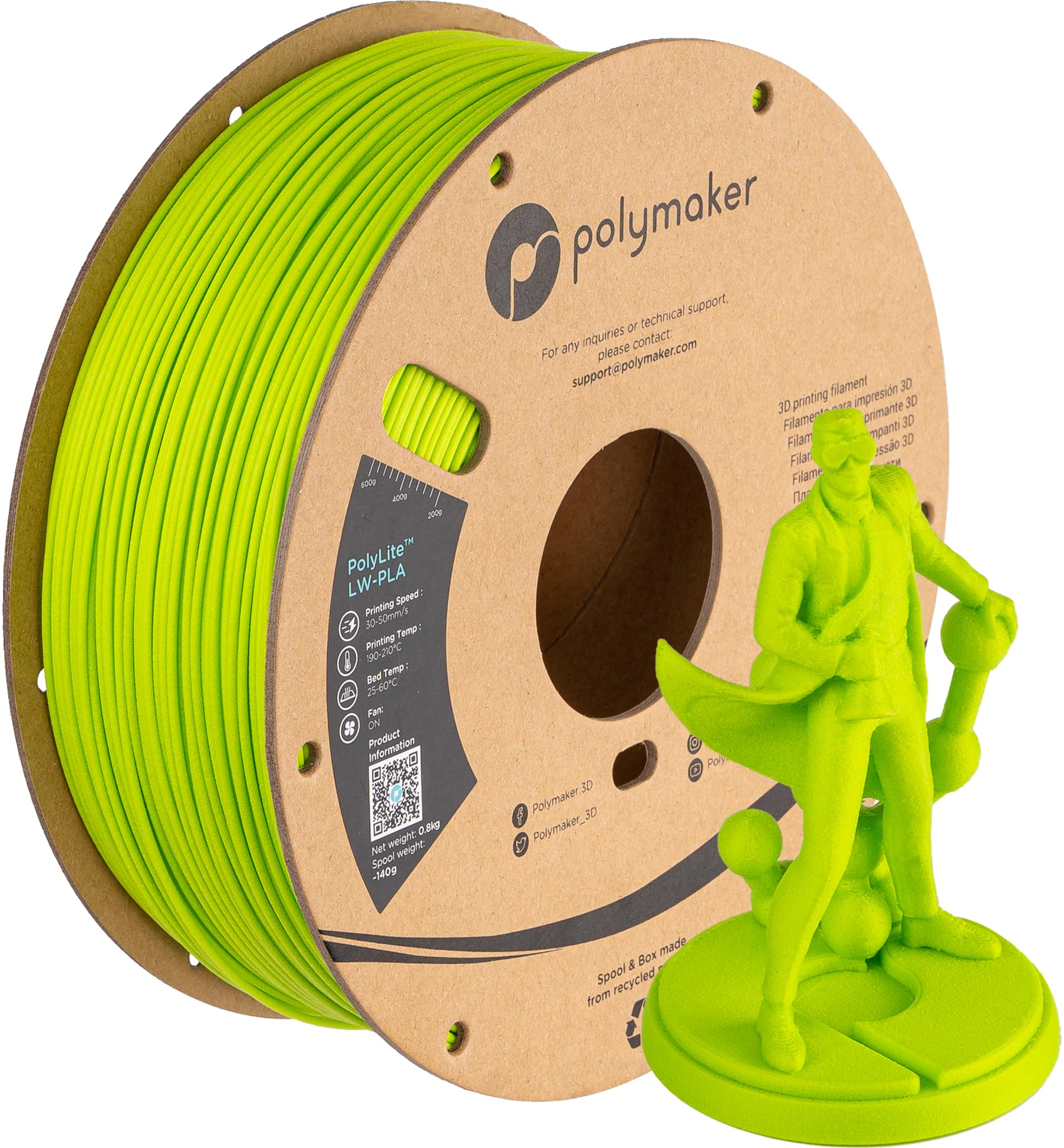
🛩️ Fly Light, Print Right — Elevate Your 3D Game with Polymaker LW PLA!
Polymaker PolyLite LW PLA is a lightweight (0.8 g/cm³) 1.75mm filament engineered for high rigidity and excellent layer adhesion, ideal for printing durable yet featherweight parts like RC planes. It prints with standard PLA settings (190-210°C) without foaming issues, delivering a matte finish that’s easy to paint. Packaged in eco-friendly recycled cardboard spools, this filament ensures consistent color accuracy and tangle-free use, backed by lifetime technical support.


| ASIN | B0B1DGSRR4 |
| Brand | Polymaker |
| Brand Name | Polymaker |
| Color | 800g Bright Green (Hex Code: #D0ed03) |
| Colour | 800g Bright Green (Hex Code: #D0ed03) |
| Customer Reviews | 4.0 out of 5 stars 35 Reviews |
| Item Diameter | 1.75 Millimeters |
| Item Weight | 0.8 Kilograms |
| Item diameter | 1.75 Millimeters |
| Item weight | 0.8 Kilograms |
| Manufacturer | Polymaker |
| Material | Polylactic Acid |
| Material Type | Polylactic Acid |
| Unit Count | 1 Count |
| Unit count | 1 Count |
S**S
schwierig/ aber möglich
Puh... Hat gedauert, bis ich es zum Laufen gebracht habe. Zuerst warst es fast unmöglich. Erste Lage 0,25 folgende 0,1. Automatische Flusskalibrierung beim Bambu A1 MUSS für dieses Filament auf aus! (steht auch im Wiki bei Bambu). max speed 40 und Lüfter max 40%. Druckplatte auf seltsame 70 Grad, damit es kleben bleibt. Flow 1,1, retract 1,2 . Düse erste 5 Schichten 215 Grad, danach 200. so läuft es bei mir endlich. war echt langwierig alles einzustellen/ zu finden
M**K
Under extrusion and more strings than PETG.
I gave up trying to get a decent part using this filament. It adhered poorly to the bed, and had a lot of strings, worse than PETG. The surface finish was not nice; rough, not smooth. The parts came out under extruded so I had to increase flow rate, totally loosing any weight benefit of this pre-foamed filament. I have had such great experience with other filaments it doesn't make sense wasting time with this stuff.
B**.
Clogs, Clogs, Clogs
While it does have some positive aspects, I encountered significant issues that outweighed the benefits. Here's a breakdown of my experience: Pros: Very strong for a lightweight PLA: The filament boasts impressive strength despite its lightweight nature. It produces sturdy prints that can withstand some stress. Really nice color and matte finish from the filament. Cons: Constant clogging on multiple printers: The most significant drawback I encountered with this filament was the constant clogging issue. It became a frustrating experience as the filament would clog randomly, either within 15 minutes of printing or after as long as 20 hours. This inconsistency made it difficult to complete successful prints. Random distortion and clogging: The filament showed signs of random distortion in certain sections, which eventually led to clogs. It seemed like there might be some foreign material embedded within the filament itself, as unclogging the nozzles became nearly impossible without resorting to extreme measures like using a torch. Wasted spool on failed prints: Unfortunately, due to the frequent clogging, I ended up wasting a almost all of the spool on failed prints.
S**T
Heavy! You will make heavy planes wit this. Not recommended.
Heavy! You will make heavy planes wit this. Not recommended.
M**I
Adhesion is a problem
If I could get it to stick to a build plate, it would make great lightweight prints. I am thinking that maybe since it is filled with pores, the higher surface area and lower volume make it more susceptible to moisture. I'm going to try drying it and see if that fixes the adhesion problems.
Trustpilot
5 days ago
3 weeks ago