
DOWNLOAD THE APP


Customer Services
Copyright © 2025 Desertcart Holdings Limited
DOWNLOAD THE APP

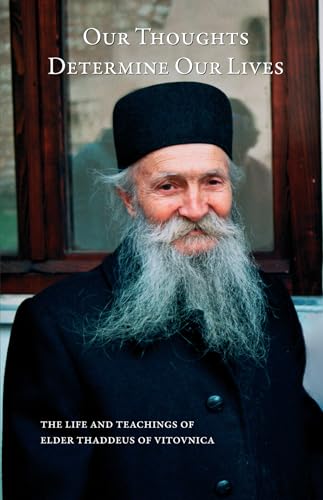

desertcart.com: Our Thoughts Determine Our Lives: The Life and Teachings of Elder Thaddeus of Vitovnica: 9781887904193: Ana Smiljanic, Elder Thaddeus of Vitovnica: Books Review: A Protestant Review - This book is the collected wisdom of Elder Thaddeus of Vitovnica. He never wrote them down, but his students and others apparently gathered them together. This is a work at what in psychology today would be called cognitive behavioral therapy. The idea is that what you think has intense power over you. Thaddeus would add a spiritual element that most secular psychologists wouldn’t, but that’s not a shock from a Christian worldview. While I do come from a Protestant perspective, this has been one of the most helpful books I have read. I think CBT is already great, but it’s even better when used from a Christian perspective that focuses on eternal realities. That is what Thaddeus gives us in the book. He urges us to look at the way we think about ourselves, about God, and about our fellow man. Sometimes when I am going through a hard time, I talk to a good friend who knows this technique well and he encourages me to write down good thoughts to tell myself on a 3×5 index card. It might sound silly, but usually after I write it down, it helps. I then carry the card around with me and look at it throughout the day. Much of our days are often spent thinking about things we cannot control. We think about other people and how they treat us. We spend less time thinking about how we treat them. We think about our situations often as if God does not exist or if He does exist, He’s not really good and working for our good. When we have these negative thoughts, there are physical and other side-effects with it. How many of us have had intense stomach aches or sleepless nights just because of our thoughts? How many of us have had relationship issues because of what we think about the other person even when we later see it’s far from the truth? Thaddeus covers topics like family life and repentance and prayer and love. Most any aspect of the Christian life is in this book. Sometimes, I think he thinks our thoughts have too much power on reality, but for the most part, there is really good material in here. The chapters are really easy to read. You can just read the one that you want and go through it quickly. Each chapter is also divided numerically into smaller bits so you can read one thought a day or so before heading out on your day. As I was going through this book, I found myself trying to catch myself in what I was thinking. Am I thinking ill of my fellow man? That is not doing him any harm and it is only doing me harm. Am I assuming reality is going to be horrible? Then I am saying that God does not really care about me like He claims to. I tried to work to see my fellow man in a new light and try to understand where he was coming from even if what he was doing seemed horrible to me. I tried to see how God could be working in my life in ways I couldn’t understand. Protestant readers might not care for references to praying to Mary and matters like that, but if a Protestant decides that will keep him from reading the book, he is really missing out. This is a book I wish more of us would read. I think even an atheist could get something out of the book as well even though he disagrees with the Christian side. In Christ, Nick Peters (And I affirm the virgin birth) Deeperwatersapologetics.com Review: Thank You, Elder Thaddeus - This is a real deal, put it into practice kind of book from a man who prayed, labored, suffered, and loved, a man guided by Grace and the teachings of the Faith. I recommend initially reading the book from start to finish, beginning with the brief biography and then going one chapter at a time. Forgive me, but I feel obliged to respond to certain statements in some previous reviews. For a start, Elder Thaddeus does NOT recommend the Jesus Prayer "in particular" as a way of dealing with thoughts. This is a vast oversimplification. As a first step, Elder Thaddeus sees putting ourselves into God's hands completely, seeing everything as coming from God and doing everything we do, every action for Christ. This is not to say that Elder Thaddeus does not recommend the Jesus prayer, but he is cautious. He does NOT recommend attempts to "move the mind into the heart" especially through techniques or without the guidance of a spiritual father for an intensive practice. It is arguable that his approach is more humble and never separated from God's grace. It is also very much about pleasing God, for the sake of others and the world. He is more inclined to St. Seraphim of Sarov's recommended practice of the self-question "Where am I?" when one takes his teachings on thoughts as whole. Moreover, one cannot sidestep his establishing everything in the context of the practice of Orthodox Faith and a particpation in the Sacraments, especially Confession before the Eucharist as well as staying close in prayer to the Mother of God, fasting, charitable deeds, and the practice of virtues, especially the humility of Christ. There is also a directive on daily thanksgiving to God which can be easily overlooked as well as Elder Thaddeus' frequent reflections on/pointing to the Divine Energies in everything, everyone, and all life's events...and to the importance of prayer for those who hurt us, our enemies. He manages to bring down to earth the teachings of someone like St. Gregory of Palamas for everyday folks who are not mystics or hesychasts...for people in the world. Specific to the cited admonition "You yourelf killed your son!" to the woman whose son died in a motorcyle accident after she made known her thoughts ("she would say") "I don't want to set eyes on him alive." This is indeed unpalatable upon first reading to modern, contemporary ears and we are advised by one reviewer in particular "not to judge Orthodoxy" by this anecdote. But I find Elder Thaddeus's admonition not only completely Christian but modern and contemporary and NOT BTW in contradiction with even psychological models such as cognitive-behaviorism. Recall that this was a "pious" woman coming to Elder Thaddeus from a "pious family" and that he was indeed seeing things relationally. This was not simply a passing thought a mother had but a monstrous stated (and repeated) policy she had constructed, and her son (described as "like an angel" by Elder Thaddeus) had very much tragically "obeyed" her. Should Elder Thaddeus have said, "I'm so sorry for your loss. It's God's Will. Everything will be fine" and wrapped his arms around her? In keeping with now televised tragedies, should he have stated, "It's time for the healing to begin?" There is much in the New Testament itself which is unpalatable to modern ears as it was for those contemporaries in the time Christ walked on the earth. We can too easily believe, "Oh, Jesus would never say that." But He did. And we can too easily not accept or deny our own contributions and responsibility for the destructive events in our personal lives and in the world. For those irked by comparisons of both monasticism and marriage to "a battlefield?" The statistics on divorce make such a statement seem reasonable, realistic. Those seeking to validate endless discussions about ecclesiology or "being Orthodox" will not find that in these pages. There is also nothing to commend "lay monasticsm" for those seeking to validate unhealthy monasticism and distortions. For every consolation there is indeed a challenge. At its core, this is a book about metanoia, repentance in the deepest, original Biblical sense of those terms. In short, this book is the exact opposite of "going through the motions" or saying our prayers "to get it over with" or instructions on "how to be a monk or a nun" when one is not. This is a book about being a Christian, for the sake of one's salvation and for others. Thank you, Elder Thaddeus. Elder Thaddeus, pray for us.
| Best Sellers Rank | #25,661 in Books ( See Top 100 in Books ) |
| Customer Reviews | 4.8 4.8 out of 5 stars (1,047) |
| Dimensions | 8.5 x 5.5 x 0.5 inches |
| Edition | First Edition |
| ISBN-10 | 1887904190 |
| ISBN-13 | 978-1887904193 |
| Item Weight | 10.4 ounces |
| Language | English |
| Print length | 212 pages |
| Publication date | October 5, 2009 |
| Publisher | St. Herman of Alaska Brotherhood |
K**R
A Protestant Review
This book is the collected wisdom of Elder Thaddeus of Vitovnica. He never wrote them down, but his students and others apparently gathered them together. This is a work at what in psychology today would be called cognitive behavioral therapy. The idea is that what you think has intense power over you. Thaddeus would add a spiritual element that most secular psychologists wouldn’t, but that’s not a shock from a Christian worldview. While I do come from a Protestant perspective, this has been one of the most helpful books I have read. I think CBT is already great, but it’s even better when used from a Christian perspective that focuses on eternal realities. That is what Thaddeus gives us in the book. He urges us to look at the way we think about ourselves, about God, and about our fellow man. Sometimes when I am going through a hard time, I talk to a good friend who knows this technique well and he encourages me to write down good thoughts to tell myself on a 3×5 index card. It might sound silly, but usually after I write it down, it helps. I then carry the card around with me and look at it throughout the day. Much of our days are often spent thinking about things we cannot control. We think about other people and how they treat us. We spend less time thinking about how we treat them. We think about our situations often as if God does not exist or if He does exist, He’s not really good and working for our good. When we have these negative thoughts, there are physical and other side-effects with it. How many of us have had intense stomach aches or sleepless nights just because of our thoughts? How many of us have had relationship issues because of what we think about the other person even when we later see it’s far from the truth? Thaddeus covers topics like family life and repentance and prayer and love. Most any aspect of the Christian life is in this book. Sometimes, I think he thinks our thoughts have too much power on reality, but for the most part, there is really good material in here. The chapters are really easy to read. You can just read the one that you want and go through it quickly. Each chapter is also divided numerically into smaller bits so you can read one thought a day or so before heading out on your day. As I was going through this book, I found myself trying to catch myself in what I was thinking. Am I thinking ill of my fellow man? That is not doing him any harm and it is only doing me harm. Am I assuming reality is going to be horrible? Then I am saying that God does not really care about me like He claims to. I tried to work to see my fellow man in a new light and try to understand where he was coming from even if what he was doing seemed horrible to me. I tried to see how God could be working in my life in ways I couldn’t understand. Protestant readers might not care for references to praying to Mary and matters like that, but if a Protestant decides that will keep him from reading the book, he is really missing out. This is a book I wish more of us would read. I think even an atheist could get something out of the book as well even though he disagrees with the Christian side. In Christ, Nick Peters (And I affirm the virgin birth) Deeperwatersapologetics.com
F**Z
Thank You, Elder Thaddeus
This is a real deal, put it into practice kind of book from a man who prayed, labored, suffered, and loved, a man guided by Grace and the teachings of the Faith. I recommend initially reading the book from start to finish, beginning with the brief biography and then going one chapter at a time. Forgive me, but I feel obliged to respond to certain statements in some previous reviews. For a start, Elder Thaddeus does NOT recommend the Jesus Prayer "in particular" as a way of dealing with thoughts. This is a vast oversimplification. As a first step, Elder Thaddeus sees putting ourselves into God's hands completely, seeing everything as coming from God and doing everything we do, every action for Christ. This is not to say that Elder Thaddeus does not recommend the Jesus prayer, but he is cautious. He does NOT recommend attempts to "move the mind into the heart" especially through techniques or without the guidance of a spiritual father for an intensive practice. It is arguable that his approach is more humble and never separated from God's grace. It is also very much about pleasing God, for the sake of others and the world. He is more inclined to St. Seraphim of Sarov's recommended practice of the self-question "Where am I?" when one takes his teachings on thoughts as whole. Moreover, one cannot sidestep his establishing everything in the context of the practice of Orthodox Faith and a particpation in the Sacraments, especially Confession before the Eucharist as well as staying close in prayer to the Mother of God, fasting, charitable deeds, and the practice of virtues, especially the humility of Christ. There is also a directive on daily thanksgiving to God which can be easily overlooked as well as Elder Thaddeus' frequent reflections on/pointing to the Divine Energies in everything, everyone, and all life's events...and to the importance of prayer for those who hurt us, our enemies. He manages to bring down to earth the teachings of someone like St. Gregory of Palamas for everyday folks who are not mystics or hesychasts...for people in the world. Specific to the cited admonition "You yourelf killed your son!" to the woman whose son died in a motorcyle accident after she made known her thoughts ("she would say") "I don't want to set eyes on him alive." This is indeed unpalatable upon first reading to modern, contemporary ears and we are advised by one reviewer in particular "not to judge Orthodoxy" by this anecdote. But I find Elder Thaddeus's admonition not only completely Christian but modern and contemporary and NOT BTW in contradiction with even psychological models such as cognitive-behaviorism. Recall that this was a "pious" woman coming to Elder Thaddeus from a "pious family" and that he was indeed seeing things relationally. This was not simply a passing thought a mother had but a monstrous stated (and repeated) policy she had constructed, and her son (described as "like an angel" by Elder Thaddeus) had very much tragically "obeyed" her. Should Elder Thaddeus have said, "I'm so sorry for your loss. It's God's Will. Everything will be fine" and wrapped his arms around her? In keeping with now televised tragedies, should he have stated, "It's time for the healing to begin?" There is much in the New Testament itself which is unpalatable to modern ears as it was for those contemporaries in the time Christ walked on the earth. We can too easily believe, "Oh, Jesus would never say that." But He did. And we can too easily not accept or deny our own contributions and responsibility for the destructive events in our personal lives and in the world. For those irked by comparisons of both monasticism and marriage to "a battlefield?" The statistics on divorce make such a statement seem reasonable, realistic. Those seeking to validate endless discussions about ecclesiology or "being Orthodox" will not find that in these pages. There is also nothing to commend "lay monasticsm" for those seeking to validate unhealthy monasticism and distortions. For every consolation there is indeed a challenge. At its core, this is a book about metanoia, repentance in the deepest, original Biblical sense of those terms. In short, this book is the exact opposite of "going through the motions" or saying our prayers "to get it over with" or instructions on "how to be a monk or a nun" when one is not. This is a book about being a Christian, for the sake of one's salvation and for others. Thank you, Elder Thaddeus. Elder Thaddeus, pray for us.
M**R
Soul Cleansing Book.
Much has been said of this book and the reviews are out there to testify of it. Upon my first reading I’m grateful for such a book that has countless ways and advice to unite the soul through work by the wisdom of Elder Thaddeus . You emphasize with him in the first half of the book on his journey, a devoted child of God with struggles and zeal and love for God. Where the real greatness of this book takes place however, is in his teachings, in the second part. This is one of the books that makes me compelled to write a review. I can tell, I will need this book tucked closely by my side in this spiritual battle, everyday, it answers so many questions that I have been seeking and more that I wasn’t aware of. If you are battling evil thoughts daily, Pride, egoism, seeking a path by teachings to humility this book will be medicine for your soul. I’m not even close to tapping into the treasure of these teachings, however. This book could be my favorite outside of the Bible. We’ll worth its price. Blessed to have it.
A**E
Best book ever!
A**A
Very insightful book
A**A
One of my favourite books. I am reading it for the 3rd time now and the more I read it, there is more and new lessons to learn about growing spirituality. Highly recommended
G**O
Impossível não se identificar com a experiência do Ancião (São) Tadeu (de eterna memória), um verdadeiro Santo Pai da Ortodoxia dos nossos dias e que entende as dificuldades das gerações mais recentes.
V**A
Good read book. This book is a short biography of Elder Thaddeus life and his portrait of Christian life. Worth reading it.
Trustpilot
3 weeks ago
1 month ago