
DOWNLOAD THE APP


Customer Services
Copyright © 2025 Desertcart Holdings Limited
DOWNLOAD THE APP

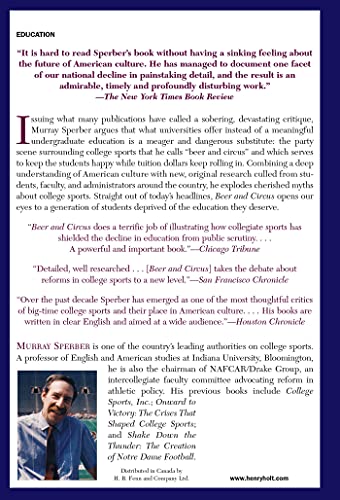
Beer and Circus: How Big-Time College Sports Is Crippling Undergraduate Education
J**N
A Powerful Polemic
Here's one of the funniest anecdotes from "Beer and Circus." It's actually a Jimmy John advertisement, written by a witty undergraduate at an American college town:Q: HEY JIMMY JOHN: Why is the University president's house so big?A: The president represents all that is important to our school as an institution of higher learning. These hallowed and noble academic grounds are the fertile fields upon which the future of our nation is grown. And the University president and the house he lives in must demonstrate to all the priority we place on this importation mission.Q: Why is the coach's house even bigger?A: No comment.Murray Sperber lacks the passion and the eloquence of Neil Postman, but he makes it up with the logic and craftsmanship of his argument. A professor of English and American studies at Indiana University in Bloomington, Professor Sperber is a contemporary of Bob Knight, the wildly successful coach of the UI basketball team who bullied his players as much as he bullied reporters and the college president. There's very little nuance and subtlety in Sperber's argument, mainly because he feels that there doesn't have to be. Right now, colleges are run like corporations with the mindset of the three Rs -- recruiting fee-paying students, retaining them, and renewing alumni support. Treating students like consumers has meant that colleges -- especially the publicly-funded state universities -- have turned away from their historical mission of turning out well-educated citizens of a democracy into a four-year playhouse in which students have access to be most lavish recreational and sports facilities, comfortable dormitories, and sports games -- but not to a professor who will challenge them to think critically and who will mark up the grammatical errors in their papers. That's because professors aren't supposed to teach -- they're supposed to be conducting research, writing books, appearing on CNN, and winning federal grants so that the colleges can look good.Professors don't teach, students don't learn, and American colleges have become nothing more than "beer and circus." That's about right.
F**D
Partly right, but missing a lot
Professor Murray Sperber presents a critique of giant, public, Research I/Division I universities, particularly of the low quality of education that many of their undergraduates get. It is well written and an entertaining read, and much of the criticism is spot-on correct. I think he misses some key points, though.These universities are a very American concept. They let in just about anyone. They take their money, and that's important for the existence of the enterprise. They then give the students a chance. Some do very well, even if they aren't in the honors college: I've seen it done. Some don't, but many of these seem placated with the "beer and circus" available at these schools.Professor Sperber doesn't seem to realize that education is fundamentally a self-directed activity. One gets out of it what one puts into it, and one needs to pursue it actively. If this message hasn't been made clear to students previously, it ought to be repeated to them clearly upon arrival at the university.Sperber does not like large classes, which are common at large universities. I agree that teaching them well does take special effort and skill. Still, several of the best classes I had when I was an undergraduate during the `70s had hundreds of students in them. They were good because the instructors knew their subjects well, and presented them well.Annoyingly many small classes I took were among the worst, for several reasons. Some instructors had poor communications skills. Some clearly put little or no effort into their teaching, and frequently came to class unprepared. Disturbingly many didn't know their subject well, because they hadn't done any research in many years and so were out of date.I resolved never to be like that. Life loves its ironies, of course: now that I'm a professor, I have no shortage of students who squander the opportunities I knock myself out to make for them.Almost none of the students from my classes of over 100 ever come to my office hours for help. Whose fault is that? If you accuse me of being intimidating, oh honestly, are we dealing with adults, or with hothouse flowers? I have quite a lot to do during the day, so why should I spend my limited time on people who would get fired, if they did any job in the world the way they are doing college?Sperber decries honors colleges, which didn't exist when he was a student in the '50s, when "all students were treated equally." He doesn't seem to realize that attitudes have changed. College is no longer regarded as a privilege, as it was in the '50s: many students today see college as an entitlement. Honors colleges don't choose their students at random: they do so by academic merit, both before and during college. Students who did not do well in high school can still get into an honors college, if they build a strong record once they're in college. They can also get booted from an honors college if they let their grades slip. Honors colleges therefore do too improve the education of all students: they provide a goal for ambitious students to work for, they attract students who may have attended more selective universities, and by doing this they prevent everyone from sliding into mediocrity.Too much hand-holding can be harmful to education. I am often ashamed by how much I get wheedled into doing, particularly since so little of it appears to do any good. Peter Sacks discusses this in " Generation X Goes to College ." I think the "sink or swim" approach often used at R1 universities has much to be said for it, particularly for cultivating student initiative. Why is it that universities are constantly criticized for being unlike "the real world," but then when one makes them that way, by holding students responsible for their education, the students so often resent it?During the 1960s, student protests did away with "in loco parentis," and instituted anonymous student evaluations of teachers. The students insisted that since they were over 18, they were entitled to be treated as adults. So, now that they say they're adults, who is ultimately responsible for their education? The students are! We have seen cases where reforms were attempted, and there was a hue and cry, which came from the students. One example was at Sperber's very university: remember the incident when someone threw a billiard ball through the university president's window when he tried to crack down on frats? Remember the "Right to Party" riots at Michigan State, made fun of by Doonesbury?Much of the logic that Professor Sperber uses to bolster his arguments is questionable. I really dig how he rips into "the student-faculty non-aggression pact." What, was this some sort of formal treaty, negotiated by the United Nations and on display in a glass case at the National Archives?The research mission of the university is important, particularly since so little basic research is being done anymore by the private sector. Drop that ball, and it will be bad for the economy. It's true that just being a good researcher is not a sufficient condition for being a good teacher, but many of the worst instructors I had when I was an undergraduate were that way precisely because they were non-researchers. (I once had a good argument about the contrapositive with a philosophy professor during an intro to logic course, despite there being 600 other undergraduates in the class.)I agree that too much emphasis on athletics can be a bad influence. Still, Professor Sperber doesn't really make the case in this book that this definitely is detrimental to education. Maybe he does this in his other books, which I haven't read, but he doesn't do this convincingly in this one: it's no more than an argument equating correlation with causation.Some of the reviews above complain that these universities "cheat their undergraduates." They ought to realize that this would be quite impossible without these undergraduates' full complicity and enthusiastic participation. It has always been possible to get a good education at these universities. Spending 5-6 years in drunken stupor (see The Five-Year Party: How Colleges Have Given Up on Educating Your Child and What You Can Do About It ) is entirely avoidable.
R**L
What are you getting out of your education?
This is the perfect book to analyze the effects of college sports on institutions of higher learning but also much more. This books starts by classifying students into four basic groups and describes what are the motivations of each group as it relates to a college education. I found this to be a very elementary but appropriate evaluation which clarifies why some things are as they are. The author also had sent out surveys, although not scientifically done, from which to draw conclusions. It nevertheless, was insightful concerning students feelings about athletics and their education.The surprise for me in this book was the historical analysis of college enrollment and marketing to prespective students in the last thirty years. Included in this, the author was very critical of the "learning environment" and teachers who want to research but not teach. This was a subject which I had not seen so effectively addressed.Yes, Murray Sperber is critical of college athletics. But I think his presentation was as balanced as possible with this bias and spared no one in his recommendations for improvement.Without giving away the ending, his conclusion is titled, "What should happen vs. what probably will happen." The author has given his subject great thought and presented the reader with good evidence. But I think the author realizes he is tilting at windmills and the ultimate conclusion which may come within 10 years will be painful. Particularly for a dedicated educator.
A**L
Four Stars
arrived as described
Trustpilot
1 week ago
1 week ago