Some deliveries may take a little longer than usual due to regional shipping conditions.

DOWNLOAD THE APP


Customer Services
Copyright © 2025 Desertcart Holdings Limited
DOWNLOAD THE APP

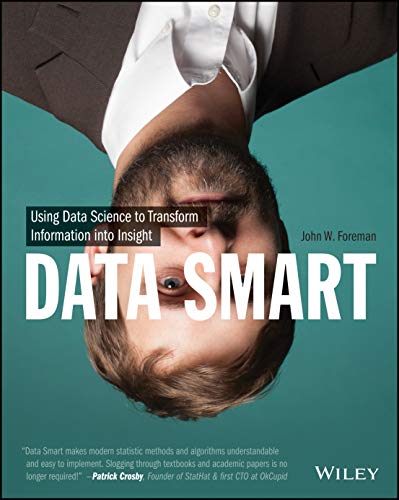
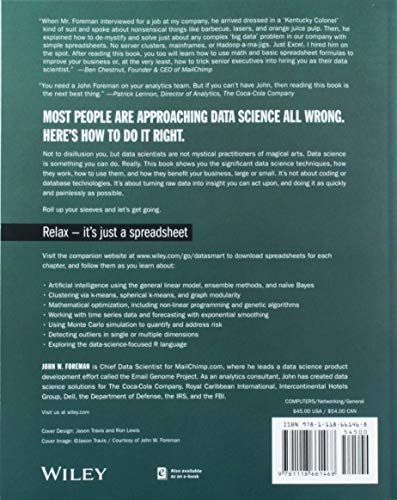
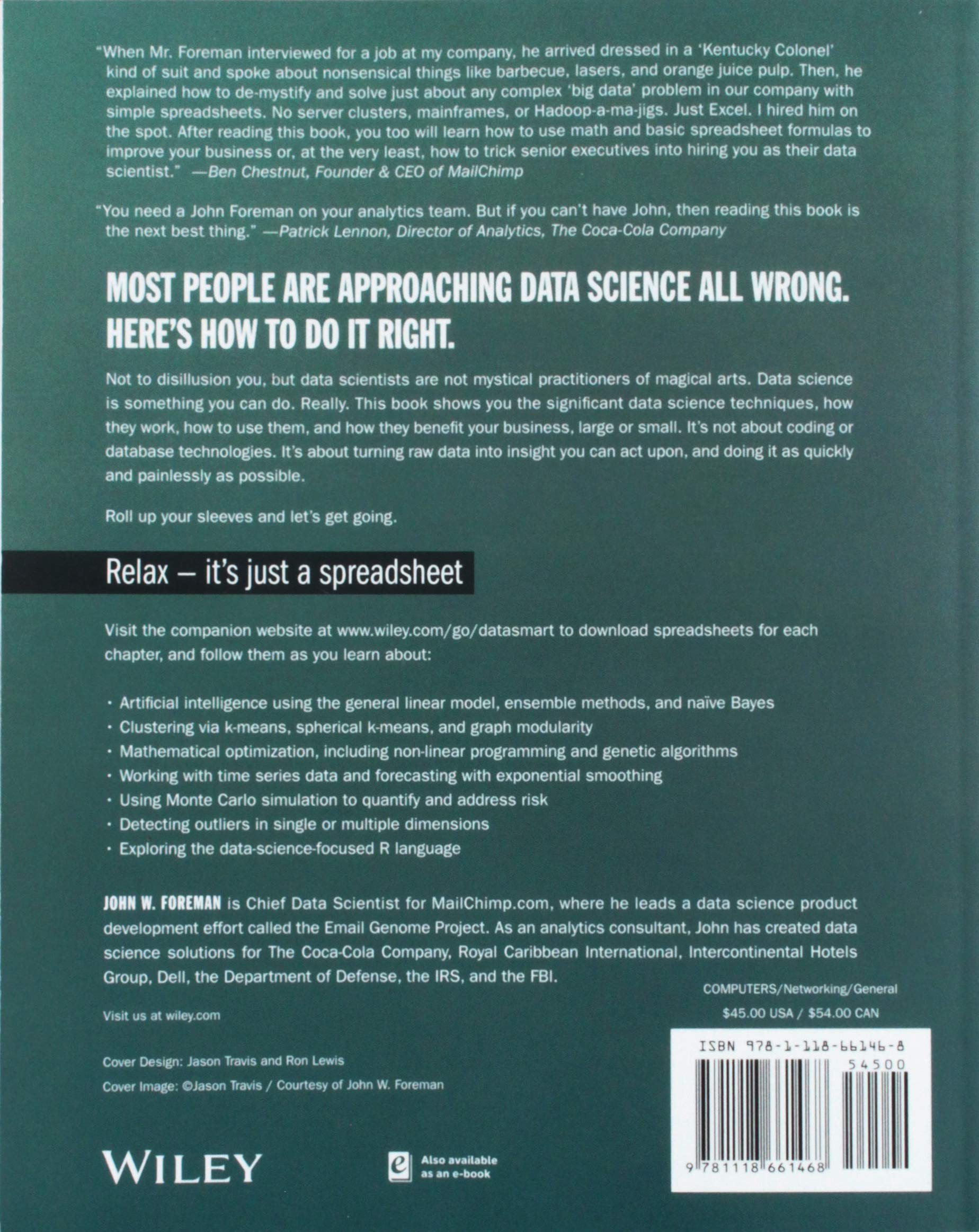

Data Smart: Using Data Science to Transform Information into Insight [Foreman, John W.] on desertcart.com. *FREE* shipping on qualifying offers. Data Smart: Using Data Science to Transform Information into Insight Review: Insightful, practical, and colorful. Perspective from a biased reviewer. - Disclaimer: I served as a paid technical editor for Data Smart. I am not affiliated with the publisher, but I did receive a small fee for double-checking the book's mathematical content before it went to press. I also went to elementary school with the author. So as you read the rest of the review, keep in mind that this reviewer's judgment could be clouded by my lifelong allegiance to Lookout Mountain Elementary School, as well as the Scarface-esque pile of one dollar bills currently sitting on my kitchen table. Anyway, books about "Data" seem to fit into one of the following categories: * Extremely technical gradate-level mathematics books with lots of Greek letters and summation signs * Pie-in-the-sky business bestsellers about how "Data" is going to revolutionize the world as we know it. (I call these "Moneyball" books) * Technical books about the hottest new "Big Data" technology such as R and Hadoop Data Smart is none of these. Unlike "Moneyball" books, Data Smart contains enough practical information to actually start performing analyses. Unlike most textbooks, it doesn't get bogged down in mathematical notation. And unlike books about R or the distributed data blah-blah du jour, all the examples use good old Microsoft Excel. It's geared toward competent analysts who are comfortable with Excel and aren't afraid of thinking about problems in a mathematical way. It's goal isn't to "revolutionize" your business with million-dollar software, but rather to make incremental improvements to processes with accessible analytic techniques. I don't work at a big company, so I can't attest to the number of dollars your company will save by applying the book's methods. But I can attest that the author makes difficult mathematical concepts accessible with his quirky sense of humor and gift for metaphor. For example, I previously had not been exposed to the nitty-gritty of clustering techniques. After a couple of hours with the clustering chapters, which include illuminating diagrams and spreadsheet formulas, I felt like I had a good handle on the concepts, and would feel comfortable implementing the ideas in Excel -- or any other language, for that matter. What I like most about the book is that it doesn't try to wave a magic data wand to cure all of your company's ills. Instead it focuses on a few areas where data and analytic techniques can deliver a concrete benefit, and gives you just enough to get started. In particular: * Optimization techniques (Ch. 4) can systematically reduce the cost of manufacturing inputs * Clustering techniques (Ch. 2 and 5) can deliver insights into customer behavior * Predictive techniques (Ch. 3, 6, and 7) can increase margins with better predictions of uncertain outcomes * Forecasting techniques (Ch. 8) can reduce waste with better demand planning It may take some creativity to figure out how to apply the methods to your own business processes, but all of the techniques are "tried and true" in the sense of being widely deployed at large companies with big analytics budgets and teams of Ph.D.'s on staff. This book's contribution is to make these techniques available to anyone with a little background in applied mathematics and a copy of Excel. For that reason, despite the absence of glitter and/or Jack Welch on the book's cover, I think Data Smart is an important business book. I had a few criticisms of the book as I was reading drafts, but almost all of them were addressed before the final revision. For the sake of completeness, I'll tell you what they were. Some of the chapters ran on a bit long, but these have been split up into manageable pieces. The Optimization chapter is a bit of a doozie, and used to be at the very beginning, but the reader can now "warm up" with some easier chapters on clustering and simple Bayesian techniques. The Regression chapter originally didn't discuss Receiver Operating Characteristic curves, which are important for evaluating predictive models visually, but now ROC curves are abundant. Only one real criticism from me remains: I would have liked to see more on quantile regression, which is only mentioned in passing. It's a great technique for dealing with outlier-heavy data. The book by Koenker has good but highly mathematical coverage, and I would have loved to see this subject given the Foreman treatment. But, you can't have everything, and I suppose John needs to leave some material for Data Smart 2: The Spreadsheet of Doom. In sum, Data Smart is a well-written and engaging guide to getting new insights from data using familiar tools. The techniques aren't really cutting-edge -- in fact, most have been around for decades -- but to my knowledge this is the first time they've been presented in a way that Excel-slinging business analysts can apply the methods without needing her own team of operations researchers and data scientists. If you're not sure whether the book's sophistication is on par with your own skills, you can download a complete sample chapter (as well as example spreadsheets) from the author's website. One last thing: unlike many books with a technical bent, the prose is engaging and extremely clear. I think this can be traced to John's childhood. When John misbehaved, his father (who is a professor of English) would punish John by forcing him to read a novel by Charles Dickens. Minor infractions resulted in A Christmas Carol being meted out, and when he was really bad he had to read Great Expectations. This is a true story which you should ask John about if you see him at a book-signing event. Review: How to perform data science in Excel - If you want to get started with Data Science and don’t like learning a new language such as R or Python, then this book is a perfect fit for you. Entertaining, Data Smart: Using Data Science to Transform Information into Insight approaches data science from a unusual angle. John W. Foreman has written a book for those who wants to apply data mining without using advanced programming (R, Python, etc.). It doesn’t mean you don’t need to understand what data science is, and this book is very good at explaining it to non-practitioners. Foreman’s book is written in a nice and funny stile, which makes it an easy read. Data mining algorithms are described with the minimum equations needed. Foreman has written a practical book and thus decided to use Excel as a tool for data science. The book starts with an introduction to Excel and its most famous functions. For data scientists using SAS, R, Python or Matlab, you may discover how powerful Excel is. But you will also see how clumsy it is to use Excel for data science. Whereas you would need a few lines in R, the book will take you through a dozen pages of step by step actions you need to perform to obtain the same in Excel. Not only is it more time consuming but also more prone to errors. Don’t get me wrong: Data Smart is excellent at explaining how to perform data science in Excel. I just think Excel is not the right tool for it. The book is also a journey into MailChimp, the author’s company. This is nice and provides plenty of examples related to e-mail marketing. The book thus provides quick and high-level description of the problem, followed by Excel steps to solve it. In conclusion, Data Smart is a must read to get a fresh perspective on data science with a “Data Science using Excel” user manual. And for the experts? You can just skip the Excel parts and get insights into the field, with a focus on MailChimp use cases.
| Best Sellers Rank | #498,658 in Books ( See Top 100 in Books ) #95 in Artificial Intelligence (Books) #985 in Artificial Intelligence & Semantics |
| Customer Reviews | 4.5 4.5 out of 5 stars (434) |
| Dimensions | 7.38 x 0.98 x 9.25 inches |
| Edition | 1st |
| ISBN-10 | 111866146X |
| ISBN-13 | 978-1118661468 |
| Item Weight | 1.65 pounds |
| Language | English |
| Print length | 432 pages |
| Publication date | October 25, 2013 |
| Publisher | Wiley |
E**R
Insightful, practical, and colorful. Perspective from a biased reviewer.
Disclaimer: I served as a paid technical editor for Data Smart. I am not affiliated with the publisher, but I did receive a small fee for double-checking the book's mathematical content before it went to press. I also went to elementary school with the author. So as you read the rest of the review, keep in mind that this reviewer's judgment could be clouded by my lifelong allegiance to Lookout Mountain Elementary School, as well as the Scarface-esque pile of one dollar bills currently sitting on my kitchen table. Anyway, books about "Data" seem to fit into one of the following categories: * Extremely technical gradate-level mathematics books with lots of Greek letters and summation signs * Pie-in-the-sky business bestsellers about how "Data" is going to revolutionize the world as we know it. (I call these "Moneyball" books) * Technical books about the hottest new "Big Data" technology such as R and Hadoop Data Smart is none of these. Unlike "Moneyball" books, Data Smart contains enough practical information to actually start performing analyses. Unlike most textbooks, it doesn't get bogged down in mathematical notation. And unlike books about R or the distributed data blah-blah du jour, all the examples use good old Microsoft Excel. It's geared toward competent analysts who are comfortable with Excel and aren't afraid of thinking about problems in a mathematical way. It's goal isn't to "revolutionize" your business with million-dollar software, but rather to make incremental improvements to processes with accessible analytic techniques. I don't work at a big company, so I can't attest to the number of dollars your company will save by applying the book's methods. But I can attest that the author makes difficult mathematical concepts accessible with his quirky sense of humor and gift for metaphor. For example, I previously had not been exposed to the nitty-gritty of clustering techniques. After a couple of hours with the clustering chapters, which include illuminating diagrams and spreadsheet formulas, I felt like I had a good handle on the concepts, and would feel comfortable implementing the ideas in Excel -- or any other language, for that matter. What I like most about the book is that it doesn't try to wave a magic data wand to cure all of your company's ills. Instead it focuses on a few areas where data and analytic techniques can deliver a concrete benefit, and gives you just enough to get started. In particular: * Optimization techniques (Ch. 4) can systematically reduce the cost of manufacturing inputs * Clustering techniques (Ch. 2 and 5) can deliver insights into customer behavior * Predictive techniques (Ch. 3, 6, and 7) can increase margins with better predictions of uncertain outcomes * Forecasting techniques (Ch. 8) can reduce waste with better demand planning It may take some creativity to figure out how to apply the methods to your own business processes, but all of the techniques are "tried and true" in the sense of being widely deployed at large companies with big analytics budgets and teams of Ph.D.'s on staff. This book's contribution is to make these techniques available to anyone with a little background in applied mathematics and a copy of Excel. For that reason, despite the absence of glitter and/or Jack Welch on the book's cover, I think Data Smart is an important business book. I had a few criticisms of the book as I was reading drafts, but almost all of them were addressed before the final revision. For the sake of completeness, I'll tell you what they were. Some of the chapters ran on a bit long, but these have been split up into manageable pieces. The Optimization chapter is a bit of a doozie, and used to be at the very beginning, but the reader can now "warm up" with some easier chapters on clustering and simple Bayesian techniques. The Regression chapter originally didn't discuss Receiver Operating Characteristic curves, which are important for evaluating predictive models visually, but now ROC curves are abundant. Only one real criticism from me remains: I would have liked to see more on quantile regression, which is only mentioned in passing. It's a great technique for dealing with outlier-heavy data. The book by Koenker has good but highly mathematical coverage, and I would have loved to see this subject given the Foreman treatment. But, you can't have everything, and I suppose John needs to leave some material for Data Smart 2: The Spreadsheet of Doom. In sum, Data Smart is a well-written and engaging guide to getting new insights from data using familiar tools. The techniques aren't really cutting-edge -- in fact, most have been around for decades -- but to my knowledge this is the first time they've been presented in a way that Excel-slinging business analysts can apply the methods without needing her own team of operations researchers and data scientists. If you're not sure whether the book's sophistication is on par with your own skills, you can download a complete sample chapter (as well as example spreadsheets) from the author's website. One last thing: unlike many books with a technical bent, the prose is engaging and extremely clear. I think this can be traced to John's childhood. When John misbehaved, his father (who is a professor of English) would punish John by forcing him to read a novel by Charles Dickens. Minor infractions resulted in A Christmas Carol being meted out, and when he was really bad he had to read Great Expectations. This is a true story which you should ask John about if you see him at a book-signing event.
S**A
How to perform data science in Excel
If you want to get started with Data Science and don’t like learning a new language such as R or Python, then this book is a perfect fit for you. Entertaining, Data Smart: Using Data Science to Transform Information into Insight approaches data science from a unusual angle. John W. Foreman has written a book for those who wants to apply data mining without using advanced programming (R, Python, etc.). It doesn’t mean you don’t need to understand what data science is, and this book is very good at explaining it to non-practitioners. Foreman’s book is written in a nice and funny stile, which makes it an easy read. Data mining algorithms are described with the minimum equations needed. Foreman has written a practical book and thus decided to use Excel as a tool for data science. The book starts with an introduction to Excel and its most famous functions. For data scientists using SAS, R, Python or Matlab, you may discover how powerful Excel is. But you will also see how clumsy it is to use Excel for data science. Whereas you would need a few lines in R, the book will take you through a dozen pages of step by step actions you need to perform to obtain the same in Excel. Not only is it more time consuming but also more prone to errors. Don’t get me wrong: Data Smart is excellent at explaining how to perform data science in Excel. I just think Excel is not the right tool for it. The book is also a journey into MailChimp, the author’s company. This is nice and provides plenty of examples related to e-mail marketing. The book thus provides quick and high-level description of the problem, followed by Excel steps to solve it. In conclusion, Data Smart is a must read to get a fresh perspective on data science with a “Data Science using Excel” user manual. And for the experts? You can just skip the Excel parts and get insights into the field, with a focus on MailChimp use cases.
B**G
parfait
T**O
Vou dividir meus pontos da seguinte maneira: 1- O que gostei 2- Fatos a serem considerados 3- O que poderia ser melhor de acordo com minhas preferências pessoais 4- Conclusão 1- O que gostei - Prático até o máximo. Pelo que parece, uma maneira inteligente de deixar de lado o misticismo, tabu e imaginação fantástica do que seria Data Science - quais ferramentas e frameworks estatísticos são usados - pode dar lugar a uma abordagem honesta e descomplicada de 10 conceitos importantes na ciência de dados. Ser capaz de aplicar tudo que o autor comenta, de maneira acessível de uma planilha ajuda a focar no cerne do pensamento analítico, se abstendo de qualquer outra distração ferramental. Você vai ler à medida que pratica em conjunto com o autor. A capacidade de ver o trabalho sendo construído torna esse livro um grande valor para o aprendizado. - Bem humorado. O autor não se leva a sério. Ajudando a tornar uma matéria reconhecida pela sua complexidade e erudição, a ciência de dados fica leve e informal. Ter referências de senhor dos anéis ou de outro conteúdo do entretenimento ajuda a tornar o raciocínio estatístico familiar e motivante. - Cases ilustrativos e aplicáveis ao dia a dia. Exemplos poderiam vir das mais diferentes observações de comportamento - inclusive de exemplos extremamente desmotivantes. Prever a gravidez baseado em um fator de consumo é completamente mais divertido e proveitoso quando comparado com prever a capacidade de performance de uma máquina baseado em sua performance. Apesar do modelo poder ser aplicado nos dois, o autor soube escolher exemplos realmente interessantes. explorando necessidade de clusters de usuários, checar contexto para classificação de nome de marca entre outros. 2 Fatos a serem considerados - Não sugiro ler em Kindle. A quantidade de tabelas e formulas torna a experiência proveitosa. Formatações que infelizmente não apresentam boa visibilidade no dispositivo. Entretanto, por se utilizar de Excel, tendo a recomendar a utilização de leitura através do aplicativo do Kindle para PC. - Para conhecimento integral: Learn by doing . Na minha experiência, apesar de ter aprendido consideravelmente quando não usava as planilhas, tenho certeza que se aplicar na planilha enquanto se aprende de fato traz um valor exponencial de aprendizado. -Se prepare para não entender em alguns momentos. Apesar do esforço em tornar simples e direto, alguns conceitos podem passar despercebidos ou com alguma incompreensão 3- O que poderia ser melhor de acordo com minhas preferências pessoais - Redução da utilização de Solver. No capítulo do modelo Bayesiano, achei incrível o resultado final e sua respectiva construção. Para isso, na minha opinião , um dos grandes motivos, veio da ausência de Solver. Entendo que é uma ferramenta essencial de otimização. Usar o Solver acabava tirando uma das etapas importantes: entender como o cálculo funciona. Com o solver, víamos uma caixa preta que recebia e mandava resultados sem sabermos com maiores detalhes seus passos 4- Conclusão O livro é recomendado para quem conhece pouco das práticas de data science , mas gostaria de saber melhor sem adicionar mais um nível de complexidade ferramental. Uma aula focada inteiramente em modelos e construções, com teste em cases de simulação aplicadas no dia a dia de diferentes negócios. A possibilidade de construir versões menores do que um Data Science constrói usualmente com as ferramentas convencionais, nos ajuda a experimentar ser um profissional - com seus obstáculos e conquistas. Saber em menor escala os pontos de benefícios, desvantagens e de geração de valor já nos torna uma pessoa com melhor senso de pensamento analítico. Obrigado.
J**R
This book is an excellent practical application of commonly used advanced analytical techniques for data analysis in Excel. I was skeptical that this was possible before purchasing the book and partly bought out of curiosity of to what extent it could be pulled off, but I was pleasantly surprised. Those with a strong background in statistics and SAS/SPSS/R will find it interesting and find it useful for the purposes of helping other understand what they are doing (i.e. it isn't magic) - but the target audience would be for those trying to gain business insight (probably in SME's) who are technically able, but who only know and / or have access to one tool for solving the problem - i.e. Excel. There are a lot of people in this situation, and this book could dramatically widen their horizons when considering issues such as optimisation or customer insight. Ultimately the author himself ends the book by stating that Excel isn't really the right tool for the job, and introduces R as an open source alternative. The demographic at which this book is aimed would most likely would not have considered this a possible path before they picked up this book, but I believe by the end of it most will give it proper consideration as a means to best apply the methods detailed within the book. As an aside, the author has a quirky and amusing style, which went down well at least with me, such that I read the first 4 chapters in one sitting...
C**R
Really like this book. The step-by-step instructions make it very easy to follow and you understand what has to be done.
D**A
There are great general books on Data Science like "Data Science for Business." High quality coverage of a broad spectrum. Then, there are Mozart like books. Books that won't replace the former, but will change the way you think about the subject (a.k.a. paradigm shift). Data Smart is such a Mozart like book. You start with Excel to formulate and play with your problem. Why? Because Excel allows you to touch and see your data in every state as an algorithm from input to output. Once you're done you can go to R or Python or .... Genius!
Trustpilot
1 month ago
3 weeks ago