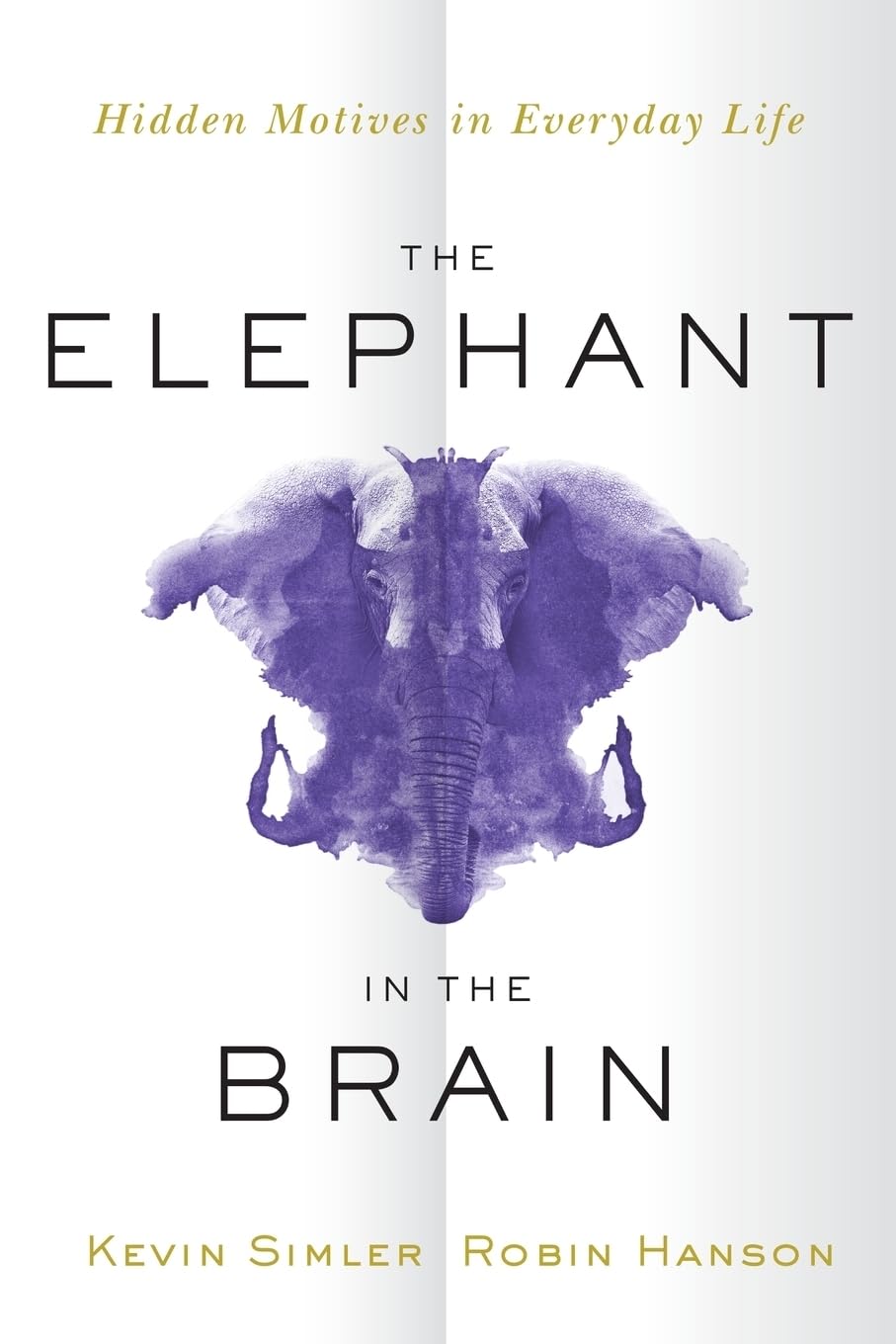
desertcart.com: The Elephant in the Brain: Hidden Motives in Everyday Life: 9780197551950: Simler, Kevin, Hanson, Robin: Books Review: You won't look at the world in the same way again. - If this book didn't make you uncomfortable, you didn't understand it. It's a really wonderful and eye-opening book. Simler and Hanson ask you to consider that evolutionary hold-overs motivate even your most selfless acts. The Elephant in the Brain (because it's about a big thing in our brain that we don't acknowledge) argues that many of our actions are motivated by a desire to cultivate allies and mates and, to cultivate effectively, humans have learned to lie others and ourselves. We've learned to fool ourselves into thinking we're pretty great because that makes it easier to fool others into thinking we're pretty great. Our brains evolved succeed in a social setting. You can argue their explanation is an incomplete understanding of human behavior. The Elephant in the Brain isn't meant to be a handbook of the human brain, able to explain every single thing people do. It's meant to highlight a part of our thinking we willfully ignore. One of the authors is an economist, but the book also draws heavily on psychological and evolutionary research. Indeed, the selfishness argument that's at the heart of the book isn't an economic one (as one reviewer erroneously claims), but an evolutionary one. Appreciate how hard Simler and Hanson's argument is to show. "You're secretly lying to yourself!" is by definition something people will not be upfront about. Much of the book applies this self-deception/selfishness theory to different areas such as art, education, donations, and body language and concentrates on the contradictions. There's a disconnect between what we claim and what we see. The "elephant in the brain" fills the gap. To get a feel for how they make their argument, consider their chapter on donations. We typically think of donations as acts of pure selflessness--motivated by a "warm glow" from helping others--but Simler and Hanson point to some contradictions. -We typically do not do research on the organizations we donate to. -We are more often motivated by individual stories rather than statistics on effectiveness. -We rarely keep quiet about our donations and most donations are not anonymous. Even "anonymous" donations aren't kept quiet. If charity was all about helping others and nothing more, we'd be more careful about where the money goes and wouldn't be so concerned with advertising our benevolence. Charity, Simler and Hanson argue, is an advertisement: a way to show off to others so we can signal success and get allies. Don't make the mistake in thinking that this a conscious concern; it's more of an explanation as to why the glow is warmer for some acts of charity rather than others. Telling people about our donations feels better than keeping quiet. Helping a person we can identify feels better than helping statistical abstractions that represent people. Our ancestors who were apt at visible giving in a way that felt genuine were more likely to proliferate because they had more allies and better mates. Natural selection made us charitable, but in a weird way. To their credit, Simler and Hanson don't think humans are terrible people or donations shouldn't occur. They acknowledge multiple times that these hidden motives can have wonderful results. We should just be aware of how easily we can fool ourselves. Review: This Book is All About Me - This book is all about me, or you if you choose to read it. The authors use data from various studies and surveys of large groups, as well as interesting historical anecdotes to make the case for individual decisions that appear to be in the group interest, but are often in one’s own interest. Not that that is a bad thing; self-interest drives the economy and enables us to survive. Much of this self-interest is evolutionary and sometimes evolution lags behind our increasingly complex society. Accordingly we make decisions that are intended to maintain or enhance our survival and pleasure, but are in fact harmful to our well-being. Becoming aware of such internal conflicts is one of the benefits I got from reading The Elephant in the Brain. I also became aware of how others appeal to our self-interest while actually, sometimes unconsciously, pursuing their own self-interests. This revelation is going to result in my writing to my Senators and Congressional Representatives about some of the current legislation being discussed in Washington. This is a well written, easy read. I’d call it a non-fiction page turner.


| Best Sellers Rank | #67,235 in Books ( See Top 100 in Books ) #6 in Cognitive Psychology (Books) #878 in Motivational Self-Help (Books) |
| Customer Reviews | 4.4 out of 5 stars 1,668 Reviews |
D**G
You won't look at the world in the same way again.
If this book didn't make you uncomfortable, you didn't understand it. It's a really wonderful and eye-opening book. Simler and Hanson ask you to consider that evolutionary hold-overs motivate even your most selfless acts. The Elephant in the Brain (because it's about a big thing in our brain that we don't acknowledge) argues that many of our actions are motivated by a desire to cultivate allies and mates and, to cultivate effectively, humans have learned to lie others and ourselves. We've learned to fool ourselves into thinking we're pretty great because that makes it easier to fool others into thinking we're pretty great. Our brains evolved succeed in a social setting. You can argue their explanation is an incomplete understanding of human behavior. The Elephant in the Brain isn't meant to be a handbook of the human brain, able to explain every single thing people do. It's meant to highlight a part of our thinking we willfully ignore. One of the authors is an economist, but the book also draws heavily on psychological and evolutionary research. Indeed, the selfishness argument that's at the heart of the book isn't an economic one (as one reviewer erroneously claims), but an evolutionary one. Appreciate how hard Simler and Hanson's argument is to show. "You're secretly lying to yourself!" is by definition something people will not be upfront about. Much of the book applies this self-deception/selfishness theory to different areas such as art, education, donations, and body language and concentrates on the contradictions. There's a disconnect between what we claim and what we see. The "elephant in the brain" fills the gap. To get a feel for how they make their argument, consider their chapter on donations. We typically think of donations as acts of pure selflessness--motivated by a "warm glow" from helping others--but Simler and Hanson point to some contradictions. -We typically do not do research on the organizations we donate to. -We are more often motivated by individual stories rather than statistics on effectiveness. -We rarely keep quiet about our donations and most donations are not anonymous. Even "anonymous" donations aren't kept quiet. If charity was all about helping others and nothing more, we'd be more careful about where the money goes and wouldn't be so concerned with advertising our benevolence. Charity, Simler and Hanson argue, is an advertisement: a way to show off to others so we can signal success and get allies. Don't make the mistake in thinking that this a conscious concern; it's more of an explanation as to why the glow is warmer for some acts of charity rather than others. Telling people about our donations feels better than keeping quiet. Helping a person we can identify feels better than helping statistical abstractions that represent people. Our ancestors who were apt at visible giving in a way that felt genuine were more likely to proliferate because they had more allies and better mates. Natural selection made us charitable, but in a weird way. To their credit, Simler and Hanson don't think humans are terrible people or donations shouldn't occur. They acknowledge multiple times that these hidden motives can have wonderful results. We should just be aware of how easily we can fool ourselves.
M**N
This Book is All About Me
This book is all about me, or you if you choose to read it. The authors use data from various studies and surveys of large groups, as well as interesting historical anecdotes to make the case for individual decisions that appear to be in the group interest, but are often in one’s own interest. Not that that is a bad thing; self-interest drives the economy and enables us to survive. Much of this self-interest is evolutionary and sometimes evolution lags behind our increasingly complex society. Accordingly we make decisions that are intended to maintain or enhance our survival and pleasure, but are in fact harmful to our well-being. Becoming aware of such internal conflicts is one of the benefits I got from reading The Elephant in the Brain. I also became aware of how others appeal to our self-interest while actually, sometimes unconsciously, pursuing their own self-interests. This revelation is going to result in my writing to my Senators and Congressional Representatives about some of the current legislation being discussed in Washington. This is a well written, easy read. I’d call it a non-fiction page turner.
J**R
Must read for fans of evolutionary psychology
Really good overview and interesting compilation of studies and research on social biology and modern society. Why we do what we do and how we could be more genuine about the whys and effective in the how’s. Loved it. Wish some of its conclusions would have offered deeper view from evolutionary psychological perspective and included the opportunities and challenges presented by modern tech in revealing the elephant and leading us perhaps to a much more examined life. For example, what is the purpose of life and where do we go from here.
F**R
Myth management
Simler and Hanson put together an entertaining and thought provoking read. They are fearless in their approach, at times walking on thin ice, but they make no claims to infallibility, and by following fairly clear lines of argument, end up with novel and interesting ideas. Every chapter enlightens. If the reader wants evidence-rich research, this is probably not an ideal resource as its scope limits the amount of detail possible. The book, instead, is designed for a individuals with broad interests willing to take a look under the fictive hood that covers our inner existence. Its pragmatic take on religion, politics, charitable donations and academia are particularly informative. Despite its theme, it is never heavy handed or cynical, and its accessibility makes it a particular treat.
G**E
OK But Nothing New
This is a very good book but was disappointing just the same. I expected more, mainly because of Kevin Simler's blog postings, which, by and large, I've found to be interesting and thought provoking. What I felt I got in the book, however, was a new packaging of known ideas. I can't say that I learned anything new here.
P**C
A Nonfiction "Catcher in the Rye"
J.D. Salinger enthralled the world with his story about an angsty teenager who gradually became aware of -and infuriated with- the "phoniness" of the world. Salinger's protagonist is blessed with extraordinary insight into people's hypocrisy and self-deception. The blessing seems at times a curse: the character has no friends, can't do well in school, is out of shape, and hints frequently at suicide. The discontent of Holden Caulfield is almost without limit (the astute reader notices that the NYC adventure is in fact narrated from an mental asylum in California). I don't know if 'EitB' will sell as well as 'CitR' (which outsold 6 of the 7 Harry Potter books), but, pound for pound, its pages are just as valuable. Like CitR, EitB is about "phoniness". But, unlike CitR, it *explains* phoniness: why it evolved, when/where it is likely to appear, and why we sometimes can't stop ourselves. The book is about our own thoughts, and since we think about ~everything, the concepts have near-universal applicability. Forewarned is forearmed (at least for a certain type of person), and readers will therefore be able to use EitB to improve their health and wealth with superior decision making. However, more interesting to me, is that *some* readers will inherit a repertoire of skills for optimized hyper-phoniness. These people will be world-class persuaders -- eventually, every leader will need to know (or at least name) the ideas presented here, if only for self-defense. This cognitive science book focuses on "ugly information", ie the kind that you don't want to show to other people. It is hard to talk about these ideas with one's friends. EitB is about disgraceful things -- things that we try not to admit, that we try not to talk about, and that we have in fact **evolved not to even think about**. After digesting the book's lessons, the reader will better understand not only [1] why our world has problems, but also [2] why some of those problems cannot be solved using traditional explanations (ie, explanations that take the form of straightforward verbal persuasion). As I hinted in the first paragraph, Elephant in the Brain is certainly not for everyone. The ideas presented are very unflattering, and, despite the authors' lighthearted attempts to backpedal the significance of their work by talking about the moon landing or whatever, the explanations in EitB are in fact informative, accurate, relevant, and significant. If anyone asks me, readers are in danger of replicating Holden Caulfield's experience of overwhelming frustration. Some people can't handle the truth, Plato's Allegory of the Cave, etc etc, ya know? This is one of those. If you're into that, you know what to do! Buy it!
N**R
Open with caution: a Pandora's box of hidden motives
The Elephant in the Brain is potentially a bitter pill to swallow. It's bad enough to be told you're selfish; it's downright maddening to be told you've blinded yourself to the fact. From health care to religion to charity, Sloan and Simler methodically cast doubt on our motives and behaviors, even (especially?) our most altruistic ones. What makes the book palatable — and exceptional! — is the authors' shared tone of non-judgement, compassion, and the right touch of humor. A spoonful of sugar makes the medicine go down... Highly readable, thought-provoking, and chock full of examples you can deploy to impress friends and strangers at your next party. But caution: you'll observe them — and yourself — in a whole new way.
D**T
Insightful self help book
The authors helps me understand the reason behind people’s seemingly selfless actions. This is not to degrade human motives in general, but to help understand why we do what we do and how we can justify and utilize our selfishness for personal and public good.
Trustpilot
1 month ago
4 days ago