
DOWNLOAD THE APP


Customer Services
Copyright © 2025 Desertcart Holdings Limited
DOWNLOAD THE APP
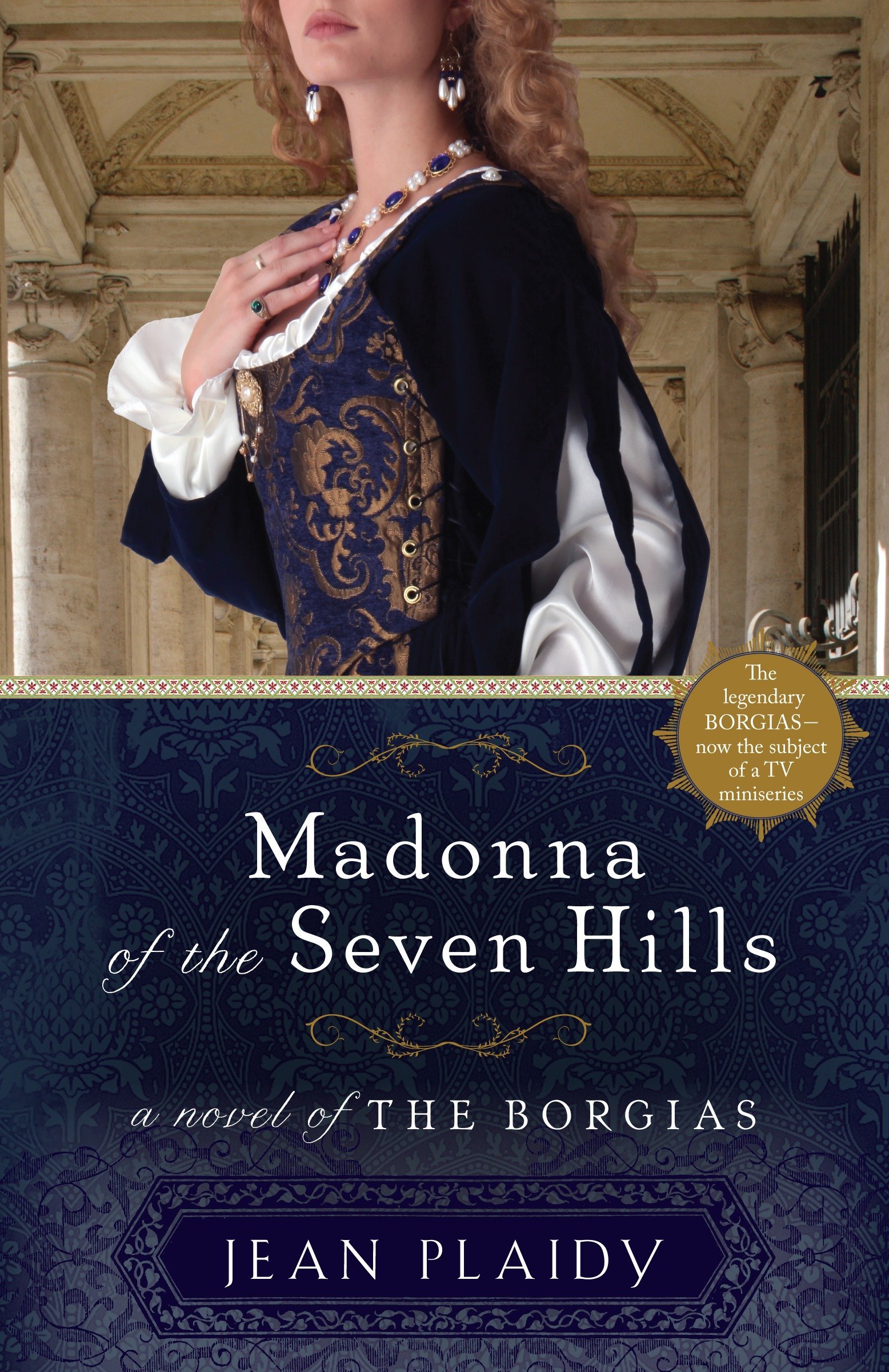
Madonna of the Seven Hills: A Novel of the Borgias
V**S
Charming and Pleasant
Poor Lucrezia! Born into such a strong male-domineering Borgia family, she didn't stand a chance. To add insult to injury, she was saddled with the undeserved label of an incestuous poisoner. Before we discuss this book, "Madonna of the Seven Hills", it is helpful to know in advance that it is only the first book of a two books series about Lucrezia.The author wisely warned us altri tempi, altri costumi: different times, different customs. Renaissance Vatican was notorious for being corrupt. Shortly after Alexander VI and Julius II, Leo X famously proclaimed upon being elected Pope in 1513, "God has given us the papacy. Let us enjoy it." It is a miracle that the Church survived.All stories about the Borgia family must center around Rodrigo, Pope Alexander VI. As Cesare said, "All blessings flowed from him." As it was a very close-knit family, all their stories were interlinked. You can't talk about one without talking about the rest of them. So, even though this story is supposed to be about Lucrezia, it is really about the entire Borgia family. I am glad the author chose to stick closely to the already juicy history and resisted the temptation to show off her creativity by reinventing a new saga.Rodrigo was a shrewd politician. He rose to the papacy by careful plotting and long term planning. As a Spaniard in a sea of Italians, he could trust only his family. Fortunately, being a priest and having children were not mutually exclusive at the time, and nepotism was the norm in any circle. He forced his oldest son Cesare to join the Church because he knew that's the source of real power (that's why every powerful family had a son in the Church) and appointed his middle son Giovanni to lead the papal army because even power needs military support. His daughter Lucrezia and youngest son Goffredo were pawns for political alliances to be married off as needs arose. Unfortunately, brilliant fathers always beget foolish sons. Giovanni got himself murdered after he humiliated himself at his one and only battle and Cesare left a promising career in the Church to become a mere condottieri. Sure enough, after Alexander died, without a powerful patron in the Church, the Borgia family fortune soon came crashing down.As hygiene and food safety were unknown but sickness was rampant, poison was the generally accepted cause for any unexpected death, that's why anyone who's anyone always had a taster. A dagger in a dark alley was the easiest way to dispose of an enemy, that's why you had an entourage and bodyguards following you wherever you went. Bribery was how you do business and simony was the most convenient charge leveled at your enemies. Only a handful of popes were not tainted by it. Alexander VI had the misfortune to be followed by his mortal enemy Julius II who vowed to destroy Alexander's reputation by any means. A widespread smear campaign was launched and no Borgia was spared. Rumors of every kind were thrown at them and some stuck. Thus, Alexander became a greedy lecher, Cesare became a murderous brute, and Lucrezia the femme fatale with a poisonous ring. As incest was so repugnant an idea, it was often used to demonize one's enemies. The Borgia family was likewise so accused.In Jean Plaidy, Lucrezia found her champion. She was portrayed with sympathy, as a kind-hearted golden girl torn between her loyalty to her family and her conscience. As this is the first of a two books series, it only covered her childhood, her first marriage to Giovanni Sforza, and her love affair with Pedro. The family dynamic was explained through their childhood. To make her more angelic, it was necessary to belittle Giovanni Sforza as unworthy of her and praise Pedro as her true love. The author incorporated every rumor in circulation to plump up the story. However, as a female writer, she avoided any gruesome details of battles and murders. And as it was originally published in 1958, there were no graphic details for any sexual encounters. The story of her second and third marriages, the fall of the Borgia family, and her later years are covered in the second book of the series, "Light On Lucrezia". Can't wait to read it!
M**.
A Realistic Look At Lucrazia Borgia...
This is only the second book I've read about Lucrazia Borgia, and it was a much more realistic potrayal than the first. I know many people differ on whether or not they think she had a sexual relationship with her father, the Pope, and her brother Cesare, but I tend to lean more towards Ms. Plaidy's opinion, which is that they were just VERY close, and that Lucrezia was more a pawn for her father and brother than some vicious poisioness.The book opens with the birth of Lucrazia and follows her through to her wedding day of her second marriage. We see her grow up with her two very competitive brothers, Cesare and Giovanni, who constantly fight for her attention and love. Their destructive relationship comes to a head near the end of the novel, and Lucrazia must come to terms with the monster that her brother Cesare has become. She comes to fear him, and this is why (according to Ms. Plaidy) Lucrazia acts the way she does around him, always subservient and fawning all over him.In this telling of her life, Lucrazia is portrayed as an innocent. She does what she's told to do, she goes where she's told to go, and she marries when she's told to marry. She can never get too close to any outsiders because her brothers intense jealousy is always a concern. Cesare will kill anyone who rubs him the wrong way, and anyone who gets too close to his sister automatically falls into that category. Lucrezia just wants to live a quiet simple life in the country, but her ambitious father has other plans for his beautiful daughter.Overall, I absolutely recommend this (as I do all Jean Plaidy books!). I really enjoyed this version of the life of Lucrazia Borgia, and as soon as I finished it, I picked up "Light on Lucrazia", which tells of the second half of her life, and picks up right where this book left off.
C**!
Oooooooh you sneaky Borgias
I didn't know much about the Borgia's before reading this, and I had such a great time learning about them as I was reading this! Just like any other book by Plaidy, you can always count on her to tell a story in such an interesting way that you don't even realize it's based on history.The Borgia's are such an interesting family, I loved the dynamic Plaidy portrayed between the brothers and Lucrezia, as well as their father, who loves them more than anything in the world. Alexander is just as conniving as any King you've read about in any historical piece, politicking his way to the top of the Church and placing his children in strategic positions both in the church and around the rest of Italy.Poor Lucrezia is stuck in the middle of everything, a pawn in everyone's game, used for whatever suits Alexander and to a lesser extent, her brothers. It makes me feel so bad for all the women during this time period, they have so little choice and get lucky every now and then to have an understanding husband once they're married. Lucrezia is lucky to have a father who protects her from everyone but her own family, which is both good and bad considering how manipulative her brothers can be.I really enjoyed this story and since it's the first of a two books about the Borgias, I'll definitely be reading the second one. I think this is a great introduction to the Borgia family, shining a great light on Lucrezia and showing us fabulous insight into the her family and the time period. I'd recommend this book to anyone who enjoys historical fiction, or anything set in Italy during this time frame.
M**
Good book
I have read only a few pages. Jean plaidy is a good historical author. Her story are well researched and her writing is lucid.I have not completed the book yet. I shall review once I am through with the book.I bought a second-hand book with turtle back. It came in good condition and was delivered on time.
D**E
An interesting, slightly old-fashioned and didactic historical novel, but still a good read
I've never read any of Jean Plaidy's books before and read this because it was nominated by a historical novelists' book group I belong to that focuses on historical novels. I have many friends and relations who have enjoyed her books so was interested to see what the fuss was about, especially now that, having been out of fashion for a while, her books have been reissued.I found this a curious book. It reminded me partly of a high school history text book, carefully and elaborately explaining the facts in a digestible way, and the sort of essay we students might have been asked to write, imagining ourselves in the period. It was occasionally heavy-handed at slipping in period detail to anchor the story historically e.g. going on about Spanish style dancing versus Italian style dancing. This is not to be dismissive of the book - I enjoyed reading it and found it a real page-turner. However, I found it hard to believe that the heroine could have grown up as innocent and naive as she was depicted, growing up within such a dysfunctional and amoral family. Therefore although it felt historically accurate overall, it struck me that it might be a bit of a whitewash of Lucrezia Borgia. I also felt slightly uncomfortable with what was almost exclusively a portrayal of the upper classes with little regard for anyone else, other than as caricatures. It did feel like something that had been written decades ago, when the British class system was rather more rigid and deferential. As a bit of a leftie, I disliked that aspect of the book intensely.Having said that, I'm glad I read it, and I can completely understand how Jean Plaidy gained such a huge following. I'll be watching with interest to see how 21st century readers take to her - and how the rest of my book group responds.
A**E
She was not what they say she was!
After watching 'The Borgias' with Jeremy Irons I wanted to read more about Lucrezia. The version of events set out in this book does not agree entirely with the film production, but that is to be expected. I am more inclined to accept Jean Plaidy's version of events - good solid research and no need to be sensational! Loved it.
A**N
Okay
Not bad but not my type of book anymore
A**E
A consummate storyteller
Jean Plaidy isn't an academic historian but this and her other books bring history, and particularly history from a woman's perspective, to life. This novel about the early life of Lucrezia Borgia paints a believable picture of an ordinary girl born into an extraordinary family and how that and what hsppened to her formed her character.
Trustpilot
2 days ago
2 weeks ago