

Desert Online General Trading LLC
Dubai, United Arab Emirates
Desert Online General Trading LLC
Dubai, United Arab Emirates

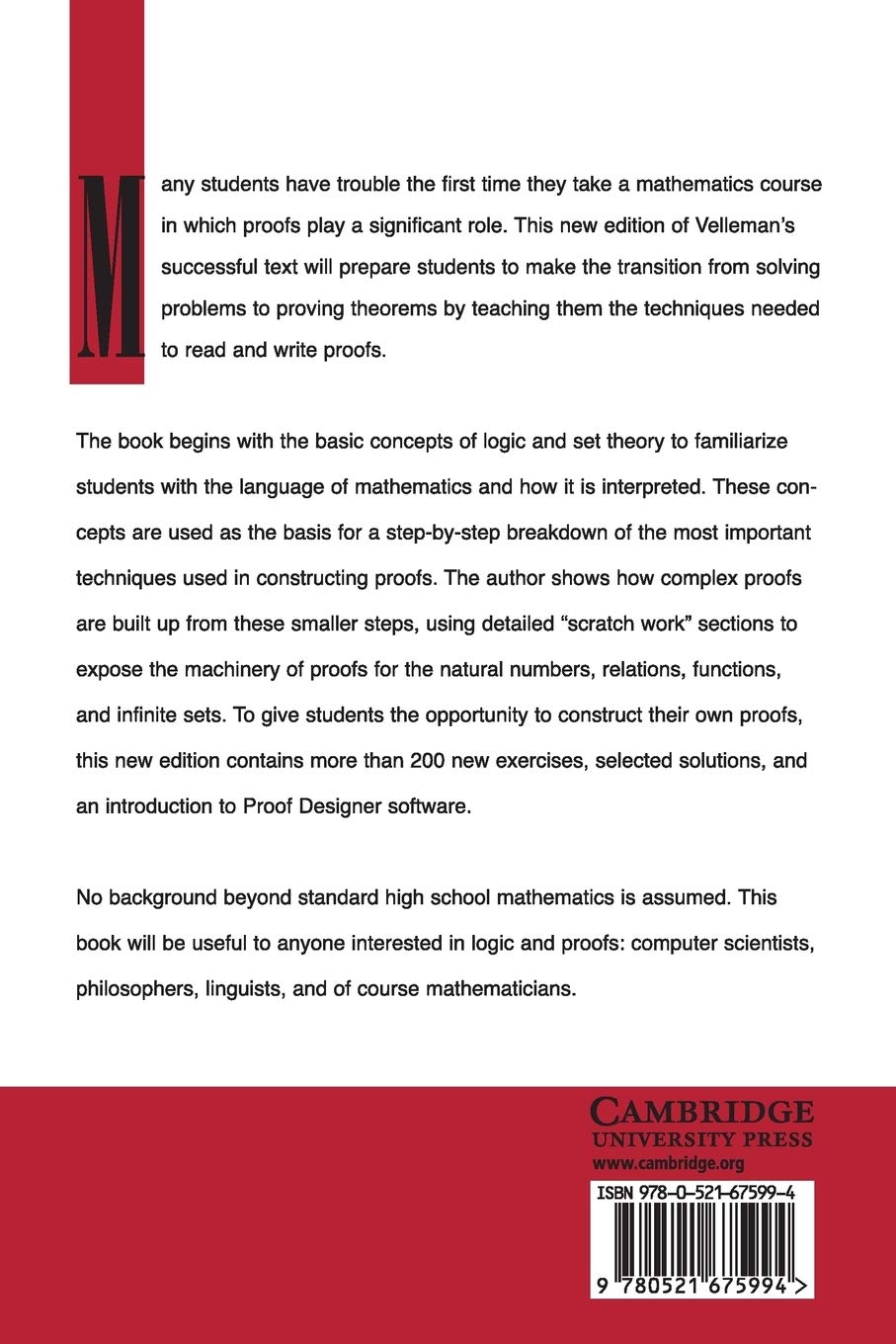
Full description not available
J**.
Deep dive into proof writing.
This is a deep dive into proof writing. As someone who is self-studying mathematics, I would have gotten more from the book if I had read something like "Discrete Mathematics" by Sussana Epp first. I read her book after and she provides a stronger foundation in mathematic reasoning and proof writing which is something that would have benefitted me.
B**E
This Book Taught Me How to "Get" Math... Please Read On..
Before buying this book, I struggled in math. I excelled at "calculating" stuff by simply plugging in numbers into some sort of equation our high school teachers would spoil us with, but when I got to college, I had to start thinking abstractly- and it bothered me a lot, because I had no idea how to test or prove the logic of some statement. I was doing very poorly in linear algebra and desperately needed help- lo and behold, my professors weren't helpful (at all). Someone recommended this proof writing book to me, and I am VERY grateful for that referral.The book takes the average student (it's shocking with how little math background one needs) and introduces him to basic boolean logic. You know, material like "If A is true, and B is false, then A implies B is false." In a discrete mathematics course, one would call this "truth tables." From there, the author takes the reader into set theory, basic proofs, group theory, etc- and into more advanced topics, like the Cantor-Schroeder-Bernstein theorem, countability, etc. So what makes this book stand out?(1) Readability. Many math professors stop just short of taking pride in how confusing, abstract, or daunting their lectures can be. Velleman, however, goes the extra mile in the text to see that the reader UNDERSTANDS the logical buildup and concepts of mathematical proofs. Sure, set theory can be confusing- but after reading several other texts in discrete math, including "Discrete Math and its Applications" by Kenneth Rosen (if you're reading this, no offense) I've found that Velleman by far writes the most comprehensive and cohesive explanations for understanding set theory. Making the material accessible is the mark of a real "teacher," and if you read through this book yourself, I believe you'd agree that Velleman is a pretty legit teacher.(2) Examples. There are plenty- plenty that Velleman works out himself. Reading the examples alone- and actually taking the time to understand them- is a task that's up to the reader, obviously, but they do show results almost immediately in understanding discrete math.(3) Problems (exercises). There's never a shortage of exercises, I found, as I tried to work through the problem set. There are plenty. Fortunately, there are some answers in the back, but just enough so that you can verify to see if you're understanding the material, and not enough so that you find yourself copying every answer in the back (even the best students get tempted to do that). Velleman gives the proper amount of answers in the back and a ton of exercises to do. If you complete them all properly, you'd be far ahead of the curve amongst math majors.I know my review may have been too wordy, or too optimistic. However, my feelings are very honest and not exaggerated: this book is written so one can learn discrete mathematics, and really helps the reader understand what higher math is all about- and how mathematicians think, write, and communicate. This book deserves an A+, and I've only given that score out to a handful of books.
R**H
My favorite book about proofs so far
A fine book. It is very clear and concise, and in my opinion very enjoyable. It goes over the foundations needed to writing proofs (basic set theory and logic) and provides a lot of exercises and examples. The first chapters deal with the ideas of logic and sets and of the different ways of proving different types of statements. In the later chapters, extremely important math concepts that are not essential to proof writing are introduced - relations, functions, and infinite sets - providing more training in proof writing. The concept of induction (both ordinary and strong) is also introduced in the later chapters.The sections are mainly very clear and concise explanations of the concepts, together with examples, theorems, and definitions. Velleman is a fine proof writer; his proofs are very readable and it is very easy to understand them. Therefore it is very worthwhile to study them and perhaps to even try to mimic them, to some extent. The end of every section is a very large set of exercises. Some exercises have solutions in the back of the book, but beware that for most of them, no solution is provided. This is a great drawback, in my opinion, and I wonder why Velleman decided to leave so many exercises without a solution. However, the exercises are very good! The first exercises in every set are generally quite easy, and the last ones can be quite difficult. Many of them are very interesting.Here's a very interesting exercise from the section dealing with strong induction:"The martian monetary system uses colored beads instead of coins. A blue bead is worth 3 Martian credits, and a red bead is worth 7 Martian credits. Thus, three blue beads are worth 9 credits, and a blue and red bead together are worth 10 credits, but no combination of blue and red beads is worth 11 credits. Prove that for all natural numbers n greater than or equal to 12, there is some combination of blue and red beads that is worth n credits."
Trustpilot
1 week ago
1 month ago
5 days ago
2 weeks ago