Some deliveries may take a little longer than usual due to regional shipping conditions.

DOWNLOAD THE APP


Customer Services
Copyright © 2025 Desertcart Holdings Limited
DOWNLOAD THE APP
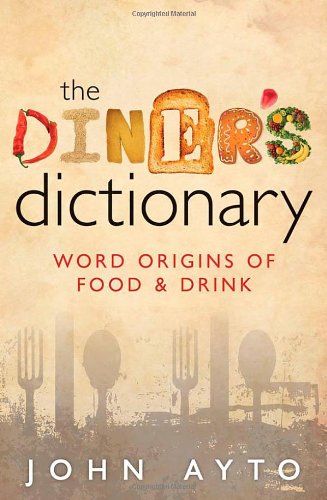
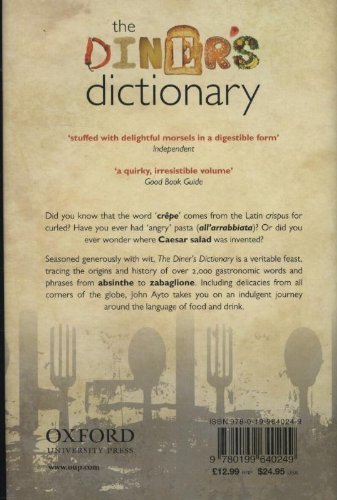
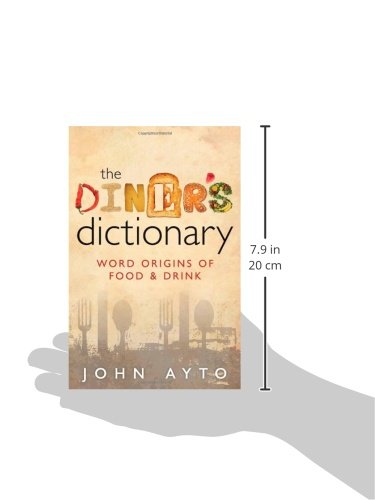
Full description not available
J**S
5-star content but beware the small type
With a thorough list of food-related terms in alphabetical order, this is a book for both foodies and word lovers.BUT -- the type is really small and isn't a sharp black. If you are farsighted or read with glasses, you are likely to have trouble with it.Content-wise, I have nothing but praise for the book. However, if I'd known how difficult it would be to read, I'd have given it a pass. This book is crying out to be published for Kindle and other e-readers.
C**L
Awesome book but could include more items!
Awesome book with a lot of fun information. However, found it was missing a few common food items, like Scallops. But overall, love this book! Very useful for my food writing needs. :)
B**E
Fascinating
A well-researched and handy source of much information about the origins of food and drink. A must for those who are foodies.
B**Y
Four Stars
Very interesting
C**8
helfpul and complete
Wow, much more than I expected and any culinaryily interested person will benefit by having this. Not light reading, however.
D**K
Words as Food
I have the first edition of this volume and I could not live without the second. It is witty and accurate in ways that make me want more and more and . . . .
H**K
Five Stars
Came as promised and as described.
B**Y
Food and Drink Lovers Book
This book gave great pleasure to the person who received it, more than I had imagined when I bought it. Anyone who loves food and drink would appreciate this book.
A**N
Present for Dad
Requested by my Dad on his Christmas list - arrived promptly and he was delighted to open it Christmas Day!
B**H
Excellent
Very informative and just what I needed. Now I can give explanations to others and help them out. Should avoid a lot of arguments.
G**T
Twenty Two Years In The Making
Back in 1990 a book was published called The Glutton's Glossary. Unsurprisingly, given the title, the book never gelled with the national subconscious. Three years later the book resurfaced, this time in soft back form, as The Gourmet's Guide. Again the world didn't hold it's collective breath. The idea seemed right - a book devoted to definitions of culinary terms, potted histories of dishes and ingredients and menu/wine list terminology - but the reading public seemingly had little appetite for such a guide.That was then. Tastes in 21st century Britain are much more advanced and people much more open to trying new flavours, new drinks, new restaurants and new cuisines. Arranged from Abernethy biscuits through to zwieback, coincidentally also a term for a rusk or biscuit, over four hundred pages John Ayto's updated version is the perfect companion to the experimental foodie. Subtitled 'word origins of food and drink' this entertaining book revisits the familiar and explores the less familiar in a gastronomic circumnavigation which leaves few stones unturned. At a time when restaurants, celebrity chefs and food experts are falling over one another to discover the next craze or newest ingredient it is going to be a very brave author who will commit himself to extolling the merits of, say, Mongolian cuisine or the dietary advantages of Batavia. However, it is also an advantage to be able to give suitable background information on established cuisines, ingredients etc that may be currently out of vogue but which may be on the verge of rediscovery - the only explanation I can offer to the inclusion of both Black Forest Gateau and the humble vol-au-vent in this book. These aside, I found Mr Ayto's book entertaining, inspiring and informative; tummelberries from the banks of a tributary of the River Tay, fish cake, as a term, originates from 1854, the deep fried Mars bar was first made, allegedly, in Stonehaven near Aberdeen and not Glasgow as I had always presumed. This is a book for dipping into, pick and mix sweet bag style, and savouring whatever gem of knowledge comes out. Having read what the pasty, that pastry enveloped pocket of meat, potato and root vegetables, means in the United States this book is also a very valuable asset when travelling abroad.
A**T
Be a know-it-all at the dinner table
My mother watches Countdown, and every time I see her she has some little tale about the origins of words she has learned from Suzie Dent. I thought it was time to get my own back.This little book is a lot more marvellous than it first appears. It is quite literally what it says it is - a dictionary full of the origins of the names of fruit, vegetables, cooked meals and various other foodstuffs. I was out at a restaurant the other week and I ended my meal with an ice cream Sundae. The next day this book arrived and I looked it up, curious about the origin of the name. The book explores the connection, but says there is some doubt about the truthfulness of suggested explanations. Still interesting though. The next day I had an omelette and learned that the saying that you can't make one without breaking eggs comes from Robespierre; and I learned a little more about the green tea I like to drink.I also looked at pages at random and found that there actually IS a dish called green eggs and ham! The non-chocolate equivalent of a brownie is called a blondie! The article on black-eyed peas actually mentions the Black Eyed Peas being formed in 1995, and the article on Wensleydale makes reference to Wallace and Gromit! Some of the articles are quite long, but interesting - for example the articles about chips and cake. At least one article there is questionable - shampoo is in there because some people used it as a joke name for champagne in 1958. Some obsolete names do deserve to be in there though, such as Chinese gooseberry (kiwi fruit).It's a useful little book, especially if you want to show off at the dinner table. Worth buying even if it's only for finding out why a Jaffa cake legally IS a cake rather than a biscuit, and how the use of "toast" to mean "done for" came about (e.g. "we're toast"). (I won't keep you wondering on that last one - it came from one of Bill Murray's ad-libs in Ghostbusters).
Trustpilot
2 weeks ago
3 weeks ago