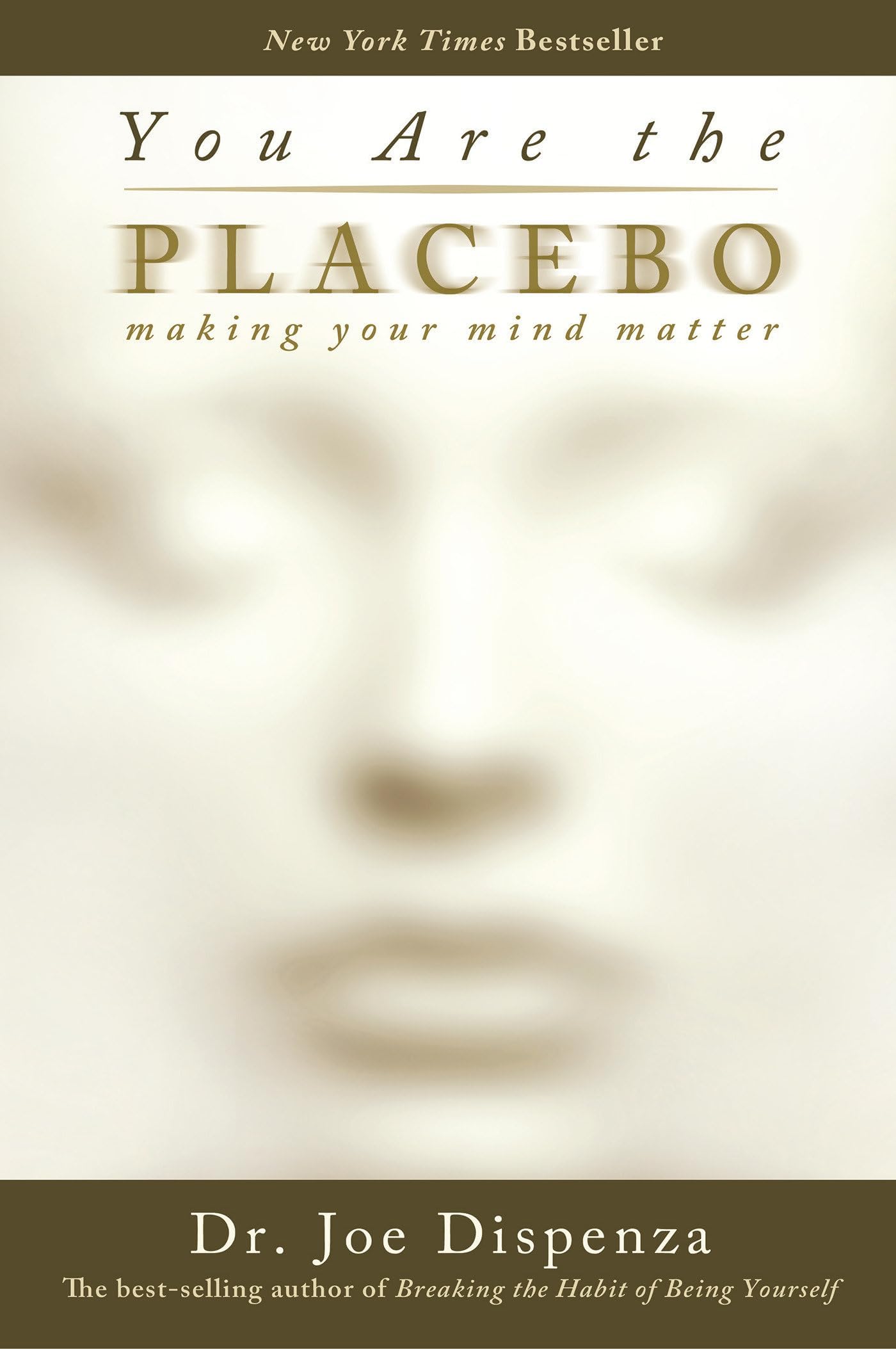
You Are the Placebo: Making Your Mind Matter
Product ID: 17319619
💡Transformative Ideas
📚Insightful Read
🧠Mind-Body Connection
Buy anything from 5,000+ international stores. One checkout price. No surprise fees. Join 2M+ shoppers on Desertcart.
Desertcart purchases this item on your behalf and handles shipping, customs, and support to Ireland.
🧘♂️ Transform Your Mind, Transform Your Life!
You Are the Placebo: Making Your Mind Matter explores the profound impact of belief on health and well-being, offering readers a blend of scientific research and practical advice to harness the placebo effect for personal transformation.
| Best Sellers Rank | #5,428 in Books ( See Top 100 in Books ) #4 in Supernaturalism (Books) #6 in New Thought #63 in Personal Transformation Self-Help |
| Customer Reviews | 4.7 out of 5 stars 9,105 Reviews |
M**E
Great book, but it's hypnosis (not meditation)
I read two of Dr. Dispenza's other books, "Evolve Your Brain" and "Breaking the Habit of Being Yourself" and I loved them both, so I had to buy his newest book, too. It's true what some reviewers noted, the book does repeat a lot of information found in his previous books, but I didn't mind it much because it served as a reminder for me, and there was plenty of new material, so it wasn't just rehashed material. Still those of you who have read his other books, be prepared for some repeated material. Another thing is that he cites the fire-walkers and strychnine swallowing ministers as people who are using an altered state of mind to accomplish something amazing. I read that it's nothing so amazing, there's a trick to it, and I think the strychnine-swallowing ministers are phonies - there is no proof to prove they actually drank strychnine, it's likely just a show, sleight of hand. Sometimes these books cite "miracles" which I doubt, even though I do believe extraordinary miraculous events occur frequently, and I do believe the stories of healing during his workshops noted in his book. Overall, the book provides much hope, and I really enjoyed it. I dogeared many pages to reread later, and plan to implement this in my life. I'll update my review in the future if I'm able to make any astounding changes in my body. So far I haven't done the "meditations" enough times to say (I've only done them twice so far). As for meditations, they are not. The scripts are hypnosis scripts, including an induction into the hypnotic state, after which the positive suggestions for self-transformation are introduced. It's absolutely, 100% hypnosis. He is basically introducing you to the meditative state (which is extremely hard to achieve, personally I suck at it) via hypnosis. Using hypnosis to help you get to the meditative state. Which is an interesting idea, as meditation is quite difficult and can be frustrating, as it's very tricky to do for any extended period of time (more on that in a moment - for anyone who isn't already familiar with meditation). Anyway, to clarify my point, Dr. Dispenza has a hypnotherapy diploma from the same college of Hypnotherapy that I do, HMI, which is located in Tarzania, California. It's a reputable, accredited college of Hypnotherapy, and Dr. Dispenza is trained as a hypnotherapist. I read this in his own account so I know it to be true. The script he uses is definitely hypnosis, (although there are many forms and styles of hypnosis). I don't say this as a criticism at all. Hypnosis is extremely useful in healing, and self-transformation. I just don't understand why it's called "meditation". Hypnosis and meditation are very similar in some ways, but in hypnosis, we do an induction to get the client into a state of relaxation (as Dispenza explains, the altered brain wave state) and then we introduce suggestions specific to the change the person wishes to accomplish. In meditation, you must clear your mind of ANY thoughts and attempt to keep thoughts of any kind at bay, to find the "gap" between the thoughts. It's very difficult NOT to think, as our brains are used to thinking constantly. The hypnotic state is not as difficult to get into, if you know self-hypnosis or are working with a hypnotist or using a recorded hypnosis. But meditation and hypnosis are not the same. Also, meditation has become very accepted in the mainstream, even hospitals will tell people meditation is good for you - hundreds of studies, including clinical studies, have been done on the benefits of meditation. Hypnosis remains somewhat on the fringe, despite some studies showing remarkable benefits from hypnosis, it is NOT as accepted as meditation, and when it IS used in healthcare settings, they often use silly terms such as "guided visualization" or "guided meditation" to keep from frightening people from the word "hypnosis" which is PRECISELY what it is. This is because many people still see hypnosis as "mind control" or "making someone get on stage and quack like a duck" it is still seen by many as frightening, suspicious, fake, or ridiculous. Hypnosis is none of those things. In the hands of a competent practitioner, hypnosis is an extraordinary tool for healing, changing habits, and improved mental and emotional health. It's great that Dr. Dispenza is using hypnosis to help people reach the meditative state, access the quantum field, and heal their minds and bodies. I don't understand why he doesn't call a spade a spade though, and call it what it is: hypnosis. The only thing I can think is that it's perhaps to avoid turning some people off or garnering ridicule. Readers can either buy his hypnosis recording online for a small fee, or they can record the script he includes in the book. He graciously provides the reader the option to record their own version and not purchase his - which is more than many authors do these days, they usually try to make you buy their add-ons and don't provide free options as Dr. Dispenza has done. Personally I prefer recording my own, as I did with his other book, as I'm familiar with recording hypnosis recordings for my clients. I purchased his recording on the last book, but ended up recording it myself anyway as I preferred my recording over his (simply a matter of personal preference, not saying that mine was better than his). Any reader can use his script to record their own free copy of his hypnosis session. All in all, Dr. Dispenza's work is very encouraging and it would be great to see the medical world begin to use people's minds to heal themselves. It's extraordinary that so little research has been done into something as important as the "placebo effect" and I thank Dr. Dispenza for taking it upon himself to do this. It's very clever, and the potential, if this can be mastered, is extraordinary.
D**H
You Are The Placebo: A paradigm shift for personal transformation
Dr. Joe Dispenza’s most recent work, You Are the Placebo: Making Your Mind Matter, is the perfect follow-on to his earlier work, Breaking the Habit of Being Yourself. Those who have studied the rationale and practiced the procedures discussed in Breaking the Habit (as I have done) will find this latest volume offers even more clarity about how to “fine tune” meditative sessions, so that practitioners can change themselves in significant and lasting ways. You Are the Placebo recounts compelling stories of people who have healed themselves – and remained healthy, by following a mindset focused on possibilities, rather than obstacles and problems. They didn’t allow the opinion of others – “professional” or otherwise – to short-circuit the beliefs they held and in many cases, felt intuitively about healing. Dr. Joe’s process in part involves “open focus” – closing one’s eyes, taking attention from the outer world and placing it on the space around us in a way that removes considerations about the material world, allowing us to…not think. Transport yourself to the present moment, moving your intention and thus your energy to a place beyond time and thought. Allow your brain, the central nervous system, and the rest of your body to begin working together, becoming more balanced and integrated. Instead of a linear, material world of limited potential (mostly because we keep responding to new events in the same conditioned, often unproductive ways), it is possible to enter the “quantum field” of unlimited possibility existing beyond space and time. In breaking the habit of being our old selves, we can begin to shape a new and more productive physical and emotional reality. In current brain research, the evolving science of neuroplasticity confirms that our brains are capable of change and improvement to an advanced age, via the construction of new neural pathways or synapses. It is becoming increasingly evident that the quality of how and what we think can go a long ways toward keeping us healthy – or making us sick. So often in life, those who are adept at helping others heal have had to go through their own baptism of fire first. In the first section of You Are The Placebo, Dr. Joe discusses what many would call – at the very least - a miraculous recovery, after he suffered severe spinal injuries when struck by an SUV while cycling in a triathlon. How he fashioned – from the inside out – the philosophy and practice that led him, against the odds to a place of optimum health, presents a powerful and informative read. Fifteen months ago, for over six weeks, a ruptured disc placed me in the most excruciating, unremitting pain I’ve ever experienced. A specialist told me “The only option for you is spinal fusion”. A prescribed medicinal pain patch – dialed down in potency by 75% at the pharmacy before it was filled – still literally almost killed me. The healing chiropractic work Dr. Joe performed at his clinic, along with my own meditation, following the very practices described in this book, enabled me to achieve a full recovery without surgery –in the process leaving behind a number of my old self’s limiting habits. I have also come to feel the incredible power and serenity that the simple act of expressing gratitude on a daily basis has brought into my life. We’ve all heard about the importance of expressing it after something helpful has happened. Before meeting Dr. Joe, I had never heard anyone recommend being grateful beforehand. Try it and see what you think. One very powerful aspect of his work involves the recognition that all of our behaviors begin first as thoughts. You think about a previous experience involving sadness, fear or anger. Soon your brain begins to respond by interpreting that emotion from the record of your past, leading to physical changes. With the body fully involved, you act out that emotion, which through time can become a temperament, even a personality. With your emotions driving your thoughts, you simply create more of your past. The result is a predictable, repetitive linear path, not unlike scenes from the movie Groundhog Day. Dr. Joe teaches you how to turn off this destructive thinking before the body can begin to act upon it. Eventually it can be left behind altogether, as a brighter future is brought into being with the help of new responses fashioned by and for yourself. If our thoughts truly create our reality – or at the very least have a major impact on its formation, then an understanding and practice of the techniques fully discussed in this book can provide actionable advice leading to profound levels of personal transformation. As Dr. Joe says, in his Introduction about examples of the self-healing he later discusses, “…you don’t have to be a monk or nun, a scholar, or a spiritual leader to accomplish similar feats.” My own experience in studying and practicing what Dr. Joe discusses in You Are The Placebo leads me without hesitation to recommend his work to anyone who desires to bring about systemic change in their lives, and who is willing to spend a bit of time and self-discipline to do so. Break the habit of being yourself –by yourself - and my guess is you’ll conclude that continuing to invoke the old ways of responding to things no longer deserves to play a role in your present – or your future.
J**E
This book is mind Blowing... I love it
I bought this book quite a while ago, but I only recently had the chance to finish it, and I’m so glad I did. You Are the Placebo: Making Your Mind Matter was truly eye-opening and inspiring. Dr. Joe Dispenza explains in a powerful and understandable way how the mind and body are deeply connected. It offers hope that positive change is possible when we begin to understand our thoughts, beliefs, and habits. I found it motivating, insightful, and full of valuable lessons. It made me reflect on my own mindset and the role it plays in everyday life. A fascinating read for anyone interested in personal growth, healing, and the power of the mind
G**X
Amazing Book; verifies what I have thought to be true for decades
I watched and listened intently to an Internet Documentary Series titled Broken Brain 2. Why was that important? It explains how this book by Dr. Dispenza came to be in my possession. There was a physician featured on the presentation and unfortunately I did not write her name down to give her credit, who said, “I will not see a new patient until the patient reads You Are the Placebo.” Think about that for just a moment. Doctors earn a living by seeing a patient and then being paid by the patient and/or the patient’s health insurance company. What better motivation to read a book for me who will probably never be a patient of the doctor making the recommendation, especially since I can’t remember her name. I purchased the book with some reservations. Whenever I have read a book written by a medical doctor I am usually overwhelmed with all the medical terms used and then followed by an in depth discussion as to what the terms mean, etc. I bought the book anyway as should you. It would be my estimate that about 5% of the book contains medical terms I cannot pronounce nor that I will ever remember; nor do I have need to. But for the remaining 95% of the book, all I can say is WOW! First a disclaimer. To some the contents of this book will be beyond what they have come to believe and frankly that is what part of the book describes. For others like me, I have always felt that the brain was more than capable of self-healing the body but until now, I do not know if anyone was sure as to how to tap into the ability. I was fascinated by Dr. Dispenza’s personal story about his bike and SUV accident and how he recovered. To put it into perspective and hopefully without getting too personal, I am experiencing severe pain in my left hip and thigh and the pain suddenly and magically appeared immediately following major back surgery; the pain is not near where the actual back repair was performed. The surgeon performing the surgery doesn’t seem to know what to do to relieve the pain. So I began researching pain that involved taking A Great Course (company name) course on Pain Management as well as reading several books and articles on pain and pain management. I felt I need to “manage” the pain because a cure didn’t seem like it was going to appear in my life. Would the contents of this book apply to me and relieve me of the pain I was experiencing? Still even more important to me, would this book validate my belief that the brain could actually heal the body if someone were to show me how to tap into that ability? Only time will tell if my personal physical pain is relieved because I happened to read this book. If it does I will certainly revised my comments regarding the book. As you read Dispenza’s book you quickly learn of stories of people who have used the power described in the book both consciously and subconsciously to change what the brain and the body has heretofore been trained to believe. Once you believe something to be true, it takes a great will power and attitude change to redefine that belief or like in my case it takes the need to find relief for my personal pain to find an alternative to what doctors have been unsuccessfully doing to relieve my pain. In my judgment I felt, “heck what have I got to lose by trying it?” I do feel, however, that I would have a “leg up” on others that read the book because of this review, but who do not as yet believe as I do that the brain can heal the body. Being able to open the brain to a new thought is critical as Dr. Dispenza points out before someone can actually believe in something new to the old ways of thinking. By “old ways of thinking” I mean yours and my old ways of thinking, not old ways meaning something old because of passing time. There would be no point in telling you what is in the book because I could never do it justice. What I can tell you is that I truly believe that everyone could benefit from reading it and I do mean everyone. Why do I say this? Because as I read it, I envisioned real estate agents who were stuck in a place and who didn’t seem capable of making the changes they need to make to make a difference. So just about everyone could benefit whether they have a chronic illness or not. Still, if you are extremely skeptical, I doubt the book would be of much value even in the face of facts, logic and common sense. After I was about half way through the book, I purchased a downloadable MP3 file created by Dr. Dispenza. Again, WOW! Not sure I have ever paid such close attention to any MP3 or CD like his Breaking The Habit of Being Yourself Book Meditations. Best $6.00 I have spent in some time if ever! Who should read the book? Everyone! Would I read it again? Sections of the book, absolutely! Would I refer the books to my friends and family? Absolutely, already have Would I buy the book as a gift? Probably but not if I thought the receiver of the book had a closed mind to such knowledge as it would then serve no purpose.
M**A
Good Book!
Good book!
D**R
Self Directed Neuroplasticity
You are The Placebo By Dr. Joe Dispenza A funny thing happened on the way to a deterministic model of biology. It was to be derailed by an ambitious international endeavor called the Human Genome Project, launched in 1990 and funded by the United States government. The Human Genome Project was based on the assumption that genes determine our destiny. Its mission was to map the entire human genome. Since genes construct proteins, and there are about 140, 000 proteins, it was reasoned, that there should also be about 140,000 genes as counterparts. Thirteen years later the project ended in a whimper. As it turned out, the project discovered about 23,000 genes, the same number as the lowly round worm. It took biologist more than 100 years to recognize what physicist had discovered with the advent of quantum theory at the beginning of the twentieth century--nature is indeterminate. No one to one correspondence exists between genes and their expression. We are not the sum of our parts. The Human Genome Project effectively ended the era of genetic determinism and the philosophy of genocentrism. The decade of the 1990s opened up the fields of epigenetics and neuroplasticity as serious disciplines of study for neuroscientists, while at the same time, the concept of self-directed neuroplasticity (SDN) has democratized these disciplines, giving everyone the power to select their own gene expressions from a vast pool of possibilities. Not only has it been shown that we can change the architecture of the brain with our minds, but it now appears that our entire physical make-up, our gene expression, is subject to moment-by-moment feedback from the environment. Eric Kandel's Nobel prizing winning work demonstrated that seventy-five to eighty-five percent of our genes are not static, but are responsive to the environment, and many of these regulatory genes, which control hundreds of other genes, can be turned on and off by our thoughts, emotions, and beliefs in just minutes, thereby, explaining many miraculous examples of healings in the literature. About one-third of the population responds to placebos in whatever form they manifest, from sugar pills, to voodoo, to sham surgeries, or injections of saline solutions. Joe Dispenza asked the obvious question. If placebos are inert substances or practices having no causal effect, what is curing these people of disease? The answer had to be that these curative effects were coming from the patient's own thoughts, attitudes, and beliefs. If this is in fact the case, the next question is how can we change our thoughts, attitudes, and beliefs to live a healthy life? Our task, Dispenza says, is to make our inner thoughts more real than our outer environment. If we are able to do this repetitively, it is possible to change our body by activating new genes to produce epigenetic changes. Dispenza states: "In our minds, we are picking a different future potential and hoping, anticipating, and expecting that we'll get that different result. If we emotionally accept and then embrace that new outcome we've selected and the intensity of our emotions is great enough, our brains and our bodies won't know the difference between imagining that we've changed our state of being to being pain-free and the actual event that cause the change to a new state of being. To the brain and the body, they are all the same." If enough emotion accompanies our imagined new state of being, the brain fires the same circuitry as if the event happens in reality. In cases in which a patient receives a placebo rather than a proven efficacious drug, the patient will often get the same benefits from the internal pharmacy of the body, as if she/he had taken the pharmaceutical. When we have thoughts, neurotransmitters such as dopamine and acetylcholine are produced in the brain. At the synapse they exist in a quantum superposition of states of fire/no fire. When a critical potential is reached the neurotransmitters cross the synaptic gap, creating an electrical discharge of information. Neurons that fire together wire together, and as a result, our brains architecture creates physical evidence of what has been learned. Thinking the same thoughts or repetitiously practicing athletic skills, for example, enhance the number of connections making the pathways automatic. When large bundles of neurons fire together, a protein within the nerve cell is created that travels to the nucleus of the nerve cell where it interacts with the DNA. This protein switches on genes that, in turn, create proteins that construct new branching connections between the neurons. As a result, repetition not only strengthens connects but generates new connections. In addition to the neurotransmitters produced when thoughts occur, protein neuropeptides are produced and interpreted by our brain and body as emotions. When the brain senses the chemicals of the emotion, it generates similar thoughts that produce more of the neuropeptide in a complementary loop. This further hardwires the subconscious brain making it difficult to break out of the loop. The neurotransmitters and the neuropeptide chemicals of emotion latch on to specific receptor sites on the cell wall throughout the body and the electromagnetic code of the messenger molecule is read creating or altering a new protein that travels to the nucleus of the cell and activates the DNA. The DNA is unzipped and transcribed by the RNA, which then travels outside of the nucleus to the Ribosome, where a new protein, such as a hormone, is produced and released into the body. Dispenza writes: "You can think positively all you want, but that 5 percent of your mind that's conscious will feel as if it's swimming upstream against the current of the other 95 percent of your mind--your unconscious body chemistry that has been remembering and memorizing whatever negativity you've been harboring for the past 35 years; that's mind and body working in opposition. No wonder you don't get very far when you try to fight that current!" Yet, somehow taking a placebo is able to change all of this in a moment. The key, of course, is not the placebo but the three key components of conditioning, expectation, and meaning in addition to the emotional qualities of acceptance, belief, and surrender. Ernest Rossi, Ph.D. writes in The Psychobiology of Gene Expression: "...While the process of genetic evolution can take thousands of years, a gene can successfully alter its expression through a behavior change or a novel experience within minutes, and then it may be passed on to the next generation." (qtd. in Dispenza, 86) If you practice focused attention your physical brain will change by creating new pathways and connections and as a result will produce the chemical signals that can change your body. Research has shown that focusing attention on skills such as playing piano or shooting basketballs have nearly the same positive results as physically practicing these skills. The more you rehearse a desire or an outcome of a future event, the more changes take place in the brain wiring and the neural chemicals. Your thoughts become the placebo. "If you bring up the emotion of gratitude before the actual event, your body and the unconscious mind will begin to believe that the future event has already happened--or is happening to you in the present moment. Gratitude, therefore, is the ultimate state of receivership." This quote precisely mirrors aspects of the Buddhists' idea of gratitude. If one has gratitude, it is as if the end result has already happened. It doesn't matter how it will happen, only that it will. Trying to analyze how it will happen, incorporates the analytical mind, which is the faster and shorter Beta wave state of the brain, in effect, collapsing the wave function and destroying the many possibilities involved in meaning. If we can calm ourselves and drop down into the Alpha brain wave state, in which we become unplugged from the body, environment, and time, we become more suggestible, and at the same time, it lowers the volume of the brain circuitry, especially the analytical mind. The slower brain wave states of alpha and theta gets us closer to timelessness and maintains the integrity of the experiment from the beginning to end, thereby conserving meaning. So, the important thing is to envision what you are trying to achieve without forcing the situation. Having gratitude is to surrender your ego and to simply believe, and allow, that your autonomic nervous system is in control in all of its wisdom. To summarize Dispenza's wonderful book, our genes are mutable. They are subject to change by our thoughts and emotions on a moment-by-moment basis. To change our situation, it is not necessary in most cases to take a drug or for that matter a placebo, because we, our thoughts and our emotions, are the placebo. By eliciting the placebo response we are opening the door to our bodies own pharmaceutical warehouse. Our genes do not determine our destiny; rather, through SDN, self-directed neuroplasticity, we are in control, not by forcing an outcome, but by simply envisioning an outcome, silencing our egos, expressing the emotions of gratitude, and allowing our autonomic system to create our new destiny. Dispenza's book, "You Are The Placebo" is top on my list of recommendations and has contributed considerably to my understanding of the nature of reality. This book review by David Kreiter, author of "Confronting the Quantum Enigma: Albert, Niels, and John. (Amazon)
K**R
I recommend it to my friends
I have both the author's prior books and his "Breaking the Habit" book is one of my all-time favorite books. (This is from someone with well over 700 books on my bedroom shelves and many others on my kindle.) Having said that, initially I wasn't all that interested in this book. I was familiar with the premise, but I thought it would be geared to people with serious illnesses or health problems, and I'm mostly healthy. I've been working with his meditations though, so I decided I might as well order the book on kindle and see what it was like. I'm so glad I did! I'm going to have to add it to my short list of favorite books. Yes, I think this book can be very beneficial for people with serious health concerns, but I think it can be equally beneficial for people without them. Basically, this book is for anyone who wants to change some aspect of their life. Does that apply to anyone you know? This is a practical book. It discusses things in easy-to-understand language and gives exercises and tools that people can easily use. It is backed by science -- both as a combination of research and empirical evidence. Neuroscience is certainly heady stuff, but Dr. Joe breaks it down in very clear explanations with the clever use of analogies that help you understand how these complex biological mechanisms work. Once you understand better why or how it works, it opens the door for you to believe it can work, and all the many examples in this book show the amazing things that happen once you believe it's possible. This isn't a self improvement or self help book. Saying that just doesn't adequately capture it. This book is about transforming your life. I've been doing some of Dr. Joe's prior work, and I just picked up the new Meditation 1 that goes with this book. I can definitely say that even in the short time (about 3 weeks) that I've renewed my daily meditation practice, I can see a noticeable improvement in my life. I am happier, calmer, and generally more positive. I can't wait to wake up in the mornings, so I can do my meditation. And if I can see that amount of change in 3 weeks, I'm excited about what continued practice can bring.
A**R
Great & helpful information to heal
A MUST read! Very informative and helpful.
K**S
An educational & exhaustive look at how the Placebo Effect can transform our lives
In Dr. Dispenza’s newest book, "You are the Placebo" we are provided with the life-affirming knowledge that our thoughts and expectations can transform our lives by helping us overcome illness, disease, and numerous other afflictions that limit our ability to enjoy life to the fullest. I do not read medical journals, so I can’t make this statement with certainty; however, I would suggest that this book is likely one of the most up-to-date and exhaustive works on the Placebo Effect available today. Furthermore, for those that do not enjoy overly technical books, I would say that in spite of the fact that the nature of this book requires medical and scientific terminology to be used, this is still a very readable book. In my own words, in very simple terms, I see the essence of the placebo effect as: mind over matter. Our minds have the power to overcome disease, depression and a vast number of negative situations that manifest in our body. Our thoughts, combined with expectation, can remedy heart disease & cancer, reduce pain, and even simulate the benefits of an actual operation. Perhaps it sounds too good to be true; however, the placebo effect has been rigorously studied throughout history and continues to fascinate/confound scientists to this day. In order to better acquaint the reader with the workings of the Placebo Effect, Dr. Dispenza uses the first part of the book to recount numerous scientific studies that illustrate how our minds can physically change our bodies, simply through what we think and what we expect. A doctor using saline water as a replacement for morphine in the late stages of the war, people suffering from depression feeling uplifted by simple sugar pills, even patients who underwent simulated knee surgery feeling less pain and being able to walk properly again – all the result of the a placebo being used. There is also the negative side of the placebo, referred to as the nocebo, wherein a person believes that they are ill, will die, or that they are suffering from the ill intentions of another person. For example, in some cultures where people believe in the ability for a person to be “cursed” by a witch doctor, there is the potential for negative beliefs and expectations to due substantial harm. The “curse” thought is implanted in the mind of the individual who then believes in the “curse”, which then eventually manifests in physical form. People have been admitted to hospital and, even under medical supervision, with no detectible illness, have died because of their negative expectations and beliefs. After the initial discussion and the sharing of the scientific research on the placebo effect, Dr. Dispenza goes on to the most important part of the book: how we can make use of the placebo in our personal lives. By providing actual, coloured, brain scans and EEG scans Dr. Dispenza illustrates that by altering our thoughts and beliefs we actually alter our physical bodies. This part of the book is very detailed and a cursory discussion would not do it justice, but I think this quote from the book will emphasize the essence of what is being said, “…we direct the formation of new neural pathways and the destruction of old ones through the quality of the experiences we cultivate…The goal here is to change our beliefs and perceptions about your life at a biological level so that you are, in essence, loving a new future into concrete material existence.” This then leads into the final portion of the book wherein Dr. Dispenza provides information on a meditation that will assist us in making use of the placebo effect. With over 300 pages in this book, there is certainly a lot of detail and information for anyone simply interested in learning more about the placebo effect. More importantly though, if one truly grasps the essence of what is being shared, that our thoughts and beliefs have a vast potential to heal or harm us, then a person becomes empowered and they can then more consciously create a life in line with their desires. In a very real, physical sense, the placebo effect proves that we can change our reality with our thoughts and expectations: what information could be more empowering than that? ** While this book can be read independently of Dr. Dispenza’s previous book, "Breaking the Habit of Being Yourself" I would suggest that reading it prior to, "You are the Placebo" would be worthwhile.**
D**S
Excellent quality
Perfect quality!! lightning fast delivery))
C**O
Psico-Neuro-Imuno-Endocrinologia
Vejo hoje uma nova tendência na Medicina. Uma nova abordagem. Uma visão mais holística do doente. O Clínico, e sou Clínico de Dor, necessita entender este novo conceito. A perspectiva da Psico-Neuro-Imuno-Endocrinologia. Um pensamento gera um sentimento, que por sua vez, gera uma emoção. E está geralmente, acarreta grande transtorno na homeostase do organismo, com a liberação de vários hormônios, que se não controlados, darão origem a vários distúrbios, proporcionando a instalação de desequilíbrios endócrinos ou mesmo doenças físicas. Mudando o pensamento, você muda o sentimento, que por sua vez mudará as emoções.
D**A
Arrived immediately!!
The book arrived quickly. Their packaging was really good and the book was great too.
H**I
Your mind can heal you
This book explains how thinking differently can actually change your body. Dr Joe makes it easy to see why mindset matters so much. Its been a real help and companion for me since I have bought it. I read Dr Joe's books on repeat. Real treasure to have to heal and also navigate life. If you dont have it, you are missing out...I have all of Dr Joe's books and ofcourse I am not a cult like followr although he deserves it.
Trustpilot
2 weeks ago
1 month ago