

Desert Online General Trading LLC
Dubai, United Arab Emirates
Desert Online General Trading LLC
Dubai, United Arab Emirates
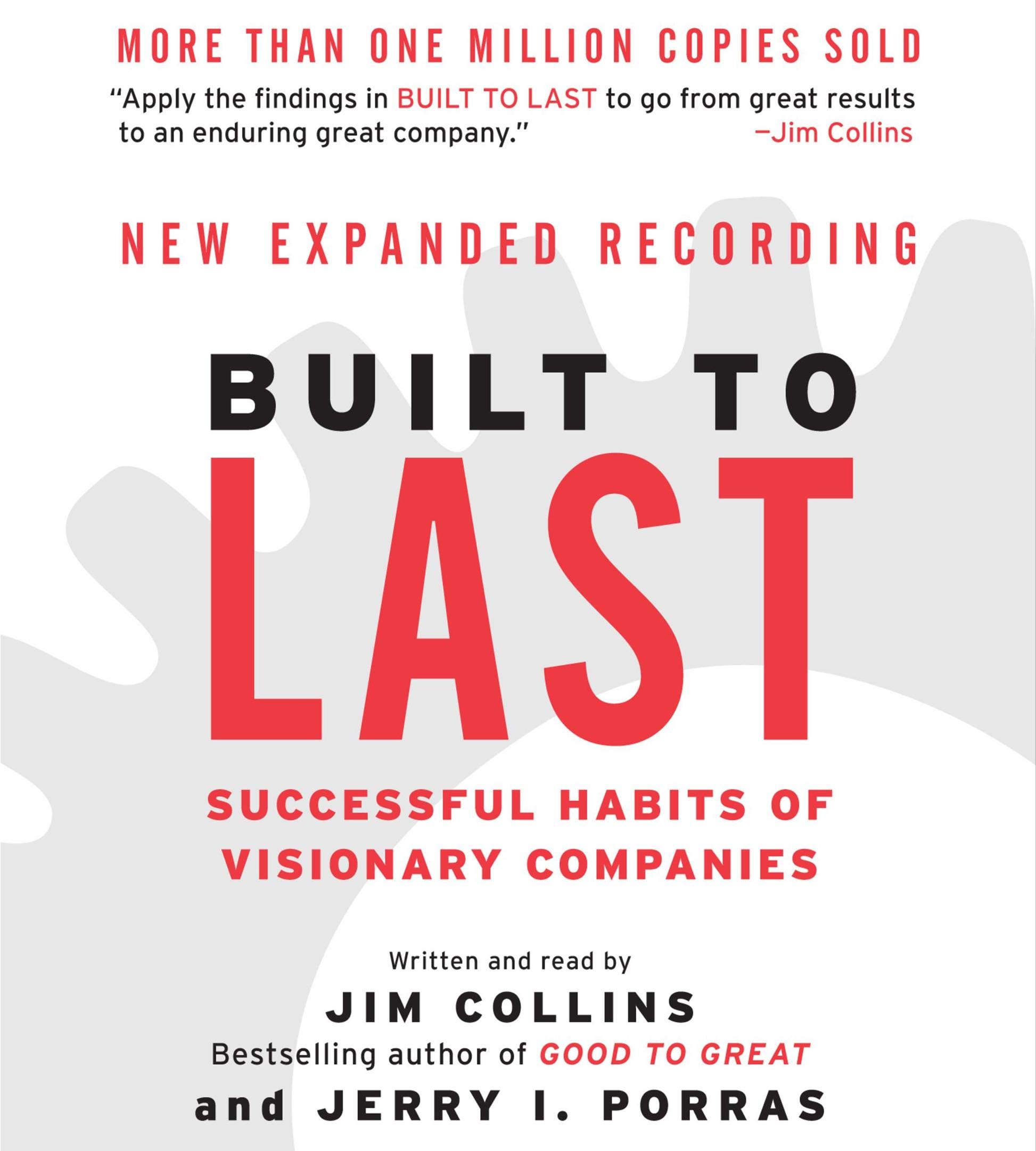
Full description not available
C**N
For Real Business
A must read. Far different then the usual business book.
A**R
Lasting insights and concepts
We sometimes wonder what makes a company great. We often look at its real and perceived competitive advantages, ideas like a strong brand, an extremely talented and visionary leader, cult followers, great idea or innovative product. We often tend to believe a company should posses these characteristics in order to be successful. I have even witnessed many people refusing to start a company before having the "aha" moment or the brilliant idea which will change the world.Mr. Collins and Mr. Porras researched many companies and identified several characteristics which identify companies which are built to last a long time. The book is written in a way of discussion on concepts and characteristics which distinguish these visionary companies from the rest of the companies. By highlighting these concepts the authors provide surprising facts and insights and breaking several myths about the reasons for a company long term success.The authors took a very interesting approach of comparing a visionary (build to last) company to a comparison company. As you read the book it seems as if the "comparison" company should be the one to last. However, after the authors provide the different approaches, characteristics and choices made by the two companies, we, the readers, are slowly coming to the realization it is the visionary companies which lasted. It is often the case the comparison companies do not even exist today.The book was first published in 1994 and a lot has changed since then. It is interesting to note that today (2012) few of the visionary companies are performing worse than their comparison company. And over the years I have heard readers being disappointed with the selection of companies and even stated, "This book is wrong, you see, these companies were not build to last".¹I believe the key to understand the book lessons, is not by focusing on the specific companies, but it is by observing the characteristics and concepts which define visionary companies as brilliantly described in this book.I highly recommend the book for leaders of companies, builders of companies and all who wish to understand how a company can be built (or changed) to last.Amir AvitzurAuthor of "Why do we sell low and buy high? The guide you must read BEFORE you invest"¹ Mr. Collins researched and wrote about the cause of companies to fail in a more recent book called "How the mighty fall".
B**N
Inspiring, but lacking analytical rigor.
This is an inspiring book, and informative. It answers the "what" question convincingly. I missed answers to the "why" questions. Why, for example, are successful visionary companies characterized by their emphasis on ethical standards? There are many possible explanations: the staff of the company are inspired by the ideals and give more to their employer; the companies reap payoffs in the long term from grateful recipients of their honorable deeds; the companies acquire a good reputation which increases sales and hence profits. More interesting, is the question of the logic of ethics in the business game - not even touched by these authors.According to Jim Collins and Jerry Porras, it does not matter what the company ideology is, as long as it is passionately believed by the management and employees. I find this a dubious claim, and not supported by the data. The ideological frameworks of the companies that were studied are not interchangeable, not for the trivial reason that the ideology of another company happens not to be the one believed by each of them. Boeing is unlikely to spend money on a program to cure river blindness in Africa. Why does Merck do this? Clearly, a pharmaceutical firm does well to invest in a reputation for medical generosity that flows from a passion for making people well? Merck is purchasing precisely the trust that pays-off in the medical market place. Trust reduces transaction costs, and in some cases is almost as good as a monopoly. Boeing, on the other hand, must buy a brand name attached to their dedication to engineering excellence. It does matter what companies are passionate about.My company operates on the Internet. Our pledge includes the words: "The tragedy of the commons is the propensity of users to take more from the commons than they give. We undertake to contribute more to the commons than we take. Our presence shall make the Internet safer, more useful and greater fun." Why is this a suitable ideology for our company? The answer is not that this is one we happen to believe in, and feel passionate about - although we do. Rather, this ideology is strategically fitting. We enhance to our brand name, and therefore the value of our software, by adding our reputation to the web applications we write.In one of our daughter businesses we are a broker of information from merchants to consumer (information about products that are available) and from consumer to merchant (we generate real time demand curves for a large range of commodities). We have pledged not to become a trader. Why? In ethical terms, we should not be a trader because our insider information would give rise to conflict of interest. The trust that we gain by not being a trader, and hence remaining a disinterested supplier of market information, enables us to broker Coasian agreements with reduced transaction costs between the parties on the Internet. The advantage is large. It is on the Internet commons that trust is scarce. We are able to purchase this by foregoing some potentially profitable trades, and that pays us more in the long term in our role as an information service provider.Our ideology was designed to give us the greatest possible strategic advantage in our markets. That is not to say we do not believe in our ideals, but that the nature of our ideology is important. It does matter what we believe. It matters what you believe, and it matters that you understand that it matters.I strongly recommend "The Modern Firm" by Roberts. Read this alongside "Built to Last". Roberts is a harder read, but he gets under the logic of corporate dynamics better than Collins and Porras. Because "Built to Last" is characterized by an ubiquitous analytical paucity, Jim Collins and Jerry Porras' interpretations of their data are not always correct. That is a pity. Their findings are exciting, inspiring even, and the book despite its limitations is a good read.
K**S
Brilliant read to building a sustainable visionary organization
Built to Last is a book of luminescent importance among books about successful companies/organizations. Based on the thorough research of Jim Collins (of Good to Great fame) and Jerry Porras, this book examines the qualities of visionary companies who had great success and staying power in their fields. They identified 18 such companies and had a comparison group of comparable companies in the same industry. The results are conclusive. Visionary companies thrive on being clock makers who build their organization to improve each year and withstand the test of time. They fervently focus on their core competencies. They consistently stay true to their core values. Yet they will change and innovate. They adopt the “genius of and” realizing they can be equally committed to seemingly contradictory purposes, yet those purposes are actually equally important. For example these companies can be committed to serving people, AND they can seek to dominate their market. They embody the yin and yang concept, complementary forces that co-exist and support one another. Visionary organizations are also committed to serving people and the greater common good, however they define it. They aren’t focused on profit as the most important purpose.This is another Collins book that is a total game changer, along with Good to Great and How the Mighty Fall. It’s a classic read of brilliant proportions. Any business or organizational leader who seeks to build something that lasts and thrives long after our own tenures passed to someone else, needs to read this book. NOW!
Trustpilot
1 month ago
1 month ago