Some deliveries may take a little longer than usual due to regional shipping conditions.

DOWNLOAD THE APP


Customer Services
Copyright © 2025 Desertcart Holdings Limited
DOWNLOAD THE APP
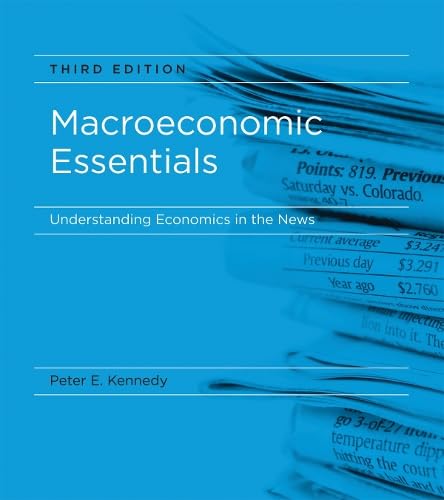
Full description not available
L**Z
A Textbook I Could Read without Falling Asleep
I had to buy this, as it was a required book for business school, but I have to say, it is one of the few text books that I decided to keep after finishing the class. Concepts are nicely and simply explained and kept me interested (and I have ADD, so this is hard to do).
D**K
different view on Macro Econ
This book was less dry than expected, making my MBA class in Macro Econ that much better. I also enjoy the "news story" questions.
S**O
Five Stars
The book is good
P**U
Knowledge every citizen should possess
I'm a computer science major, and my only relationship with economics is through the microeconomics of Bank Credit products because of my job. Essentially nothing macroeconomics related. This book accomplishes the target its title sets (Understanding Economics in the News) and more. But the most important thing is that it opens up a new world for everyone not versed in economics, a world that affects everyone's lives directly. This book should be taught in schools. The only reason I'm giving four stars out of five is that I haven't read any other Economics book to compare it to, and it doesn't feel like an "Introduction to Algorithms" or "The C programming language" so I'm holding back.
A**R
Lazy
Like many reviews here state, it is true that this is knowledge every citizen possess. However, that does not warrant an automatic 4-star rating, making the many critiques of this book irrelevant. Though it dumbs down much of academic economics, this book still assumes much of the reader's knowledge. For example, each section is ended with a sample exam question, many of which are dependent on knowledge of economic terms the section or book (I'm reading in sequential order) have never introduced. For example: Sample Exam Question 6.1: "Hoarding labor is not profit-maximizing behavior by firms - they could lay off these workers and output would not be affected. a) is it true that hoarded workers could be laid off without affectin goutput? b) is it true that this is not profit-maximizing behavior by firms?" Having read this text from front cover to this question, I have no idea what hoarding workers means. What's more, answers to these questions are not given anywhere in the book.Other key relationships, such as between interest rates and inflation, are extremely poorly explained, or are promised to be explained in later chapters and even a rudimentary explanation is spared. How can one make sense of the concepts being introduced if such fundamental ideas are not made clear? It seems to me that this book was written and edited by people who already have an understanding of economics and to whom assumptions of such knowledge is easily overlooked because of their expertise. For a book targeted towards those wanting a basic economic understanding, such oversights greatly detract from the book's purpose.Lastly, while the author remains mostly professional throughout, he often urges readers "for more on this topic, just Google it!" Again, the assumption here is that people trying to learn economics will somehow be able to distinguish good economics amid the sea of bad economic one finds themselves in after a Google search. This is just lazy on author's part, as could also be said for any of my critiques above.
A**A
Am happy with the book
Very good book
F**A
Five Stars
perfect condition and great book
K**S
Bought for Class
This was used for one of my classes, and the book came in good condition. It was perfect for class, but I wouldn't read it otherwise.
E**N
Five Stars
Excellent...all in time...
Trustpilot
1 month ago
3 days ago
1 month ago
1 month ago