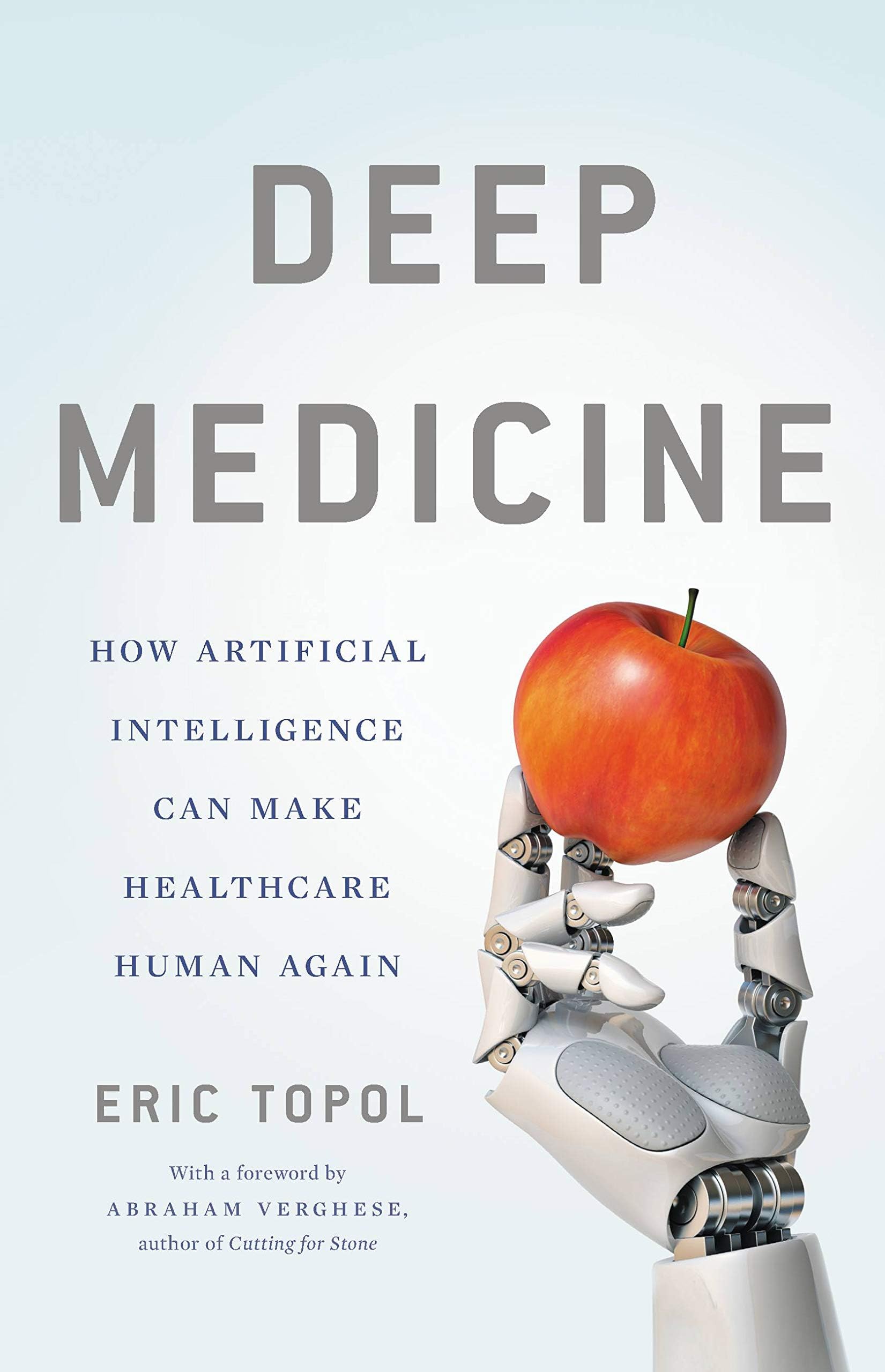
Deep Medicine: How Artificial Intelligence Can Make Healthcare Human Again
Product ID: 74806402
Buy anything from 5,000+ international stores. One checkout price. No surprise fees. Join 2M+ shoppers on Desertcart.
Desertcart purchases this item on your behalf and handles shipping, customs, and support to Ireland.
One of America's top doctors reveals how AI will empower physicians and revolutionize patient care Medicine has become inhuman, to disastrous effect. The doctor-patient relationship--the heart of medicine--is broken: doctors are too distracted and overwhelmed to truly connect with their patients, and medical errors and misdiagnoses abound. In Deep Medicine , leading physician Eric Topol reveals how artificial intelligence can help. AI has the potential to transform everything doctors do, from notetaking and medical scans to diagnosis and treatment, greatly cutting down the cost of medicine and reducing human mortality. By freeing physicians from the tasks that interfere with human connection, AI will create space for the real healing that takes place between a doctor who can listen and a patient who needs to be heard. Innovative, provocative, and hopeful, Deep Medicine shows us how the awesome power of AI can make medicine better, for all the humans involved. Illustrations note: 46 Halftones, black & white 11 Tables, black & white Review: ".a marathon without a finish line." realistic assessment; (rosy) vision; silence on costs - In a very insightful book, Topol, builds on the key themes from his previous works - In "Creative Destruction..", he had highlighted the digitizing of all information pertaining to our health and in "Patient Will See..", he had provided a roadmap for new service models that are truly patient-centric. Here, he extends those themes even further and posits that AI, correctly applied, will be transformative to healthcare delivery. That is not necessarily a novel prediction. Numerous authors have highlighted the increasing role of machine-learning/AI in healthcare (and more than a few tech companies have hyped it). Topol acknowledges all that enthusiasm, and using a short set of examples hihglight the value of AI in the first chapter itself. The rest of the book is a systematic expansion of where Topol sees the biggest opportunities in AI are - to the extent he calls it the next industrial revolution. Topol does an excellent job in differentiating clinicians as those that work with and without patterns - these two chapters highlighting the complexities and skill set required to master a cognitive, integrative process is perhaps the most interesting part of the book. These highlight the key assumptions AI developers should (and shouldn't) make while designing their systems. The discussions on how health systems are approaching AI and ML is interesting, but a reader familiar with the academic literature may brush it off as old news; however, Topol manages to convey the key insights and implications that can be extrapolated to other applications. He also provides an interesting take on the role of AI in nutrition and mental health and then becomes very generous with imagination in his discussion on virtual medical assistant. Imaginative, informative, and inspiring - but Topol, almost always ignores the question of "who will pay for it" that has dogged the field of mHealth etc for a while. A reader would have benefited from his expanded views on this issue as well. Overall, an excellent read for anyone remotely interested in healthcare or technology and a wonderful thought-starter for any start-up. Review: The future is coming faster than we think - Eric Tool has created another great book. Building on the foundation of the Creative Destruction of Medicine, a book he wrote in 2012 related to the digital revolution in medicine, Deep Medicine shares the rapid progress that has been made, particularly in the last few years in AI technology throughout medicine and science. It is a book rich with insite and information. Having read Deep Medicine twice (rereading Creative Destruction in between) it becomes clear that AI is rapidly becoming a compelling force in the healthcare world more than likely faster than the slow moving medical and biomedical research communities can deal with the change. Because it so successfully brings together the patterns of change that AI is driving, Deep Medicine will be incredibly important in helping us to understand the impact of AI and therefore allow a shaping of the future where we can gain maximum benefit as this technology rapidly evolves. Every page contains gems of information and clues to creating a better future. I know of no deeper thinker on how technology is shaping the future of healthcare and biomedical research (which is the future of healthcare and biomedical research) than Eric, a great physician, scientist, technologist and communicator. If you have anything to do with shaping the healthcare and research world Deep Medicine will change you perspective in a very positive manner.


| Best Sellers Rank | #38,477 in Books ( See Top 100 in Books ) #4 in Biotechnology (Books) #12 in Medical Informatics (Books) #102 in Artificial Intelligence & Semantics |
| Customer Reviews | 4.6 out of 5 stars 910 Reviews |
J**R
".a marathon without a finish line." realistic assessment; (rosy) vision; silence on costs
In a very insightful book, Topol, builds on the key themes from his previous works - In "Creative Destruction..", he had highlighted the digitizing of all information pertaining to our health and in "Patient Will See..", he had provided a roadmap for new service models that are truly patient-centric. Here, he extends those themes even further and posits that AI, correctly applied, will be transformative to healthcare delivery. That is not necessarily a novel prediction. Numerous authors have highlighted the increasing role of machine-learning/AI in healthcare (and more than a few tech companies have hyped it). Topol acknowledges all that enthusiasm, and using a short set of examples hihglight the value of AI in the first chapter itself. The rest of the book is a systematic expansion of where Topol sees the biggest opportunities in AI are - to the extent he calls it the next industrial revolution. Topol does an excellent job in differentiating clinicians as those that work with and without patterns - these two chapters highlighting the complexities and skill set required to master a cognitive, integrative process is perhaps the most interesting part of the book. These highlight the key assumptions AI developers should (and shouldn't) make while designing their systems. The discussions on how health systems are approaching AI and ML is interesting, but a reader familiar with the academic literature may brush it off as old news; however, Topol manages to convey the key insights and implications that can be extrapolated to other applications. He also provides an interesting take on the role of AI in nutrition and mental health and then becomes very generous with imagination in his discussion on virtual medical assistant. Imaginative, informative, and inspiring - but Topol, almost always ignores the question of "who will pay for it" that has dogged the field of mHealth etc for a while. A reader would have benefited from his expanded views on this issue as well. Overall, an excellent read for anyone remotely interested in healthcare or technology and a wonderful thought-starter for any start-up.
J**A
The future is coming faster than we think
Eric Tool has created another great book. Building on the foundation of the Creative Destruction of Medicine, a book he wrote in 2012 related to the digital revolution in medicine, Deep Medicine shares the rapid progress that has been made, particularly in the last few years in AI technology throughout medicine and science. It is a book rich with insite and information. Having read Deep Medicine twice (rereading Creative Destruction in between) it becomes clear that AI is rapidly becoming a compelling force in the healthcare world more than likely faster than the slow moving medical and biomedical research communities can deal with the change. Because it so successfully brings together the patterns of change that AI is driving, Deep Medicine will be incredibly important in helping us to understand the impact of AI and therefore allow a shaping of the future where we can gain maximum benefit as this technology rapidly evolves. Every page contains gems of information and clues to creating a better future. I know of no deeper thinker on how technology is shaping the future of healthcare and biomedical research (which is the future of healthcare and biomedical research) than Eric, a great physician, scientist, technologist and communicator. If you have anything to do with shaping the healthcare and research world Deep Medicine will change you perspective in a very positive manner.
D**R
A fascinating glimpse into the future of medicine, but sometimes is a bit too far-reaching ...
The first time I encountered anything by Eric Topol was when I read his last book [[ASIN:9780465040025 The Patient will See You Now]]. I’ve always had an interest in the history of medicine, particularly that of the nineteenth century. It was during that particular time that, despite the quackery of some men and women of medicine, great advances were made. We’re yet again at a juncture in time where we are once again moving forward at a rapid rate. This is a time where the past and the future are melding, where we are finding best practices in a highly technological age. I should say attempting to find the best practices as some people are finding it difficult to move into this new world, miring themselves in the past. Topol is what I’d dub a futuristic author, one who envisions a future in medicine, a visionary not unlike some of his nineteenth century predecessors. If you heard Dr. Topol on NPR, you probably got a glimpse as to what he is attempting to do in this book. He wants to introduce us to the future of medicine, the way AI (artificial intelligence) and technology can help us move into that future. If you listened long enough, you may have heard a frustrated physician express his views. Topol also, once again, recounts the tale of the medical mystery of “Robert,” and how his misdiagnosis “represents everything wrong with medicine today.” Medicine, as it has been practiced and is being practiced, failed not only Robert, but Topol himself. Add the rest of us as far as he’s concerned. He feels this book, as far as futuristic medicine goes, is the “most far-reaching one.” Topol begins by explaining the three-fold components of the deep medicine model. He quickly shifts into what he calls “shallow medicine,” the medicine he assumes most physicians now practice. According to Topol, in part, this results in “extraordinary waste, suboptimal outcomes, and unnecessary harm.” I feel he is not giving his peers credit for what I see as an incredible shift toward the use of AI and high-tech practices in medicine. For example, the physicians and specialists I see are in the trenches, already utilizing deep medicine. Had they not been, I would have long been in the bone yard pushing up daisies. However, I do love Topol’s remarkable compilation of studies, discussions on the positive impact AI tools can have in today’s medicine, the importance of patient advocacy, etc. For those who love to read about science and medicine (I do), this is a fabulous resource. My only quibble with Dr. Topol are a few sweeping opinion-based views. For example, when he talks about shallow medical practice that leads to “plenty of misdiagnoses and unnecessary procedures,” he takes a stab at the new blood pressure guidelines outlined by the American Heart Association and American College of Cardiology in 2017. Topol goes on to say that this is “leading to the diagnosis of more than 30 million more Americans with hypertension despite the lact of any solid evidence to back up this guideline.” This, according to Topol, “was misdiagnosis at an epidemic scale.” This statement is rather irresponsible at best considering the guidelines were changed in 2017 for good reason. The study, which Topol doesn’t mention, was the Systolic Blood Pressure Intervention Trial (SPRINT). Check it out if you will. This book is quite readable, fun actually, but make sure you consult with your doctor before tossing out your meds. I for one am seeing physicians practicing deep medicine and am not finding those doctors Topol claims can be overconfident, condescending, arrogant, or simply not caring. I would suggest a bit of due diligence and a bit of extra research as well as a trip to your physician before making any lifestyle changes one may read about in this book. The book has an excellent index, source notes, and numerous charts and graphs for reference.
A**E
AI and Healthcare - More Than Just Technology
Deep Medicine is a great read for anyone interested in healthcare and how technology can improve the lives of patients, healthcare providers, and our communities. Artificial intelligence has the potential to fundamentally change how we teach and practice medicine, but as so aptly presented by Dr Topol, we should proceed with caution and not let the hype get ahead of clinically-sound research and the appropriate application of this technology. This review is well-written and expertly documented, making it a great introduction for readers new to artificial intelligence, deep learning, digital technology, and genomics. It also serves as a great reference for those familiar with the various topics who want a clearer picture of the larger technology and ethical landscape. The book is timely in its discussion of the “gift of time” that technology, if appropriately and thoughtfully used, can return to the healthcare provider and the patient. This additional time for their visit can result in a more meaningful and deeper relationship between provider and patient as well as an opportunity to enhance the healing aspect of the practice of medicine and significantly decrease physician and other healthcare provider burnout. Deep Medicine is a book well worth the reader’s time and reflection.
O**H
An optimistic future for healthcare
Dr. Topol knows his stuff. Which can be challenging to chew through and digest at times, unless you're a nerd who loves to spin that beany propeller. But it's definitely worth the effort. The book gives a good overview of how medicine is currently changing and will continue to change because of technological advances, including the pros and cons for the application of artificial intelligence, even touching upon the dangers of privacy violation and hacking of personal data, the third-rail topic many Quantified Self technologists are reluctant to acknowledge and discuss. But the tech genie is now out of the bottle and there's no going back. Machine learning and big data will continue to alter the medical landscape, for better or for worse. But given the advances I've witnessed personally, such as in the treatment of insulin-dependent diabetes, I remain optimistically hopeful. The Artificial Pancreas System (APS) is one such example, where a continuous glucose monitor collects blood sugar data that instructs a small wearable pump to deliver precise amounts of insulin with little human interaction, 24/7. Young children diagnosed with Type I diabetes will be able to live healthy lives with average life expectancies, unlike previous diabetics before the creation of APS. If you enjoy programs such as NOVA and Scientific American and care about the future of your healthcare, this book's for you.
D**R
Crystal Ball for the Next Era of Healthcare
Dr. Topol’s new book, Deep Medicine – How Artificial Intelligence Can Make Healthcare Human Again, is an encyclopedia of the emerging Fourth Industrial Age; a crystal ball in what is about happen in the next era of healthcare. I’m impressed by the detailed references and touching personal and family stories. Centers for Medicare & Medicaid Services (CMS) policy modifications in the past 10 months reveal sweeping changes that fortify Dr. Topol’s vision: May 2018 medical students can document for attending physicians in the health record (MLN MM10412), 2019 ancillary staff members and patients can document the History/medical interview into the health record, 2021 medical providers can document based only on Medical Decision Making or Time (Federal Register Nov, 23, 2018). Part of making healthcare human is also making it fun. The joy of practicing medicine is about to return to the healthcare delivery as computers will be used to empower humanistic traits, not overburden medical professionals with clerical tasks. For patients, you will be heard, understood and personally treated. Deep Medicine is not a vision of what will happen in 50 years as much will start to reveal within the next 5! Bravo Dr. Topol! Michael Warner, DO, CPC, CPCO, CPMA, AAPC Fellow
A**M
A very long list of medical start-ups
The main theses of this book are: physicians may use algorithms based on deep learning for diagnosis (and some other tasks), but they should be careful, since sometimes these algorithms err, and they should have more free time to treat their patients in an empathic way. I’m not familiar with anyone who disagrees with these rather obvious theses. The book belongs to the trend of futurologists forecasting the influence of Artificial Intelligence. It surveys the history and the algorithm of AI (there are some minor errors in this survey) as well as a very long list of medical start-ups. Strangely the author ignores the following problem: the deep learning algorithm does not explain its predictions (the model is a black box), and therefore relying on deep learning does not lead to physiological understandable theories. Other machine learning algorithms, such as decision trees and association rules, do present explanations.
D**S
Hands down the best book on the topic
I've been in various forms of AI since 1984-- yes, it goes back that far-- including the space, defense, and intelligence world in the 1990s when AI was overhyped. I've been in healthcare analytics, AI, and decision support for 22 years now. I know the topic and theme of this book as well as anyone...and all I can say is, there's no way I could write a book that is this thorough, understandable, realistic, accurate, and aspirational. Eric covers all the many aspects of AI in medicine, from hype to reality, from culture to technology, from ethics to economics. If you're in the healthcare industry in any role-- clinical, technology, or otherwise-- you need to read this. Use it to drive your AI strategy. I hope that patients will read it, too, because the impact on them/us will be significant, and the impact could be bad if it's misdirected. This is an impressive book with very current guidance on a fast moving topic.
A**R
Realistic, empathetic and compelling
Deep Medicine is a fascinating and superbly well informed view of how we can and should harness new technologies to improve healthcare. Dr Topol is an absolute authority on the medical applications of technology and offers a balanced, cautiously optimistic but still realistic overview of the future. Highly recommended reading for those in the medical world and patients alike - Iet's hope we can follow Dr Topol's advice to harness technology to help Doctors be more human.
C**N
Gran libro, packaging prácticamente perfecto
Algo salió mal durante el packaging Afortunadamente sin mayor incidencia, al menos por el momento
O**E
コンテンポラリー
時代の動きを的確に捉えている快作です。医療の行政に携わる方々にも読んでいただきたいと思います。
M**A
Recomendo para quem se interessa no futuro da IA aplicada na saúde. Abrangente e informativo.
Aborda todos as questões importantes da IA, com foco na saúde.
B**R
hochaktuell
ein echter page turner - ein mitreißendes Buch, spannend geschrieben und hochaktuell, ein Muss für alle, die sich für KI in der Medizin interessieren
Trustpilot
1 month ago
1 month ago