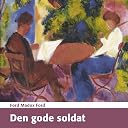
Den gode soldat [The Good Soldier]
Product ID: 61372210
Igennem ni år har det amerikanske ægtepar John og Florence tilbragt deres somre på et mondænt kursted i den tyske by Nauheim. Det samme er tilfældet for det engelske par Edward og Leonora. Et venskab er spiret frem mellem ægteparrene i en verden styret af etikette og pli. Ren idyl, tilsyneladende, men krusninger begynder snart at vise sig på den ellers så verdslige overflade. Utroskab, løgn og forment lidenskab truer med at blotlægge en forfaldshistorie af dimensioner, der løber på tværs af de to ægtepar, og som er præget af alt andet end takt og tone.Den gode soldat er Ford Madox Fords psykologiske melodrama fra 1915, en subtil og satirisk afdækning af sindets skjulte mekanikker og kødets længsler. Den har opnået klassikerstatus og figurerer på flere anerkendte lister over verdens bedste bøger. Please note: This audiobook is in Danish. Review: Ford Madox Ford: so good they named him twice - Julian Barnes relates that when a guest at one of his dinner parties dared to criticise The Good Soldier he ejected him from the premises ('I four lettered him out of the house'.) Ford Madox Ford's greatest novel, subtitled 'a tale of passion', itself has passionate advocates. And while I'm not sure I would go to such extremes as Barnes in the book's defence, it is an extraordinarily interesting work. Published in 1915, The Good Soldier tells the tale of two married couples in their thirties who meet by chance at a spa town in Germany. To outward appearance the couples are eminently respectable but it soon becomes clear that there is more than meets the eye. Each marriage conceals a complex web of infidelities, lies and rival loyalities. There are some similarities with the world of E.M. Forster. Both writers deal with middle class England in the Edwardian era, and both are concerned with the desperate struggle to maintain respectability. They share a sense of the absurdity and comedy that often results from this constant effort, and well as its withering effects and the limits it places on human potential. But Ford is much sharper, more acidic, than Forster and perhaps more interesting. There is no sense with Ford that a more rational and enlightened social code would on its own result in harmonious relations between men and women. The reasons for the unhappiness and failure of so many marriages lie deeper. Technically, the book is a tour de force, with an apparently artless and bumbling narrator delivering a complex plot through a patchwork of episodes. He is sometimes said by commentators to be 'unreliable' although paradoxically his frequent professions of uncertainty and doubt add to his credibility. One sometimes feels that he may be deluded but rarely that he is deliberately misleading the reader. The book is read splendidly in the Naxos audio version by the American Kerry Shale. Detecting irony is not a skill thought to be widely dispersed among the population of the United States, but Shale is fully alive to the novel's tonal shifts. Review: Enchanting - Ford Madox Ford originally intended to call this beautiful but tragic novella "The Saddest Story", based upon the opening sentence, "This is the saddest story I have ever heard"> His publisher objected, suggesting that such a title would have a disastrous impact upon sales. Ford was not convinced, responding angrily that the publisher should do whatever he thought fit, adding that one might as well just call it "The Good Soldier". "The Saddest Story" might have spelt disaster on the booksellers' shelves but it would certainly have satisfied those who lean towards the "It does what it says on the tin" approach to titles. It is an immensely sad story - the tale of two self-destructive couple touring Europe in the early years of the twentieth century. However, it is also a beautifully written story, to such an extent that one suffers all the pain of the narrator as he recounts his tragic story. Ford was a master of literary criticism and brought all his stylistic knowledge to bear here giving a series of different literary devices (flashback, impressionism, florid conjecture). It is a short book but infinitely rewarding .. yet also heartbreaking.
M**C
Ford Madox Ford: so good they named him twice
Julian Barnes relates that when a guest at one of his dinner parties dared to criticise The Good Soldier he ejected him from the premises ('I four lettered him out of the house'.) Ford Madox Ford's greatest novel, subtitled 'a tale of passion', itself has passionate advocates. And while I'm not sure I would go to such extremes as Barnes in the book's defence, it is an extraordinarily interesting work. Published in 1915, The Good Soldier tells the tale of two married couples in their thirties who meet by chance at a spa town in Germany. To outward appearance the couples are eminently respectable but it soon becomes clear that there is more than meets the eye. Each marriage conceals a complex web of infidelities, lies and rival loyalities. There are some similarities with the world of E.M. Forster. Both writers deal with middle class England in the Edwardian era, and both are concerned with the desperate struggle to maintain respectability. They share a sense of the absurdity and comedy that often results from this constant effort, and well as its withering effects and the limits it places on human potential. But Ford is much sharper, more acidic, than Forster and perhaps more interesting. There is no sense with Ford that a more rational and enlightened social code would on its own result in harmonious relations between men and women. The reasons for the unhappiness and failure of so many marriages lie deeper. Technically, the book is a tour de force, with an apparently artless and bumbling narrator delivering a complex plot through a patchwork of episodes. He is sometimes said by commentators to be 'unreliable' although paradoxically his frequent professions of uncertainty and doubt add to his credibility. One sometimes feels that he may be deluded but rarely that he is deliberately misleading the reader. The book is read splendidly in the Naxos audio version by the American Kerry Shale. Detecting irony is not a skill thought to be widely dispersed among the population of the United States, but Shale is fully alive to the novel's tonal shifts.
J**N
Enchanting
Ford Madox Ford originally intended to call this beautiful but tragic novella "The Saddest Story", based upon the opening sentence, "This is the saddest story I have ever heard"> His publisher objected, suggesting that such a title would have a disastrous impact upon sales. Ford was not convinced, responding angrily that the publisher should do whatever he thought fit, adding that one might as well just call it "The Good Soldier". "The Saddest Story" might have spelt disaster on the booksellers' shelves but it would certainly have satisfied those who lean towards the "It does what it says on the tin" approach to titles. It is an immensely sad story - the tale of two self-destructive couple touring Europe in the early years of the twentieth century. However, it is also a beautifully written story, to such an extent that one suffers all the pain of the narrator as he recounts his tragic story. Ford was a master of literary criticism and brought all his stylistic knowledge to bear here giving a series of different literary devices (flashback, impressionism, florid conjecture). It is a short book but infinitely rewarding .. yet also heartbreaking.
P**L
The Good Soldier: A Tale of Passion
The book was recently recommended on a radio review of Ford Madox Ford. It's a strange read; reminds one of the Edith Wharton, Henry James style of literature. Of course it is well written, a classic indeed, but ultimately a sense of dissatisfaction creeps in, as the teller of the tale, Dorrell, a man who seems to lack all passion and worth, seems the least harmed of all the personae of the story. What was his sexuality? Did he have any? He appears to favour friendship, even marriage, as an acquisition rather than a bond of love. The book takes us back to the days when feelings were suppressed rather than expressed, and the resulting antipathy explodes in bursts of spite and hatred. Good that there are still publications of this story even though the paperback font was not pleasant.
P**B
Intense and satisfying
This book is said to be one of the best books of the 20C and much as been writen about it by people much cleverer then me. However this story about two rich married couples at the turn or the 20C is probably unique in the unusual interaction between all four of them. Like characters in a Henry James novel they have nothing to do; instead they travel around Europe from spa to spa to improve their health problems, which are almost certainly imaginary. They have love affairs both within and outside the central four, one man's wiife faked a weak heart for ten years in ordert to avoid the marital bed, in fact she locks her room every night . At the same time she is conducting a love affair with the man from the other couple, the "Good Soldier" of the title. It appeals to us in an unhealthy way and unsuprisingly it all ends very badly. The book's narattor is the the decieved husband of the "invalid, and he as been called an unreliable witness,leaning us to make our own decisions as what we belive, On first reading the book I thought the author was careless in some details as related by the narrator but now I know these were done on purpose in an act or genius to indicte his unreliability. I can not recommend this book enough, seldom have I had such enjoyment in reading.
P**N
The illusion of reality
A reader of 'The Good Soldier' may well feel mystified. Writers of whodunnits mystify their readers on purpose; perhaps this writer hopes to lend interest to his story in a similar way. Or perhaps the narrator is proceeding rather like Proust’s Elstir, who (after Turner) painted things not as he knew they were but as he had first perceived them—perhaps the narrator is presenting this affair not as he may understand it now but as he lived it. ‘Life is a long discovery, isn’t it?/You only get your wisdom bit by bit.’ ‘Yes—oh dear yes—the novel tells a story.’ Whether or not implying an apology for novels in general and a justification of his own in particular, do E.M. Forster’s words indicate a criterion of a novel’s value? He himself valued one of the greatest modern novels, 'The Leopard', not for the story but for ‘making him realise how many ways there are of being alive’. (For references and notes see the version of this review on my website.) If the modernists Ford Madox Ford is numbered with did seem modern once, it was partly because they were less interested in story-telling than in their hidden selves, in certain states of consciousness, or in conveying the quality of existence. So far as Proust does tell a tale it is anything but straightforward. And Ford’s narrative here does seem such a vehicle as the intimate psychology of the modern novel requires; only you hardly get such psychological finds with him as with Proust. He has no doubt an interest in character—for Virginia Woolf, the novelist’s distinctive quality—as well as in situation; and a persevering reader will hear his characters speak and see them act; but always through the thick glass of the narrative, so that they live only faintly, and their story isn’t as sad as it was meant to be. We hear often how sad it is, but if we are to feel this, it must be in spite of the complications Ford was so pleased with. Since we needn’t follow Woolf in thinking of those modernists as including her friend Forster, we may in fact think the author of 'The Good Soldier' closer to Forster than to them—not because Ford’s narrative is conventional (it isn’t), nor because adultery is typically a nineteenth-century subject (though it is), but because evidently to Ford also the story is the thing. Of all the people in the book, the narrator (John Dowell) is the least alive and speaks most, and what exercises him most after the situation—and situation here is story—is how to relate it. The way he does relate it is indeed ‘very rambling’, it is indeed ‘a sort of maze’, and this on the part of a perfectly self-conscious narrator (those descriptions are his) is unnatural—unless he happens to be a theorist of the novel himself. But as to that, when he says: ‘I am, at any rate, trying to get you to see what sort of life it was I led with Florence and what Florence was like’, doesn’t he sound just like his creator, who in an essay probably contemporary with the novel called himself ‘a perfectly self-conscious writer’? Of course for a novelist actually to address the reader is, like an anachronism, fatal to realism—whether or not to the thing a literary critic distinguishes from naturalism or impressionism or modernism, at least to the fiction that what you are reading about is real. Ford himself was to suggest that Thackeray’s ‘incursion of himself’ into his account of Becky Sharp’s ‘manœuvres’ on Waterloo day was ‘the greatest literary crime ever committed’. And this form of authorial intrusion was opposed not only to realism: to give an illusion of reality was the aim of Ford’s ‘impressionism’ too—indeed when Wyndham Lewis queried the need for that illusion, Ford answered, ‘Why then write?’. Obviously, though, a story told in the first person, as this one is, can’t be intruded into in this way; Huckleberry Finn or Holden Caulfield can address us with no such breach of realism, at once and repeatedly. But what if the narrator is also an author? Such a one is Proust’s Marcel, or at any rate he is an author-to-be; his is the story of a literary vocation, his ‘material’ is his own past life. No doubt he both is and is not the author, still he lives as a character only in so far as he is not like Proust; in this it’s the same with him as with Yuri Zhivago, who, as a poet, is Boris Pasternak—the fact that the Proustian narrative is a first-person narrative doesn’t alter the case. And the narrator of 'The Good Soldier'? His proving unreliable doesn’t matter (and some of the mistakes in the narrative may be the author’s), realism is served by it; it does matter that the fiction of his being John Dowell should be kept up. Dowell is addressing a ‘silent listener’, to whom he tells not only the story but also his difficulties in telling it, until it’s a question whether, if the situation is the story, story-telling isn’t the real subject. Then he remarks that for six months he has been ‘writing away at it’, though he subsequently addresses his silent listener once more. And when he actually refers to his ‘last chapter’ we see that narrator and listener here are no different from author and reader. But even before that, how could the illusion of reality survive his justifying his rigmarole on the grounds that this is ‘a real story’ and this is the way real stories are told? A real narrator would never say that—though Ford indeed in his Dedicatory Letter tells us ‘the story is a true story’, just as in that contemporary essay he tells us the writer must address himself to ‘a silent listener’. The narrator in his preoccupation with both the story and his way of telling it is not Dowell but Ford, the literary technician who after the Letter saying the story is true shows what he can do with it. Certainly, where the common reader may see a botch, a crime writer like Julian Barnes finds a lesson in technique. To Ford’s editor, Ford seems to be doing something different here from psychological realism, something that anticipates post-modernism. Evidently it is also different from Ford’s own impressionism. The narrator’s self-consciousness as a narrator, his preoccupation with his story as a story, may be considered metafictional. And it is because Ford brought such things into his writing that he has influenced some later writing. But in letting himself in with them, he departed from the doctrine he had preached for most of his working life. Wasn’t the impressionist author supposed to be sedulous in keeping himself out of his book? Naturally so, if impressionism was concerned to produce an illusion of reality. As to which, many readers will feel that fiction should indeed do this, and that they have seen through the illusion here, in so far as they see the author in the narrator.
A**M
A difficult read, but well worththe effort
This is book that requires more than one readings. As this was my first I am not sure I can do it justice. Suffice it to say that I found the time dislocations slightly confusing, I had to constantly remond myself who-was-who and what-X- knew or did not know at the time of a particular action. I had the feeling that I was reading a 'worthy' book rather than a book to lose oneself in, the characters being slightly alien and not conforming to realist fiction norms. I'm glad I've read it and might re-read it at some point in the future.
B**E
Not a book for me.........
This was the most boring book I ever had the misfortune to encounter. It is quite a short book and I thought it would never end. Idle people with too much money and too much time on their hands. I honestly felt like saying 'get a life' or go and do some good in the world. One character in the book seemed to fall in love every other week. I actually lost count of all the lovers. On a plus note: I studied this book at university as it was a course on 'Unreliable Narrators' if you need a book for this subject then Mr. Ford is your man, just don't expect a riveting read.
A**S
An absolute masterpiece - don't miss it
'The Good Soldier' is an absolute masterpiece, one of the finest books ever written. There's a profound understanding of human nature conveyed through the first person unreliable narrative of someone whose view of the world is remarkably narrow and lacking in insight, That's a remarkable achievement in itself. The novel really is immensely forward looking for its time. Published precisely 100 years ago in 1915, in many ways it could pass as a later 20th century novel. Only recently has the unreliable narrator become a standard point of view for novelists. The plot also moves backwards and forwards in time (mostly between 1904 and 1913) without ever being confusing, but creating an accurate portrayal of how we all experience the world in a non-linear way. The key characters are remarkably well created in some depth, and we also get a gradual awareness of the part the narrator in his ignorance has actually played in the unfolding tragedy too. For anyone seriously interested in the development of the novel as a way of understanding human existence this is a must read. For anyone who likes a good, gripping story with energy and a sense of movement making you want to read on, this is also hugely worth reading. The language is very accessible and the book very well structured.Don't miss this masterpiece written by an under-rated novelist.
J**M
Totally avoid this version
This version is translated from some foreign language back into english by a very clumsy translator; Some sentences make no sense at all
M**C
A really sad but wonderful story
I must admit I am Italian so my english is not all perfect, but I found this book amazing! I was curious about the works of Ford Madox Ford so I downloaded this for my brand new Kindle. Tecnically, the table of contents is not there and sometimes the chapter inside each part are not well marked: so pay attention to the Roman numbers at the beginning of a sentence. They are the beginning of the chapter! The narrator (and partly witness to the fact) talks as if he had experienced it all before, and now, afterwards, remembers everything not in a cronological way. That is difficult for example for me, because it's not my primary language, but it's quite engaging! I really recommend it to anyone who enjoys a sad but intriguing story.
A**R
Não gostei.
Livro cansativo.
A**R
Boring Soldier
An interesting novel from the aspect of the writing technique involved, but boring in the detailing of the odd relationships of the main characters. I was expecting more from the legendary Ford Madox Ford.
D**E
Fast delivery
Good read
Trustpilot
1 month ago
2 weeks ago