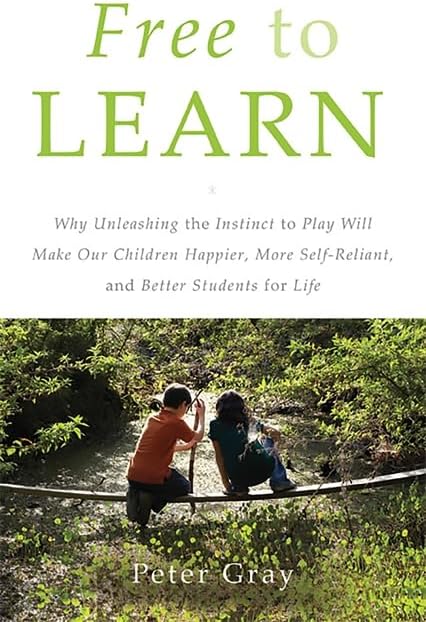
Free to Learn: Why Unleashing the Instinct to Play Will Make Our Children Happier, More Self-Reliant, and Better Students for Life
Product ID: 4536567
Buy anything from 5,000+ international stores. One checkout price. No surprise fees. Join 2M+ shoppers on Desertcart.
Desertcart purchases this item on your behalf and handles shipping, customs, and support to Ireland.
Title: Free to Learn( Why Unleashing the Instinct to Play Will Make Our Children Happier More Self-Reliant and Better Students for Life) Binding: Hardcover Author: GrayPeter Publisher: BasicBooks(AZ) Review: Impeccable research, critical conclusions - Peter Gray's book Free to Learn is an excellent addition to the genre of books on restoring freedom in education. Gray clearly states: "Children are biologically predisposed to take charge of their own education. When they are provided with the freedom and means to pursue their own interests, in safe settings, they bloom and develop along diverse and unpredictable paths, and they acquire the skills and confidence required to meet life's challenges. In such an environment, children ask for any help they may need from adults. There is no need for forced lessons, lectures, assignments, tests, grades, segregation by age into classrooms, or any of the other trappings of our standard, compulsory system of schooling. All of these, in fact, interfere with the children's natural way of learning." So why did we create schools that so directly "interfere with the children's natural way of learning"? Gray shows that in tribal cultures the focus of childhood was playing and learning knowledge, skills, and how to live self-sufficiently and honorably. When the agrarian revolution increased the need for child labor on farms, the values of school turned to toil, competition and status. While Gray's view of this is perhaps a bit idyllic, the reality is that modern schools are less concerned with student knowledge, skills, honor or abilities than with the universal goal of job training. Certainly job training has an important place in advanced society, but Gray is focused on the education of children, and in fact the toll on children in our modern job-obsessed schools is very high. They are way more stressed than earlier generations of children and youth. Why are we raising a generation of children and youth who are stressed, not secure? Gray's answer, based on a great deal of research which he outlines in the book, is that we have turned learning into a chore, a task, a labor, rather than the natural result of curiosity, interest, passion to learn, and self-driven seeking of knowledge and skills. In short, we've taken too much play out of childhood and too much freedom out of learning. The results are a major decline of American education in the last four decades. The solution is to put freedom back into education. Interestingly, Gray suggests that in many of the educational studies of classrooms, schools, homes and teachers that have found a way to successfully overcome these problems and achieve much better educational results, one of the key ingredients is "free age-mixing." Where students are allowed to freely mix with other students of various ages, without grade levels, the capacity of individuals to effectively self-educate is much higher. As for the impact on college and career success, students from free educational models excel. This is a good book, and a must read for those who really care about education. I don't agree with everything the author teaches, but I learned something important on almost every page. Whether or not you read Free to Learn, all of us who have children or work in education need to do more to promote the importance of increased freedom in education. Gray is a particular fan of "unschooling," a type of homeschooling and private schooling where parents and teachers set an example of great education, create an environment of excellent learning, and let the kids become self-learners. While this may not be the ideal learning style for every student, it is the best model for a lot of them--and for nearly every young person under age 12. If you disagree with this conclusion, you simply must read the book. The research is impeccable. If you do agree, the book can help you get to work setting a better example for any students in your life. Review: this is about much more than play. It explain depression in adults, self control and empathy - If you are a parent, about to become a parent, or even a parent of a teenager, this book is a must read. I have reading and researching a lot about play, and I have been working with children of all ages for more than 10 years, and now that I have my own kids I have become increasingly preoccupied with what exactly contributes to a child's independence, sense of self and sense of control over his own destiny. It finally makes sense now why my 6 year old cries, every day, on the way from his 5k public school, and tells me, in frustration "mom, but I didn't get to PLAY today". After reading this book I now understand why:... "my child goes to school to socialize with other children" is the biggest lie we parents have been told. In school, children are strictly supervised, and their actions are dictated at every second of every day. They are not free, nor will they be until we accept their innate desire to be in the company of peers and be able to take control over their actions, their games, their own destiny. I struggled, for a long time, to understand that giving children freedom to play is NOT THE SAME as raising undisciplined, misbehaving children. Actually, quite the opposite, and this book explains why. I can be a good parent, set limits to my children, enforce consequences for disobedience, BUT at the same time offer my children the freedom to play outside, get their hands dirty, invent games, let them carry out those game, let them negotiate changes in the rules of the games etc. That said, please don't imagine that this book is simply advice on "..oh, you know, letting kids play is good for them because I say so...."; no, the author did the most comprehensive research review analysis I have ever read. He explains, from anthropological, evolutionary, and psychological points of view, why giving children the reins over their games sets them up to be kinder adults, with a deeper understanding of what other are feeling, and with a deep sense of owning their destiny, all of which contribute to a reduction in depression as adults. If you want to understand why more adults are anxious, selfish, unable to relate to others, willing to step on others to reach the top without any considerations for peers, read this book. If you want a glimpse into why the current public education system is inefficient at TEACHING, read this book. If you are thinking, the way I was before reading this book, that public school is the best way for children to interact with other children, think critically and learn to be creative, read this book- you will find out that that's not the case.... I also now finally understand why, in a few short weeks since kindergarten started, my son has become increasingly selfish, refusing to clean up anything other than his own toys, whereas before, he would gladly help his little sister with her "part of the mess". Now, after consistently being told in the classroom to keep his hands to himself, worry "about yourself", "do YOUR work" (the reason I know this is because I worked in a classroom), he is self centered to a degree I have not seen in him before. This selfishness will eventually be the reason why we are pulling him out of system...Anyway, another story for another time. Now I accept my past decision (for which family and friends have criticized plenty), of allowing my kids and their playmates to roam our yard, get the toys they want, mix water with dirt IF THEY CHOOSE TO, gather sticks to build a "fort" and all the other fun stuff they like to do (of course all this stopped with kindergarten) without intervening. I had plenty friends looking at me sideways ; You don't go outside with them to watch what they're doing??? OH the audacity! This may have been the longest review I have ever written, so I will try to conclude by saying that if you want to find out how children learn, you have to read this book. Hint: it has nothing to do with sitting at table and tracing letters. Plenty of social and psychological studies across multiple countries and across time serve as a solid backbone for what the author is presenting. Also: I still have a hard time accepting and applying the Sudbury Valley school model that the author describes. I need to do some research before being OK with it. But tha's fine. It's always nice to learn other points of view. Are you still reading this? I hope that by now you have clicked the "BUY" button. No? do it now
| Best Sellers Rank | #1,219,028 in Books ( See Top 100 in Books ) #158 in Experimental Education Methods (Books) #294 in Psychology Education & Training #630 in Vegetarian Cooking |
| Customer Reviews | 4.7 out of 5 stars 1,098 Reviews |
O**D
Impeccable research, critical conclusions
Peter Gray's book Free to Learn is an excellent addition to the genre of books on restoring freedom in education. Gray clearly states: "Children are biologically predisposed to take charge of their own education. When they are provided with the freedom and means to pursue their own interests, in safe settings, they bloom and develop along diverse and unpredictable paths, and they acquire the skills and confidence required to meet life's challenges. In such an environment, children ask for any help they may need from adults. There is no need for forced lessons, lectures, assignments, tests, grades, segregation by age into classrooms, or any of the other trappings of our standard, compulsory system of schooling. All of these, in fact, interfere with the children's natural way of learning." So why did we create schools that so directly "interfere with the children's natural way of learning"? Gray shows that in tribal cultures the focus of childhood was playing and learning knowledge, skills, and how to live self-sufficiently and honorably. When the agrarian revolution increased the need for child labor on farms, the values of school turned to toil, competition and status. While Gray's view of this is perhaps a bit idyllic, the reality is that modern schools are less concerned with student knowledge, skills, honor or abilities than with the universal goal of job training. Certainly job training has an important place in advanced society, but Gray is focused on the education of children, and in fact the toll on children in our modern job-obsessed schools is very high. They are way more stressed than earlier generations of children and youth. Why are we raising a generation of children and youth who are stressed, not secure? Gray's answer, based on a great deal of research which he outlines in the book, is that we have turned learning into a chore, a task, a labor, rather than the natural result of curiosity, interest, passion to learn, and self-driven seeking of knowledge and skills. In short, we've taken too much play out of childhood and too much freedom out of learning. The results are a major decline of American education in the last four decades. The solution is to put freedom back into education. Interestingly, Gray suggests that in many of the educational studies of classrooms, schools, homes and teachers that have found a way to successfully overcome these problems and achieve much better educational results, one of the key ingredients is "free age-mixing." Where students are allowed to freely mix with other students of various ages, without grade levels, the capacity of individuals to effectively self-educate is much higher. As for the impact on college and career success, students from free educational models excel. This is a good book, and a must read for those who really care about education. I don't agree with everything the author teaches, but I learned something important on almost every page. Whether or not you read Free to Learn, all of us who have children or work in education need to do more to promote the importance of increased freedom in education. Gray is a particular fan of "unschooling," a type of homeschooling and private schooling where parents and teachers set an example of great education, create an environment of excellent learning, and let the kids become self-learners. While this may not be the ideal learning style for every student, it is the best model for a lot of them--and for nearly every young person under age 12. If you disagree with this conclusion, you simply must read the book. The research is impeccable. If you do agree, the book can help you get to work setting a better example for any students in your life.
J**Y
this is about much more than play. It explain depression in adults, self control and empathy
If you are a parent, about to become a parent, or even a parent of a teenager, this book is a must read. I have reading and researching a lot about play, and I have been working with children of all ages for more than 10 years, and now that I have my own kids I have become increasingly preoccupied with what exactly contributes to a child's independence, sense of self and sense of control over his own destiny. It finally makes sense now why my 6 year old cries, every day, on the way from his 5k public school, and tells me, in frustration "mom, but I didn't get to PLAY today". After reading this book I now understand why:... "my child goes to school to socialize with other children" is the biggest lie we parents have been told. In school, children are strictly supervised, and their actions are dictated at every second of every day. They are not free, nor will they be until we accept their innate desire to be in the company of peers and be able to take control over their actions, their games, their own destiny. I struggled, for a long time, to understand that giving children freedom to play is NOT THE SAME as raising undisciplined, misbehaving children. Actually, quite the opposite, and this book explains why. I can be a good parent, set limits to my children, enforce consequences for disobedience, BUT at the same time offer my children the freedom to play outside, get their hands dirty, invent games, let them carry out those game, let them negotiate changes in the rules of the games etc. That said, please don't imagine that this book is simply advice on "..oh, you know, letting kids play is good for them because I say so...."; no, the author did the most comprehensive research review analysis I have ever read. He explains, from anthropological, evolutionary, and psychological points of view, why giving children the reins over their games sets them up to be kinder adults, with a deeper understanding of what other are feeling, and with a deep sense of owning their destiny, all of which contribute to a reduction in depression as adults. If you want to understand why more adults are anxious, selfish, unable to relate to others, willing to step on others to reach the top without any considerations for peers, read this book. If you want a glimpse into why the current public education system is inefficient at TEACHING, read this book. If you are thinking, the way I was before reading this book, that public school is the best way for children to interact with other children, think critically and learn to be creative, read this book- you will find out that that's not the case.... I also now finally understand why, in a few short weeks since kindergarten started, my son has become increasingly selfish, refusing to clean up anything other than his own toys, whereas before, he would gladly help his little sister with her "part of the mess". Now, after consistently being told in the classroom to keep his hands to himself, worry "about yourself", "do YOUR work" (the reason I know this is because I worked in a classroom), he is self centered to a degree I have not seen in him before. This selfishness will eventually be the reason why we are pulling him out of system...Anyway, another story for another time. Now I accept my past decision (for which family and friends have criticized plenty), of allowing my kids and their playmates to roam our yard, get the toys they want, mix water with dirt IF THEY CHOOSE TO, gather sticks to build a "fort" and all the other fun stuff they like to do (of course all this stopped with kindergarten) without intervening. I had plenty friends looking at me sideways ; You don't go outside with them to watch what they're doing??? OH the audacity! This may have been the longest review I have ever written, so I will try to conclude by saying that if you want to find out how children learn, you have to read this book. Hint: it has nothing to do with sitting at table and tracing letters. Plenty of social and psychological studies across multiple countries and across time serve as a solid backbone for what the author is presenting. Also: I still have a hard time accepting and applying the Sudbury Valley school model that the author describes. I need to do some research before being OK with it. But tha's fine. It's always nice to learn other points of view. Are you still reading this? I hope that by now you have clicked the "BUY" button. No? do it now
H**N
Love it. Hate it. Worth reading!
Some books you read and think "Yes! Yes! Yes!" Some others, "No, No, No." This one, for me, had parts of both. The "Yes!" parts: 1) A very insightful critique of traditional education. Peter Gray offers a rare, poignant critique of what is fundamentally wrong with public education in his outline of the seven sins of forced education. As he states, children generally don't like school, and for many good reasons, the paramount of which is that government schools are forced education: "A prison, according to the common, general definition, is any place of involuntary confinement and restriction of liberty. In school, as in adult prisons, the inmates are told exactly what they must do and are punished for failure to comply. Actually, students in school must spend more time doing exactly what they are told to do than is true of adults in penal institutions. Another difference, of course, is that we put adults in prison, because they have committed a crime, while we put children in school because of their age." Beyond the denial of liberty, Gray also identifies many other real problems of schools: - They interfere with the development of personal responsibility and self-direction. - They undermine intrinsic motivation to learn, and turn learning into work. - They judge students in ways that foster shame, hubris, cynicism, and cheating. - They interfere with the development of cooperation, and encourage bullying (in large part by their forced nature and their strict age-segregation.) - They inhibit critical thinking, because of their focus on getting high marks on very simplistic multiple-choice tests. 2) An insightful analysis why and how play and playfulness can foster real learning. This is the part of the book I loved most: Gray shows, in many examples and lots of detail, how a playful attitude can foster learning. He specifically describes five key attributes of play, which I found illuminating: play isn't just crazy running around, or fantasy. Play, to Gray, is defined by choice and self-direction; it's an end in itself, not a means to something else; it's not crazy chaos, but defined by mental rules the players either design, or freely accept; it draws on a human beings unique attribute of using imagination; and it is characterized by an alert mental attitude that is stress-free. As a Montessori parent and professional, I just wanted to say "Yes!" to each of these, as they so clearly line up with what happens in a Montessori preschool or elementary environment--but many observers think Montessori is all work, because children don't run around, or yell, but instead are rather calm, intent, and joyful in a quiet way. Yet because they choose their activities freely, they learn so much; to them, their learning is play, in the sense identified by Gray in this book. Gray's advocacy of child-led, mixed-age environment and intrinsic motivation for learning is right on target. This is what education can and should be all about. Yet... The "No!" part: Rejection of any structured curriculum. In an insightful chapter on play as learning in early hunter-gatherer times, Gray makes the point that children in these societies learn solely by play, with hardly any direction by adults. Later in the book, he presents the Sudbury Valley School as an example of this same approach applied to modern times. At Sudbury Valley, children run the school. There are no adult-imposed areas of study, no schedules, no curriculum: students freely decide what to do, all day long, every day, without, apparently, much or maybe any adult direction. Adults serve as resources - but only if and when children ask for help. The hypothesis here is that children will naturally learn what they need, that their innate curiosity about the world is not just necessary, but sufficient to enable them to self-educate, provided they have an environment where they are free to do so in the presence of older children and helpful adults. The question is: while this may have worked for hunter-gatherers, does it still work today? Gray's answer is an emphatic yes. How could that be, though, when what we need to know in today's modern, conceptual civilization is fundamentally different from the perceptual level knowledge required to be a great hunter or gatherer? Most of the knowledge hunter-gatherers needed was perceptual level knowledge, ideas about things that are very near to what we can see, hear, smell, things we can perceive directly with our senses, or that are just a few steps removed from direct perception. This knowledge may well have been very sophisticated, as indicated by Gray's review of anthropologist studies, and becoming a good hunter may well have taken decades of study. Yet hunter-gatherer knowledge is substantially different from the very conceptual knowledge needed to really understand the world today. Philosopher Ayn Rand showed that knowledge is hierarchical, that higher ideas build upon lower ideas, and that in order to understand sophisticated concepts like individual rights, or gravity, or photosynthesis, we need to be able to retrace the chain of ideas that led to the discovery of these concepts. Knowledge is not just repeating back memorized words (that's dogma, and it's unfortunately what happens in most schools today); it's being able to have a first-handed grasp of what, in reality, gave rise to an idea. To know something means to be able to point to the facts in reality that make it true. In a hunter-gatherer society, pointing to reality to support ideas is very simple. In ours, it's not. Just ask yourself: how do we know that the earth rotates around the sun? What gives rise to the theory of evolution? What is it that makes the US Constitution so unique: what are individual rights, and why do they matter? Most adults cannot answer these questions: they live in a society that calls for conceptual thinking every day, yet they function at the perceptual level of hunter-gatherers, accepting (or rejecting) many ideas without truly understanding them. This hierarchical nature of knowledge gives rise to the need of educated adults to shape children's education so they can come, over the course of many years, to understand the essential ideas of the modern world--in history, in math, in science, in literature, in language arts. If our goal is to equip our children to be conceptual thinkers, thought-guided actors, it is our role as educators to help train their conceptual minds by equipping them with the essential knowledge and skills they need to thrive in today's world which is fundamentally different from that of hunter-gatherers. Today, we live in a modern, conceptual civilization--which demands a modern, conceptual education. (I don't dispute that children can self-teach many practical skills for our modern world, like how to operate a computer, or play an instrument, or learn photography or film editing. Many of these are modern-day equivalents of hunter-gatherer knowledge, and playful self-education among differently-skilled peers is probably a great way to learn these skills. What unguided self-education will not do, however, is train the conceptual mind in the systematic, careful thinking that is needed to understand big questions, to be able to tell truth from falsehood, and to maximize the potential to understand and apply conceptual level knowledge to ones life in a principled way.) The real challenge today is not to abandon curriculum, and letting children play all day, like hunter-gatherers did. The real challenge is designing a curriculum and an educational environment that will enable children to playfully, joyfully learn the conceptual knowledge they must have to thrive in the 21st century and beyond. The real challenge is to bridge the gap between the content-focus of traditional education, and the process-focus of progressive education, and create a third way, which combines the best of the two, and truly prepares children to live in the modern world, as conceptual, thought-guided, joyful doers. For those who embrace this task, "Free to Learn" is a great book to read, as it provides many insights into the catastrophe that is today's public education, and into the essential role that intrinsically-motivated, playful learning plays (no pun intended) in any truly meaningful educational revolution. Despite (or maybe because of) the "No!" parts, I'll definitely recommend the book to friends and to my colleagues at LePort Schools, where we are working on creating a different educational model, one that is playful and conceptual at the same time.
B**N
Compelling…though I don’t fully agree
If I had to summarize the first part of Peter Gray’s book in a few words, it would be something like the following: “Traditional schools are too authoritarian. Traditional education stifles children’s curiosity and desire to learn by telling them what to study and by teaching them to do as they are told.” This part of the book, where he presents his understanding of the historical and psychological causes and human impact of traditional schooling (whether public or private), is extraordinarily compelling, and has forever changed my perspective on traditional education. Having read Dr Gray’s book, I will no longer take for granted that the use of a standard curriculum for everyone is a good idea, and I am thoroughly convinced that extinguishing a person’s natural desire to learn is at the root of many if not every unmotivated student. Whatever else we do, we must keep our children – and ourselves – wanting to learn, which is easy, Dr Gray argues, if we allow everyone to learn what about what interests them. Although equally well-argued, I was less convinced by the second part of his book, his proposal for a solution. Although I am now thoroughly convinced that the student needs to be significantly involved in setting the direction of his learning (I would add, to the extent possible from his age and level of maturity), the specific implementation of this practice I believe needs some further refinement. Essentially, Dr Gray argues for the widespread introduction of “unschooling” environments and specifically schools like the Sudbury Valley schools that encourage each student from a very early age to choose on their own what to study, and how. I had been unaware of the unschooling movement and the Sudbury Valley schools prior to reading this book, and so began my own investigation on these topics. Among other things, I learned that we live near one of these schools, and so I went to check it out. After observing the school and after further reading and reflection, I came to the conclusion that there are at least two issues with Dr’s Gray’s “unschooling” approach as a solution for some of the problems with traditional schooling. The first problem is that this type of schools (deliberately?) appears to lack sufficient resources, both human and otherwise. If children are in an environment that includes a kitchen and a shop but not a PhD in mathematics, it seems highly unlikely that they will discover a natural bent for quantum physics and calculus. I remember seeing an extraordinary video clip years ago where Jesse Jackson led a tour of two cross town public high schools, one white and one black, showing the dramatic differences in facilities available. (The white high school included computers, sophisticated science equipment, a beautiful track and an Olympic size pool, while the black high school had outdated textbooks, less rigorous academics and a dramatically lower graduation rate.) Perhaps the local Sudbury Valley-type school I saw was unique, but I think that unless we are simultaneously offering them the best possible resources, our children will never rise to their full potential via unschooling. The second issue I have with unschooling as advocated by Dr Gray is his excessive adulation for learning from one’s childhood peers. It is certainly true that kids can and do learn things from their peers, but many of those things (the pressure to conform, bullying, and drug use, to name a few) are challenges that I believe are better handled with the support of caring adults. It would be interesting to put Dr Gray in the same room with Gordon Neufeld and Gabor Mate, the authors of another excellent book, Hold On to Your Kids. This book is an excellent complement to the many positive/attachment parenting books now available (Peaceful Parents Happy Kids, Playful Parenting, and Two Thousand Kisses a Day are among my favorites). Neufeld and Mate’s book, also well worth the time, focuses on the external pressure from peers that have been affecting the last few generations of children, and not in a good way. Although both books have their share of unsubstantiated assertions, I found myself agreeing much more often with Drs Neufeld and Mate than with Dr Gray regarding peer relationships. Interestingly, both books are highly critical of our current traditional method of schooling, but they come to very different conclusions about what to do about it. It would certainly be interesting to read these two books together. Since presumably many readers of this review will not be visiting a Sudbury Valley type school in person, I thought it might be worth closing with some further reflections on my visits there. I was able to visit the local Sudbury Valley type school three times, and twice was able to spend a few hours interacting with students of various ages and reviewing the artifacts of various processes including the judicial committee. The children I spoke with seemed generally satisfied with attending this school and many were reasonably articulate as to its value to them, but to me many of them appeared as if they were drifting. Few seemed to have identified areas of learning about which they were passionate, or even especially interested in. The minutes from the judicial committee also made it clear that although the authority of the school may rest with the student-faculty committee, rules and constraints on behavior are as prevalent as in a traditional school. In looking at educational options for my son, I have now visited a fairly large number of schools. For whatever it is worth, my most important litmus test for a school has become to see whether the students and staff are going about their day with enthusiasm and joy. Sadly, it is not something I typically see, and it was not apparent at this school either. Back to Dr Gray’s book. In spite of my disagreement with some of Dr Gray’s conclusions, I have decided I must give it a 5-star rating because of his cogent presentation of his ideas and because those ideas have forever altered my views on traditional schooling. (As I learned, many of those ideas were initially presented in his Psychology Today column, but I did find that the book presentation of those ideas really strengthened and solidified his views in a way that reading the columns alone did not.) I am glad that he wrote it, and would recommend it to anyone trying to understand how we learn best.
M**M
Lifechanging book!
This is one of the best books I have ever read! When I finished it I was quite bummed that I had no more of it to read. I wanted immediately give it to my mom to read, but I wanted to keep it to myself to read again. I came across this book while considering pulling my eight year old boys from a public school I love and begin homeschooling them. In this decision making process I did lot's of research. I have my master's degree in education with certifications in elementary education K-8, special education all disabilities K-12, and reading specialist K-12. Education is not foreign to me and I have many years of teaching experience. The world of education is not foreign to me. I have long followed the research around excess screen time and links to ADHD, links between decreasing amounts of recess and increased ADHD, the proof that children who are taught to read before the age of six do worse in the long run than their peers who are taught to read later, the need for play for young children, the developmentally inappropriateness of current educational systems in the U.S., and how all children learn best in an inclusive and differentiated classroom setting. I was drawn to this book the moment I read about it. As I devoured this book, my decision to homeschool was quickly made. I want my children to learn in a way that is developmentally appropriate, engaging, where they learn how to learn, where they use their creativity and higher level thinking skills, where they are able to dig deeper into their interests, and where they learn just by living an enriched life. This book taught me exactly how children learn. It taught me the importance of kids being able to just be. It solidified my concerns about the current state of even our best public schools. It was just so fascinating and motivating to me, as a parent and teacher, to bring about change. Right now that change is merely with my own children, but it is change that I hope will grow. We are not unschoolers and my boys do not spend every day just playing and learning with their peers. But this book has changed how I teach, the amount of free discovery I allow, and shaped my desire to get my boys around other kids not for organized activities, but just to play and learn.
R**Z
amazing, revolutionary book
This is a groundbreaking, amazing, revolutionary book. I personally was homeschooled and often felt like I was missing out on the full wealth of information that would have been available to me in a standard style school. But thinking back on it I really had such a well rounded education and more life experience than any of my same-age public schooled friends. I assumed though when I had kids that they would go to some charter/private school (public schools around here are awful), but started really being disillusioned when I put my water loving 3yo daughter in swim lessons and we had such a bad experience that the teachers made me to feel frustrated with my daughter, I started pressuring her and she closed down even more, they also put me in a position of either making excuses for her or feeling like she wasn't as smart as I really felt she was. This trend continued when we tried ballet classes and Spanish immersion preschool. But I started to notice a trend, the teachers would get mad when she was observing rather than participating (hello? Not singing along with a song that she doesn't know, or minimalist drawing rather than coloring the whole picture [even had one teacher continue to color the rest of her picture because she did a little bit and was done]). So instead of understanding her learning style, they condemned and ridiculed her IQ and age. The understanding I have of my own daughter and her personality and learning style set me off to learn a bit more and a friend referred me to this book. I love that the book delves into hunter-gather societies and gives plenty of history, but it does seem a bit far fetched and irrelevant to someone who has grown up in such a modern society. But the research on play he gives and the life I've lived have fully persuaded me. My personal experience was that I was accepted to UC Davis, Berkeley and LA, when I filled in temporarily in HR at my previous job, they practically created a job for me begging me to stay, all with no previous HR experience. Not to say that I'm super smart, but the schooling and experience I had interacting with children of various age groups, learning from the numerous adults in my world, and being exposed to numerous activities and such definitely set me up for success. As for my kids, I think we're leaning towards Montessori school to start out, specifically for my daughter because she is definitely a self directed learner, preferring individual assignments. But further down the road we'll definitely explore the Sudbury school near us, or at least charter/home school. While this is a bit more revolutionary, or extreme, than I would lean, I think the ideas need to penetrate our schooling system as they currently are very dismal.
D**S
How kids use play and curiosity to learn, and what this means to parents
Kids have endless curiosity. They love to play, explore and enjoy the world. And then we send them to school and they become sullen, miserable shadows of themselves. And they don't learn - despite all our supposed best efforts, their level of literacy and ability is lower than previous generations. So yes, school makes kids miserable, and yet our property tax invoices show that we spend more and more resources to get less and less. Why has nobody questioned this and dug into these facts? Peter Gray has, and it all started with his own kid, who was an endless nuisance to his school and its teachers and administrators. After research, he found the Sudbury Valley School in Massachusetts, whose child-centered principles upend the entire educational establishment and its endless drab classrooms and monotonous tests. Could it work, he wondered? Certainly his kid had nowhere to go but up. So how does Sudbury Valley work? It gives kids complete freedom and mixes ages. Younger kids notice things older kids are doing, and are highly motivated to do them too. So when someone creates art, other students hang on to try and figure out how it's done. Eventually books are discovered, and they get the idea that those odd symbols on the page actually should mean something. Slowly but surely they puzzle it out, and eventually become full-fledged readers, all on their own and because they are motivated by a desire to do things that matter to them. In short, kids are wired evolutionarily to learn and grow. They are not wired to sit in rows and watch as a leader demonstrates something. They are wired to figure it out themselves. Think about how you figure out a new computer program or skill. You watch others do it. You read books about it. You learn. Learning doesn't take being forced to sit in rows in a classroom, and in the end most learning doesn't take place that way at all. This is a fascinating book, the first I've read that gives me a sensible explanation of why all the time, effort and money that we have poured into our schools has created such dreadful results. And it provides an upbeat and sensible way forward. Expose kids to more play, for that is how they learn to cope with real-world problems. And don't try and mold them into little clones of yourself, or fear every last potential hazard. The experiences you deprive them of by trying to keep them totally safe are the ones that truly matter in their development. I urge every parent to read and understand this book. An engrossing read and a great way forward for kids and parents alike.
K**E
Well-grounded in research but accessible
Free to Learn places our current education systems into the 'big picture' of our evolutionary history, our cognitive development and the reliance of our learning on autonomous, self-directed curiosity-driven play. Every page has clearly communicated insights about what it is to be human and to learn as a human being and support for those insights from the primary research literature, whether that be in anthropology, psychology or history. The scope is breathtaking yet easily traversed with Peter Gray as the guide. Most importantly, it makes an exceptionally strong case for challenging the current form of what we call 'education' today, which appears to bear little relationship to truly deep learning. Just how we came to normalise the institutionalised and controlling approach to children's lives taken in today's society - and then convince ourselves that it is being done for our children's own good - remains completely mystifying, more so when you read the case against it in Gray's straightforwardly written, well-founded argument. It will irritate those who like to think that our modern world does everything better than any other previous society but that is simply the price for reminding us all about the facts of the matter as opposed to reinforcing the comforting myths we so often live by.
D**N
An excellent book!
Moving out of the mainstream requires trust. Letting children learn self-directed requires even more trust. And sometimes it can be scary to not measure and control your child's learning. That is where Peter Gray's book Free to Learn comes in. Peter Gray was a sceptic, he was a worried parent whose son embarked on a free learning journey and he is an academic who looked to research to get piece of mind. This book uses research to make the case for free learning or life learning. Peter Gray describes why this is a suitable and better way to learn and he takes away all doubts. He looks at adult free learners and how they found their place in society, he looks at how parents can support their children and how schools can open up. As a parent of two free learners this is the book I will always go back to when I have a wobble. I highly recommend this book to every parent and teacher who is interested in an alternative way to learning that uses the child's natural curiosity to learn and supports their interests and passions rather than relying on a set curriculum and standardised tests.
C**É
Phenomenal
Amazing book. Although I had already heard some good arguments for the value of play and self directed learning, this book really solidified all of that with its very convincing argumentation and an impressive body of research behind it.
I**E
Eye opening
Science based and well researched.a fascinating alternative view to the current mainstream way of educating our children. Provides examples and suggestions
S**A
Óptimo
Adorei!
R**J
Marvelous & Amazing!
A marvelous book. One of the most amazing, shocking and fascinating books I ever read. Looks like the educational system, all over the world, is rotten. The author presents an alternative model for educating our young which seems to be field proven and looks eminently doable and that too at a much lower cost to the world.
Trustpilot
2 months ago
2 weeks ago