

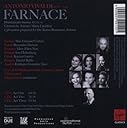
Vivaldi: Farnace
Product ID: 26477059
Virgin Classics invites you to enjoy the world premiere recording of Viviadi's Il Farnace in a version that Vivaldi prepared specially for the city of Ferrara in 1737-38 after its success in Venice. This is not only the first time the Ferrara version of Farnace has been recorded, but also the first time it has been heard, as the planned performances of 1738 were cancelled due to the local failure of the Vivaldi opera that preceded it, Siroe. Farnace was never staged again anywhere, and the only surviving trace of its music is in the form of an incomplete score carefully notated and preserved by Vivaldi in his personal collection. It is the only remaining opera of Vivaldi never to have been performed since the composer's time, and, unlike all the others, has remained unrecorded until now.The chances are that Vivaldi never completed this Farance. However, with the reconstruction of the third act by Diego Fasolis and Frédéric Delaméa, this album presents a rare opportunity to discover a work bursting with riches, the last fruit of Vivaldi's unprecedented operatic output. In this recording, the cast is led by the brilliant countertenor Max Emanuel Cencic in the title role with the support of conductor Diego Fasolis and the famed I Barocchisti ensemble. Review: Superb performance on all levels! - As a bassoon major at University 45 years ago, my experience of Vivaldi was limited to several bassoon concerti and the famous Gloria. In the last year I have discovered a new wealth of Vivaldi material in the singing of Phillipe Jaroussky and Max Emanuel Cencic.I refer to the recordings of Vivaldi's "Farnace" and Vinci's "Artaserse." Firstly, the orchestra and Diego Fasolis. I am astounded by the attention to minute detail. I found myself able to hear inner parts, and carefully crafted phrasings throughout the score in every instrumental part. Someone here has done their homework and thoroughly rehearsed. Kudos to Mr. Fasolis for his amazing work with the orchestra. Vocalists: First, there is not a weak link. Like the orchestra, these singers are all absolutely top-notch, both in terms of terrific voices, and in terms of a scholarly knowledge of the style of the Baroque, Vivaldi's music in particular. Max Cencic is beyond words! I think it quite possible that this may have been what the very best castrati sounded like, such as Farinelli and Carestini. The voice is feminine, yes, but has a core of masculine metal, along with evenness of range and a very broad range at that. The flexibility of the voice is amazing! Karina Gauvin, Ann Hallenberg, Daniel Behle, and the others all are exemplary in their performances, adding many, many changes in the da capo sections of their arias. The vocalists, like the orchestra have paid great attention to the tiny, minute details, that make such a difference in this performance. The harpsichords!!! These players are not just mindlessly tinkling along with the strings!! They are inventing and creating atmosphere and colour!! I played harpsichord at one point in my musical career. I know how much knowledge one must have to do this style correctly! And then they add to it!! WOW! This recording, like the recording of Artaserse, should be studied in Music History classes in universities, so that students gain not only an appreciation of the Baroque opera, but also become aware of the performance practice of the period Again, congratulations to Maestro Fasolis and the entire cast, for a performance more than well done!! Review: Thrillingly performed rarity. - This is not a pasticcio by Vivaldi - the entire work is authentically Vivaldi's composition, though never performed. According to information, there were two versions of this opera which Vivaldi wrote. This performance is the latter Ferrara (and never performed) version. In this recording, we got two bonus tracks from the first version that were cut from this latter Ferrara version. The vocal line up is extraordinary - all the singers are baroque experts, if not outright 'super stars'. In the title role, Croatian countertenor Max Emanuel Cencic depicts a tortured King of Pontus who was betrayed by members of his own family following political defeat. As his aggressive mother-in-law Queen of Cappadocia Berenice, Mary Ellen Nesi, an expert mezzo in trouser roles, sung an overbearing middle-aged queen with a chillingly incisive timbre. The relatively minor character of her captain Gilade, a love-sick for Farnace's sister Selinde, is very effectively portrayed by the wonderful soprano Karina Gauvin. Her aria in the final Act is enchanting in an unearthly manner that demonstrates nothing but artistic greatness. As Farnace's schemy sister Selinde, Ann Hallenberg is aptly elegant and steely in turn, which can at the quick-sand like instant become devastatingly enchanting. This great baroque mezzo-soprano has been around for almost two decades without ever receiving her due! The male characters are also wonderfully effective, and so is Tamira, the spouse of Farance, sung by Bulgarian mezzo oprano Donose. Fasolis and his 'band', needless to say, is all that you would ask for on such a stellar performance. Having said that, am glad that the producers restored two major arias of Farnace as Bonuses in CD3. I relistened this recording, and have to admit that Max Emanuel Cencic was at his absolute vocal prime in 2010 when this was being recorded. His timbre has since became darker and warmer, but here, it is a very masculine and somewhat steely and luscious sound. The Ferrari version assigned the bulk of arias to Tamiri, and Farnace is just one of the major characters, not the hero. Ruxandra Donose has a musky timbre but not too rich in colours. As I said, luckily they restored two cut major arias of Farnace as Bonuses.
| ASIN | B0057JWW0K |
| Best Sellers Rank | #391,168 in CDs & Vinyl ( See Top 100 in CDs & Vinyl ) #52,758 in Classical (CDs & Vinyl) |
| Customer Reviews | 4.7 4.7 out of 5 stars (36) |
| Date First Available | July 21, 2011 |
| Is Discontinued By Manufacturer | No |
| Label | Erato Disques |
| Manufacturer | Erato Disques |
| Number of discs | 3 |
| Product Dimensions | 5.47 x 5.24 x 0.87 inches; 9.24 ounces |
R**X
Superb performance on all levels!
As a bassoon major at University 45 years ago, my experience of Vivaldi was limited to several bassoon concerti and the famous Gloria. In the last year I have discovered a new wealth of Vivaldi material in the singing of Phillipe Jaroussky and Max Emanuel Cencic.I refer to the recordings of Vivaldi's "Farnace" and Vinci's "Artaserse." Firstly, the orchestra and Diego Fasolis. I am astounded by the attention to minute detail. I found myself able to hear inner parts, and carefully crafted phrasings throughout the score in every instrumental part. Someone here has done their homework and thoroughly rehearsed. Kudos to Mr. Fasolis for his amazing work with the orchestra. Vocalists: First, there is not a weak link. Like the orchestra, these singers are all absolutely top-notch, both in terms of terrific voices, and in terms of a scholarly knowledge of the style of the Baroque, Vivaldi's music in particular. Max Cencic is beyond words! I think it quite possible that this may have been what the very best castrati sounded like, such as Farinelli and Carestini. The voice is feminine, yes, but has a core of masculine metal, along with evenness of range and a very broad range at that. The flexibility of the voice is amazing! Karina Gauvin, Ann Hallenberg, Daniel Behle, and the others all are exemplary in their performances, adding many, many changes in the da capo sections of their arias. The vocalists, like the orchestra have paid great attention to the tiny, minute details, that make such a difference in this performance. The harpsichords!!! These players are not just mindlessly tinkling along with the strings!! They are inventing and creating atmosphere and colour!! I played harpsichord at one point in my musical career. I know how much knowledge one must have to do this style correctly! And then they add to it!! WOW! This recording, like the recording of Artaserse, should be studied in Music History classes in universities, so that students gain not only an appreciation of the Baroque opera, but also become aware of the performance practice of the period Again, congratulations to Maestro Fasolis and the entire cast, for a performance more than well done!!
A**T
Thrillingly performed rarity.
This is not a pasticcio by Vivaldi - the entire work is authentically Vivaldi's composition, though never performed. According to information, there were two versions of this opera which Vivaldi wrote. This performance is the latter Ferrara (and never performed) version. In this recording, we got two bonus tracks from the first version that were cut from this latter Ferrara version. The vocal line up is extraordinary - all the singers are baroque experts, if not outright 'super stars'. In the title role, Croatian countertenor Max Emanuel Cencic depicts a tortured King of Pontus who was betrayed by members of his own family following political defeat. As his aggressive mother-in-law Queen of Cappadocia Berenice, Mary Ellen Nesi, an expert mezzo in trouser roles, sung an overbearing middle-aged queen with a chillingly incisive timbre. The relatively minor character of her captain Gilade, a love-sick for Farnace's sister Selinde, is very effectively portrayed by the wonderful soprano Karina Gauvin. Her aria in the final Act is enchanting in an unearthly manner that demonstrates nothing but artistic greatness. As Farnace's schemy sister Selinde, Ann Hallenberg is aptly elegant and steely in turn, which can at the quick-sand like instant become devastatingly enchanting. This great baroque mezzo-soprano has been around for almost two decades without ever receiving her due! The male characters are also wonderfully effective, and so is Tamira, the spouse of Farance, sung by Bulgarian mezzo oprano Donose. Fasolis and his 'band', needless to say, is all that you would ask for on such a stellar performance. Having said that, am glad that the producers restored two major arias of Farnace as Bonuses in CD3. I relistened this recording, and have to admit that Max Emanuel Cencic was at his absolute vocal prime in 2010 when this was being recorded. His timbre has since became darker and warmer, but here, it is a very masculine and somewhat steely and luscious sound. The Ferrari version assigned the bulk of arias to Tamiri, and Farnace is just one of the major characters, not the hero. Ruxandra Donose has a musky timbre but not too rich in colours. As I said, luckily they restored two cut major arias of Farnace as Bonuses.
G**I
Mi è piaciuta grande Vivaldi lunga ma ci si fa
P**R
Thank you, the performance is wonderful. Peter
I**N
Well, I hesitated for quite a while before buying this set as I already own the Alia Vox (recently re-issued by Naive) set of this opera and really had to convince myself that I needed two recordings of this late Vivaldi opera. I was perfectly happy with my old recording (although I accept that there are all sorts of things wrong with it stylistically) and it is a fine piece. I have to say though that this new recording by Diego Fasolis is much, much better! I just bursts with energy and is conducted with such flair. I Barrochisti are glorious with brass - there are a couple of arias for Aquilio and Tamiri that I just can't stop listening to! The cast are uniformly excellent. I doubt if there is a countertenor voice out there at the moment that I enjoy as much as Max Cencic (although Franco Fagioli comes very close) and he sings the title role very well indeed. His unfortunate wife Tamiri is sung by my new favourite mezzo soprano, Ruxandra Donose - this lady must record more baroque music; her voice is glorious! Belligerent queen Berenice is also sung with tremendous flair by the ever more impressive Mary Ellen Nesi. Alan Curtis regulars Ann Hallenberg and Karina Gauvin are as distinguished as always in their roles and there are a couple of really good tenors in Daniel Behle and Emiliano Gonzalez Toro. The whole thing is just splendid and I don't really care if its a little over the top - its just tremendously good fun! Highly recommended.
G**R
1738, Vivaldi parvenait au crepuscule de sa vie et gardait intact la fougue de ses débuts, meme si à Venise l'heure du déclin avait sonné pour lui et qu'une autre étoile s'elevait pour briller au firmament de l'art lyrique, Johann Adolf Hasse. Cette version, le Farnace de Ferrare, fut la derniere à sortir de la plume vivaldienne, et ne fut jamais representée. Diego Fasolis lui rends par cet enregistrement un hommage merité, et sa direction se montre digne des joyaux que cet Opera contient. Le plateau de chanteurs qu'il a reuni sous sa baguette se montre également pour notre plus grand plaisir à la hauteur de ce projet, à commencer bien sur par max Emmanuel Censic, dont le "gelido in ogni vena" en appendice de cet enregistrement , est une veritable merveille, Karina Gauvin et Ann Hallenberg, des valeurs sures, sont au meilleur de leur forme, mention speciale à la tres belle Tamiri de la Mezzo Ruxandra Donose. Un "must"de Vivaldi , le chant du cygne d'un des plus grand maitre de la musique baroque, émouvant et magnifique.
A**E
Magnífica grabación de la ópera de Vivaldi, en la versión revisada por el compositor para la ciudad de Ferrara que nunca llegó a ser representada. El tercer acto ha sido reconstruido por Diego Fasolis y Frédéric Delaméa basándose en manuscritos del compositor veneciano hallados en Turín. Farnace fue una de las óperas de Vivaldi que más éxito cosechó en su época, aunque posteriormente caería en el olvido, como ocurrió con tantas óperas barrocas de tantos compositores. El libreto de Antonio Maria Lucchini está repleto de las habituales intrigas, amores y luchas de poder tan queridas por los libretistas del barroco. Para esta grabación Fasolis se rodea de un elenco de primera magnitud, en el que todos brillan a pesar de no haber ningún cantante italiano. Max Emanuel Cencic resplandece como el derrotado rey de Ponto que ordena a su esposa, Tamiri, que mate a su hijo y se suicide antes de caer en manos del ejército romano. El contratenor croata hace gala de un virtuosismo y una técnica admirables, alternando las arias de bravura (Quel torrente che s'innalza, acto III) con las de tono más íntimo (Perdona, o figlio amato, acto II) y otorgando gran fuerza expresiva al personaje; la mezzo rumana Ruxandra Donose tiene un timbre bonito y cálido e interpreta con acierto a Tamiri, la esposa del protagonista; la mezzosoprano canadiense de origen griego Mary Ellen Nesi convence en el papel de Berenice, la malvada suegra que odia a Farnace, y realiza una interpretación llena de energía; la mezzo sueca Ann Hallenberg, excelente como siempre, encarna a Selinda, hermana del protagonista, e interpreta sus arias con maestría y buena coloratura; la canadiense Karina Gauvin, en el papel de Gilade, príncipe y capitán del ejército de Capadocia, cuenta con algunas de las arias más hermosas de la ópera, como Scherza l'aura lusinghiera (acto III), en la que la soprano deslumbra con su timbre aterciopelado y exquisito; el tenor alemán Daniel Behle, de bella voz, interpreta al procónsul romano Pompeo, y el tenor suizo de origen chileno Emiliano González-Toro es Aquilio, prefecto de las legiones romanas, de timbre enérgico y armonioso. Diego Fasolis dirige I Barocchisti con determinación y elegancia en una grabación de calidad impecable, superior a la de Jordi Savall que era en directo. Una obra indispensable para los amantes de la ópera barroca. Excelente.
Trustpilot
1 week ago
3 weeks ago