Buy anything from 5,000+ international stores. One checkout price. No surprise fees. Join 2M+ shoppers on Desertcart.
Desertcart purchases this item on your behalf and handles shipping, customs, and support to Ireland.
🚀 Cross the chasm, lead the market, and never look back!
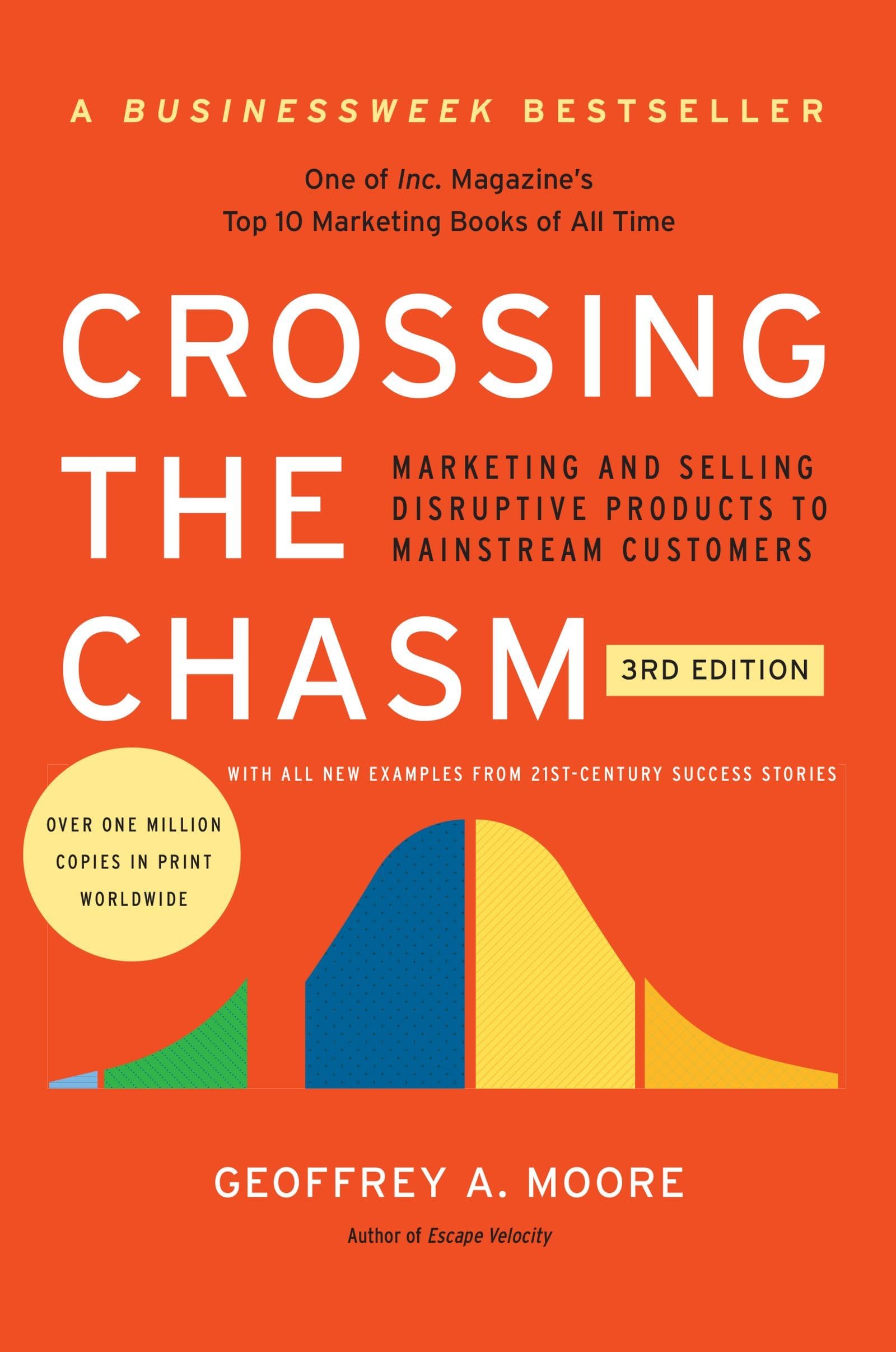
Crossing the Chasm, 3rd Edition, is a definitive guide for tech marketers and entrepreneurs aiming to transition innovative products from early adopters to the mainstream market. With updated insights, real-world examples, and actionable strategies, this bestseller (4.6/5 stars from 2,589 reviews) is a must-have for mastering market segmentation and accelerating product adoption.
| Best Sellers Rank | #12,996 in Books ( See Top 100 in Books ) #6 in Market Research Business (Books) #11 in Starting a Business (Books) #124 in Business Management (Books) |
| Customer Reviews | 4.6 out of 5 stars 2,597 Reviews |
V**N
I didn't know much about marketing, so this gets 5 stars
The book adressed a lot of issues relevant to my current company directly. First of all, the chasm model applies in B2B scenarios. This is not a b2c marketing book even if some ideas do apply. What I found interesting was that this book provides this model describing 5 different types of customers. Then we find ways in which to address these customers, the proper timings, the proper sales pitches, the product pricing, the competitors, the strategic partnerships, the development team, and even the compensation appropriate for the team, in order to attack each of the 4 market segments (1 market segment, or psychographic, as the author calls it, being pretty unapproachable). Awesome book. For me it would be an honest 4.5, as I didn't see a lot of references to more formal papers, but just to a few other books, and I don't want to just trust the author's wisdom on this, even if the book seems full of good ideas, and great explanations, and showcases nice ways of thinking about problems. I recommend this to anyone living in a capitalist system, seriosly....But more seriously indeed, this is very good for developers that work in product companies. All of the marketing, sales and management stuff will make a hell of a lot more sense after this book! For marketing and sales people I'm not sure what to recommend, but the book does claim to create a common vocabulary for the different departments of an organization, so dunno, maybe try it, marketing/sales/management folks! Enjoy! Also, if anyone knows a good B2C marketing or sales book, feel free to recommend!
W**R
Extraordinary Crossroads Marketing
This wonderful book creatively combines three business school concepts at the crossroads of the innovation adoption lifecycle (diffusion curve), market segmentation, and customer satisfaction. In brief, the main chasm for the adoption curve is the interval between the “early adopters” and the “early majority.” This is due to the different psychographics of these two distinct market segments and what satisfies each market. The “early adopters” are more or less difficult-to-please but well-funded visionaries who are willing to spend whatever is necessary to reshape their companies with futuristic technology. The “early majority” are those cautious pragmatists who want their companies to quickly benefit from proven technologies. They won’t buy because of your success with the “early adopters.” However, they will buy when enough customers in their own market segment are satisfied with the product but won’t buy without positive word-of-mouth. The main problem here is that the “early majority” exists in a “catch-22” trap. So, who among them will be the first to buy? A good answer is a definite requirement for “crossing the chasm” and getting a new product from one segment to the next. To address many fascinating, mostly high-tech B2B questions such as this, the author takes a deep dive into the frequently overlooked mechanics of what gets a successful product from inception to sustained success at each segment of the adoption curve. One major takeaway is seeking, finding, and using the target customer’s compelling reason to buy. Another is the need to capture one-half of the market segment within a year, a segment big enough to matter yet small enough to lead, and one that fits well with your crown jewels. The book is a relatively easy and enjoyable read, as the author makes a myriad of otherwise deep, dry issues come alive with analogies, similes, and metaphors. He also includes real-world examples of how and why companies did and didn’t cross the chasm, summarizing his strategic advice along the way with to-do and to-don’t lists. At least one major proof of the author’s theory is the amazing, continued best-seller success of his own book! Bottom-line, it’s a must-have, must-read for any good business library! If interested in more information about strategy in general, consider reading the following book, which distills and integrates the works of 87 master strategists: Strategic Advantage: How to Win in War, Business, and Life
R**S
Excellent
This is an excellent book for B2B companies to "cross the chasm" that sets apart early adopters of a new, innovative product from the mainstream market. It brings original and insightful ideas that have been tested (and being the 3rd edition of the book, it even includes examples of companies that deployed the ideas of the 1st edition). The broken bell curve of Enthusiasts, Visionaries, Pragmatists and Conservatives, the Compass of Competitive Positioning and the Whole Product model by Theodore Levitt are just the main highlights that make this book mandatory for anyone learning about startups and marketing in general. Very relevant, interesting and even entertaining.
K**H
great breakdown of a startup's journey
I was in two minds at the beginning of the book. I thought there was a pompousness to the writing and this was mainly for tech geeks. But I continued. As I read more, the concepts and stages become more clear and it's so interesting to see how the author defines the D-day siege as the way forward. I get it. It makes a lot of sense.
A**R
Playbook for how to succeed in Tech
I loved this book - it's not boring or slow paced. It's an excellent read for anyone trying to bring out a new technology or working at a technology company. I worked at a small software company and this book was recommended by a coworker from his previous role at a different software company. It was really eye opening to me and helpful. The author has excellent insights (I love his pioneer / settler reference). It really explains the lifecycle and why you may hit a wall after initial success and how to push through and overcome. I highly recommend this book.
F**I
Chasm Crossing for Disruptive Innovations Updated
This book provides a lucid, updated account about what is involved in successfully introducing and getting mainstream acceptance of disruptive innovations in high tech related businesses that can also be applied more broadly as well (e.g. in other industries, non-profits). I first became aware of Moore’s book “Living on the Fault Line” (see my review of this and “Escape Velocity”) when at CSC Consulting where I also started to hear about his concepts such as the “Technology Adoption Life Cycle.” Given increased recent interest in such topics, it was heartening to discover that Moore had issued a new edition of his initial book which drew me to examine this version. and the book for the first time. The book consists of two parts. Part I is about “Discovering the Chasm” the need to gain support for a disruptive innovation vs. just expecting The Field of Dreams (if you build it they will come) can be realized. Part II is about Crossing the Chasm using an analogy to the WWII D-Day invasion where the group has to: target the point of attack, assemble the invasion force, define the battle, and launch the invasion. A conclusion discusses the financial, organizational and R&D aspects of approaching and leaving the chasm behind. He treats how different stakeholders are involved and mobilized (see my review of Stakeholder Theory: The State of the Art ). Helpful appendices summarize the high-tech market development model (which is business to business and the subject of Moore’s second book “Inside the Tornado”) and a four gears model for engaging consumers in adopting digital innovations (business to consumer). At the time of this writing, I was doing some work with a non-profit organization advocating treatment and research advances related to mental health issues. I was struck by the notion that Moore’s model could apply in such non-profit sector situations as well (see my review of Daniel Siegel’s Mindsight: The New Science of Personal Transformation based on recent neuroscience). It also appeared to me that these ideas could relate to career entrepreneurship (see my review of the book “Value Proposition Design” by A. Osterwalder et al and another of their books, “Business Model You”). Because of my background and interests at the time, my favorite parts had to do with the parts on basic definitions of the technology adoption life cycle and marketing elements such as the diagrams showing “the simplified whole product model” (page 137) and “the competitive positioning compass” (page 167, 189). I was impressed that the revised edition had pertinent references to then current developments such as the evolution of SaaS (Software as a Service) with groups such as when the founders of PeopleSoft overtaken by SAP and Oracle initiated Work Day and contributed to the rise of Cloud Computing. Other cases sited that were particularly relevant to me included the one on Documentum (use in Pharma Regulatory & Safety matters), early targeting of the Mac computer at Corporate Advertising/Art Departments and the graphic appeal of these machines. Moore’s proposed definition of chasm crossing transition roles such as target market segment manager and whole product manager as well as the compensation/reward considerations between them and pioneering salespeople and technologists also stood out for me. So, for an update on chasm crossing for disruptive innovations (and its broader application), take a look at Moore’s most recent edition of his excellent first book.
S**N
Excellent overview for any company wanting to grow
Moore has updated his seminal work on making it big in high tech, but the principles can be applied anywhere. The book is based upon his own observations and covers the natural laws about moving from one customer segment to the next. A MUST READ for any entrepreneur. I am now building my fifth startup and Crossing The Chasm has been a great help in my 34-year IT career.
K**R
Great read
Really great and insightful. Definitely worth your time. As a tech sideways on the left of the chasm good to look across.
J**L
A great read
A classic that every entrepreneur, marketer, or product manager should read. It provides timeless strategies for taking innovative products from early adopters to the mainstream market. The updated edition keeps the examples relevant to today’s tech landscape. A foundational book that continues to deliver value years after its first release.
D**Z
Muy buen análisis del mercado de high tech desde el punto de vista del proveedor
Extraordinario análisis del mercado de "high tech" y de las diferentes etapas por la que pasa una empresa que inicie su andadura en él. Su primera versión se publicó en 1991. Sus conceptos siguen muy vigentes, además de que el libro se ha ido actualizando. Yo en concreto he leído una edición de 2014. Casi imprescindible para alguien que esté planteandose innovar en ese mercado
I**D
Interesting read
Although it was written decades ago, but many of the approaches are still applicable.
R**A
Moore's classic work remains highly relevant
Moore's classic work remains highly relevant. This updated edition provides valuable insights for technology companies navigating the transition from early adopters to the mainstream market. The framework for understanding different customer segments and tailoring marketing strategies accordingly is invaluable for anyone involved in technology product development and go-to-market strategies." This review highlights: Timeless Relevance: The core concepts of the book continue to be valuable. Updated Insights: The 3rd edition incorporates the latest market trends. Valuable Framework: Provides a practical framework for understanding customer segments. Relevance for Technology Companies: Essential for navigating the challenges of market adoption.
M**1
Still as relevant today
Still worth reading 50 years on. Dont stop at section 1, the second is even more insightful
Trustpilot
4 days ago
2 months ago