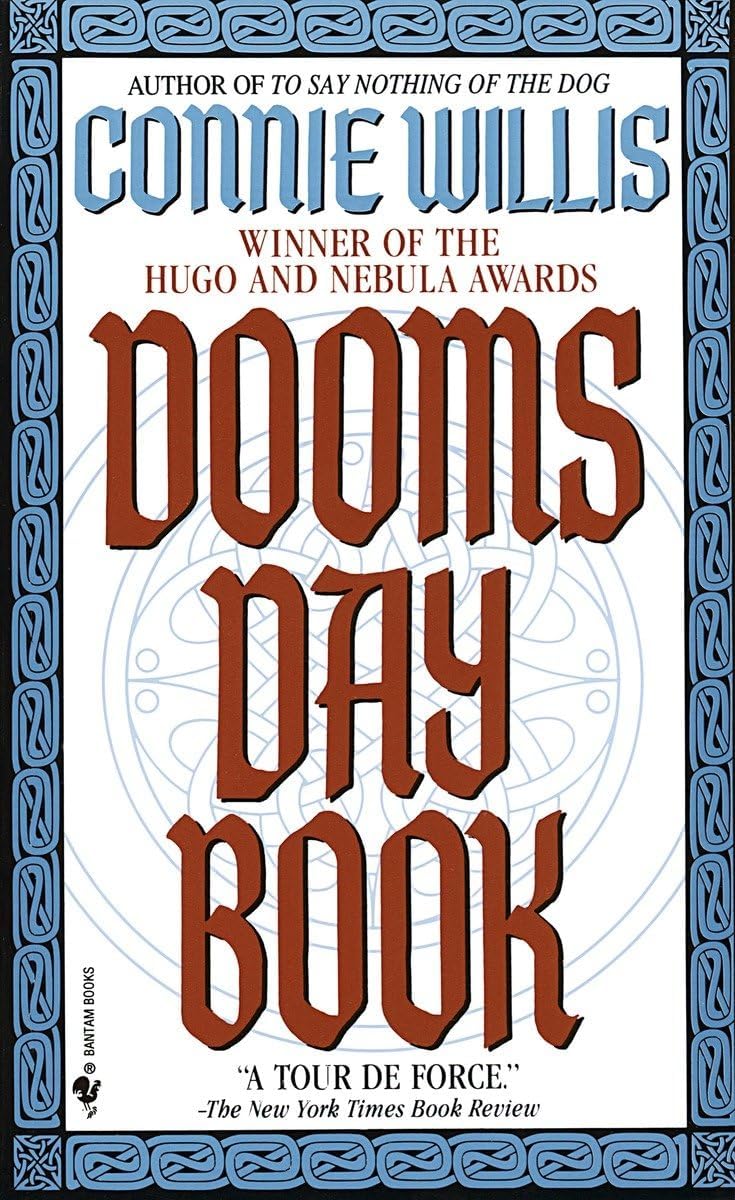

Doomsday Book [Willis, Connie] on desertcart.com. *FREE* shipping on qualifying offers. Doomsday Book Review: My modest understanding of what it must have been like to live in the 14th century has been much enriched - The Doomsday Book by the American author Connie Willis is an amazing, unique, captivating 600 page novel taking place in two times concurrently: near-future Oxford, England and a 14th Century medieval English village. Historian and Great Courses lecturer Teofilo Ruiz recommended this work to me and I’m glad he did – Doomsday Book is a terrific read. The novel is science-fiction in the sense that those 21st century Brits have the technology to place historians back in time via a sophisticated version of Mr. Peabody’s WAYBAC machine (recall the 1960s cartoon where Mr. Peabody, a bespectacled intellectual dog, and his adopted human son Sherman travel back through time and meet such historical figures as Cleopatra and Nero). Take my word for it here, Doomsday Book’s time-travel and parallel dramas will keep you turning the pages. And there are a lot of pages to turn, which prompts me to offer a couple of observations about reading longer novels. Really make the commitment by taking notes, creating outlines and sketching maps; a longer novel is a world unto itself and usually requires years for the author to complete. You will be honoring the integrity of the art form by devoting the needed energy to keep up with the details. The payoff is great: you’ll have the enjoyment of living for many hours in a vivid, fictional reality. Also, try listening to the audiobook as listening will open an additional dimension on the world created by the author, especially the various voices of the characters. Anyway, back on Doomsday Book. I wouldn’t want to say too much about the storylines and thus spoil for readers because this novel is simply too good and has too many unexpected surprises. Briefly, the time-traveler is an medieval historian, a young woman by the name of Kivrin, who has a thirst for first-hand experience of the 14th century. Her wish is granted and we join Kivrin as she travels to a small medieval village and develops a deep emotional connection with a number of the villagers, including 12 year old Rosemond, 6 year old Agnes, and Father Roche, the village priest. Kivrin is given a very real and direct experience as the villagers face challenges and live the cycle of their days and nights in a harsh, hostile, rustic world. By the time I finished the book, I had the feeling I also spent time living with these medieval men, women and children. The novel is that powerful. Meanwhile, back in 21th century Oxford, Kivrin’s mentor, a scholar by the name of Mr. Dunworthy, has his own problems with the time-travel technology and unfolding events at his school and in his town. He has to deal with an entire range of people, such as Mrs. Gaddson, an overbearing mother of one of the students, Mr. Gilchrist, a power-hungry academic, Colin, a precocious 12 year obsessed with the extremes of medieval history, Badri, a key technician for the time-travel machine, Montoya, an American Archeologist., not to mention a chorus of bell-ringers from America, including their headstrong leader. Again, I really got to know these people via the magic of Ms. Willis’s fiction. Like all first-rate literature, Doomsday Book provides insight into what makes us all human, our dealing with love and hate, with hope and despair, with the beauty of life and those ugly and disgusting parts of life. However, there is an added component in this novel: Kivrin, our main-character and heroine, lives in a medieval world with the knowledge and historical vision of the 21st century, which adds a real spice. What a fictional world; what a reading and listening experience (I also listened to the audiobook). My modest understanding of what it must have been like to live in the 14th century has been much enriched. Review: Fascinating and Intriguing Time Travel Novel - Time travelling novels have always piqued my interest, and I had heard of Connie Willis’ Hugo Award-winning novel, for quite some time via Book tube and online discussions, so the premise intrigued me. This also feels like a good “end of the year” , holiday kind of read because the alternating timelines both take place as Christmas is approaching. The novel concerns a young historian in 2054, Kivrin Engle, going back to the 1300s England during the Black Plague to do research. However, once she gets there, there are a host of problems and issues that must be dealt with both in present-day Oxford (2054) and the past (1348). There is a little bit of lifting due on the part of the reader, but I wouldn’t really call it heavy lifting. This being that we are not given much in the way of backstory/context into various terminology thrown around that are central to the story, that is words such as “drop” (the location of where the person arrives in a time period), and “slippage” (the shift in time that might not make the landing point in time exactly 100% accurate). That and the constant shifting in time. However, I think once the novel gets going, the readers can put the pieces together. There is a parallel structure to the plot narrative, as we traverse back and forth between the present (2054) and the past (1348) in chapters. One of the characters in the present day contracts a virus, but leaves a cryptic message “Something is wrong” to those who are looking after Kivrin’s mission to the past. However, this character is delirious and unintelligible, so the other characters, namely Professor Dunworthy, must scramble and try to decipher and put together what exactly went wrong when Kivrin was transported to the Middle Ages, all the while dealing with a pandemic. Meanwhile, in 1300s England, Kivrin also contracts a virus upon her arrival, and also realizes that something has gone terribly wrong with the timing of her arrival, the slippage. The conception of the novel is really genius and original to me, and I was fascinated to see how Kivrin would try to figure out her situation. She had studied up on language and dialect and understanding of the times prior to her departure, but once there, realizes she has a bit of a problem with communicating with the family who is helping her recover. She has a journal that she leaves (the Doomsday Book), which updates us on her progress and her findings and all the problems she is having. Once the big problem is realized, she must try to find a way to return. The book is well thought out and explored, but for my money, I would have liked quite a bit more of time spent and dedicated to the past in the novel with Kirvin and her situation with the family and those who found her, and less in the present, where characters are scrambling around frantically dealing with the pandemic and trying to contact people to figure out what to do. The novel digs into such themes as dealing with viruses and human suffering, but also faith, and hope and resilience, and we see this play out more as the novel progresses. There are some interesting characters as well, such as Father Roche. At any rate, it’s a fascinating look into time travel, the complexities that one must deal with, and has that historical aspect that makes it an intriguing experience. Willis wrote several other time travel novels, and I have them now on my to-read radar. Fans of time travel novels should give this one a try for sure.


| Best Sellers Rank | #567,445 in Books ( See Top 100 in Books ) #413 in Time Travel Fiction #856 in Science Fiction Crime & Mystery #3,731 in Literary Fiction (Books) |
| Customer Reviews | 4.4 4.4 out of 5 stars (6,798) |
| Dimensions | 4.14 x 1.2 x 6.81 inches |
| ISBN-10 | 0553562738 |
| ISBN-13 | 978-0553562736 |
| Item Weight | 10.4 ounces |
| Language | English |
| Part of series | Oxford Time Travel |
| Print length | 592 pages |
| Publication date | August 1, 1993 |
| Publisher | Spectra |
G**L
My modest understanding of what it must have been like to live in the 14th century has been much enriched
The Doomsday Book by the American author Connie Willis is an amazing, unique, captivating 600 page novel taking place in two times concurrently: near-future Oxford, England and a 14th Century medieval English village. Historian and Great Courses lecturer Teofilo Ruiz recommended this work to me and I’m glad he did – Doomsday Book is a terrific read. The novel is science-fiction in the sense that those 21st century Brits have the technology to place historians back in time via a sophisticated version of Mr. Peabody’s WAYBAC machine (recall the 1960s cartoon where Mr. Peabody, a bespectacled intellectual dog, and his adopted human son Sherman travel back through time and meet such historical figures as Cleopatra and Nero). Take my word for it here, Doomsday Book’s time-travel and parallel dramas will keep you turning the pages. And there are a lot of pages to turn, which prompts me to offer a couple of observations about reading longer novels. Really make the commitment by taking notes, creating outlines and sketching maps; a longer novel is a world unto itself and usually requires years for the author to complete. You will be honoring the integrity of the art form by devoting the needed energy to keep up with the details. The payoff is great: you’ll have the enjoyment of living for many hours in a vivid, fictional reality. Also, try listening to the audiobook as listening will open an additional dimension on the world created by the author, especially the various voices of the characters. Anyway, back on Doomsday Book. I wouldn’t want to say too much about the storylines and thus spoil for readers because this novel is simply too good and has too many unexpected surprises. Briefly, the time-traveler is an medieval historian, a young woman by the name of Kivrin, who has a thirst for first-hand experience of the 14th century. Her wish is granted and we join Kivrin as she travels to a small medieval village and develops a deep emotional connection with a number of the villagers, including 12 year old Rosemond, 6 year old Agnes, and Father Roche, the village priest. Kivrin is given a very real and direct experience as the villagers face challenges and live the cycle of their days and nights in a harsh, hostile, rustic world. By the time I finished the book, I had the feeling I also spent time living with these medieval men, women and children. The novel is that powerful. Meanwhile, back in 21th century Oxford, Kivrin’s mentor, a scholar by the name of Mr. Dunworthy, has his own problems with the time-travel technology and unfolding events at his school and in his town. He has to deal with an entire range of people, such as Mrs. Gaddson, an overbearing mother of one of the students, Mr. Gilchrist, a power-hungry academic, Colin, a precocious 12 year obsessed with the extremes of medieval history, Badri, a key technician for the time-travel machine, Montoya, an American Archeologist., not to mention a chorus of bell-ringers from America, including their headstrong leader. Again, I really got to know these people via the magic of Ms. Willis’s fiction. Like all first-rate literature, Doomsday Book provides insight into what makes us all human, our dealing with love and hate, with hope and despair, with the beauty of life and those ugly and disgusting parts of life. However, there is an added component in this novel: Kivrin, our main-character and heroine, lives in a medieval world with the knowledge and historical vision of the 21st century, which adds a real spice. What a fictional world; what a reading and listening experience (I also listened to the audiobook). My modest understanding of what it must have been like to live in the 14th century has been much enriched.
F**9
Fascinating and Intriguing Time Travel Novel
Time travelling novels have always piqued my interest, and I had heard of Connie Willis’ Hugo Award-winning novel, for quite some time via Book tube and online discussions, so the premise intrigued me. This also feels like a good “end of the year” , holiday kind of read because the alternating timelines both take place as Christmas is approaching. The novel concerns a young historian in 2054, Kivrin Engle, going back to the 1300s England during the Black Plague to do research. However, once she gets there, there are a host of problems and issues that must be dealt with both in present-day Oxford (2054) and the past (1348). There is a little bit of lifting due on the part of the reader, but I wouldn’t really call it heavy lifting. This being that we are not given much in the way of backstory/context into various terminology thrown around that are central to the story, that is words such as “drop” (the location of where the person arrives in a time period), and “slippage” (the shift in time that might not make the landing point in time exactly 100% accurate). That and the constant shifting in time. However, I think once the novel gets going, the readers can put the pieces together. There is a parallel structure to the plot narrative, as we traverse back and forth between the present (2054) and the past (1348) in chapters. One of the characters in the present day contracts a virus, but leaves a cryptic message “Something is wrong” to those who are looking after Kivrin’s mission to the past. However, this character is delirious and unintelligible, so the other characters, namely Professor Dunworthy, must scramble and try to decipher and put together what exactly went wrong when Kivrin was transported to the Middle Ages, all the while dealing with a pandemic. Meanwhile, in 1300s England, Kivrin also contracts a virus upon her arrival, and also realizes that something has gone terribly wrong with the timing of her arrival, the slippage. The conception of the novel is really genius and original to me, and I was fascinated to see how Kivrin would try to figure out her situation. She had studied up on language and dialect and understanding of the times prior to her departure, but once there, realizes she has a bit of a problem with communicating with the family who is helping her recover. She has a journal that she leaves (the Doomsday Book), which updates us on her progress and her findings and all the problems she is having. Once the big problem is realized, she must try to find a way to return. The book is well thought out and explored, but for my money, I would have liked quite a bit more of time spent and dedicated to the past in the novel with Kirvin and her situation with the family and those who found her, and less in the present, where characters are scrambling around frantically dealing with the pandemic and trying to contact people to figure out what to do. The novel digs into such themes as dealing with viruses and human suffering, but also faith, and hope and resilience, and we see this play out more as the novel progresses. There are some interesting characters as well, such as Father Roche. At any rate, it’s a fascinating look into time travel, the complexities that one must deal with, and has that historical aspect that makes it an intriguing experience. Willis wrote several other time travel novels, and I have them now on my to-read radar. Fans of time travel novels should give this one a try for sure.
L**R
Apocalyptic!!
The good, the bad, the selfish and the brave. A real adventure. This story was an interesting picture of what love and faith are.
E**A
Apocalyptic... read during the 2020 Pandemic, this novel truly hit home. Loved every minute - unputdownable 🌹🌹🌹 Add to your reading list if time travel and historical novels are your “thing” 👏👏👏👏
R**D
---Brief Synopsis--- This book has two story threads running through it. It is set in 2054 and time travel is possible, but done only by historical researchers - but no-one has gone back as far as the 14th century. The story is based in and around Oxford University and a young student who is determined to get back to the 14th century. Kevrin does get back to the 14th century but the trip is not as straight-forward as she had expected. Together with her troubles in the past there is a parallel story being played out in 2054 Oxford and the story chops and changes between the two. I will add a little more at the bottom of the review but as it will contain spoilers I will not go into further details here - as I did find out more than I wanted when reading someone elses review myself. ---My Opinion--- This book combined two of my interests - time travel and history. I had not read any of Connie's books before so came to it fresh. I enjoyed the element of twin stories unravelling together. I especially enjoyed the details of life and clothing in the 14th century. Plus there was a lot of discussion to begin with as to how words were pronouced and how Kivrin had been taught the wrong pronouceations - though she did have an embedded translator that helped her understand others and also be understood. It was a large book of 650 pages but I read it over a few days and felt sorry when it was finished -though I couldn't wait to get to the end to see what happened. I enjoyed this on two levels - first as a good science fiction read but also as it gave me an added insight into what medieval life was like and I will use that information when I imagine how life was like in and around our little village. The research seemed very though into living conditions back in the 14th century - from the type of dye used on their clothing to the way women had to behave and how young girls were betrothed at an early age. ---Star Rating--- 5 stars. An excellent read. ---Would I Recommend?--- Yes. Connie has written other time travel books in the same vein which I will probably buy as well - 'Blackout' and 'All Clear'. She has also written other books and many short stories. ---Websites--- Website - [..] Blog - [...] ---SPOILERS--- Kivrin ends up not in the 1320s as she had planned but in 1348 when the plague was just arriving in Oxford and the little surrounding villages. Parallel to this story there is a bad influenza outbreak in the Oxford she left behind - so she arrived with a very bad case of flu wich means she has to be nursed back to health. Then later on she has to nurse everyone else who falls prey to the plague one by one. Kevrin has been immunised against it but we hear in gory detail the terrible suffering of those who all die around her. Back in the 20th century Oxford is quarantined and the flu spreads. Kevrin has recorders embedded in her wrists and she records her life in a medieval village - this is what she calls her 'Doomsday Book' and what gives the book its title. There are extracts at the end of many of the chapters. Because of the time error when Kivrin was sent to the past - one of the technicians was coming down with a serious case of flu and miscalculated, she travelled back through a 'net' but the time for her to return had been set at 2 weeks but because of the time error and the technician's delirium it was touch and go whether she would be able to be found and brought back to her own time. Or if she would actually want to come. Summary: Fantastic story that brings the 14th century alive.
E**.
Ayant découvert Connie Willis à la bibliothèque, je me suis dépêché de lire autant de ses livres que possible. J'ai acheté The Doomsday Book pour quelqu'un qui a étudié et aime beaucoup le Moyen Âge et la Science fiction. En outre, bien entendu, il n'y a rien de tel que la lecture pour parfaire ses connaissances d'une langue étrangère !
M**E
Wow! Was für ein Roman! Er lässt mich so beeindruckt zurück, dass ich es kaum in Worte fassen kann!! Connie Willis schreibt jenseits aller ausgedienten und ausgelutschten Genres. Ein spirituelles Zeitreisehistorienepos, das einem die Sprache verschlägt. Von der ersten Seite an wird man in die Geschichte um Kivrin und ihren Mentor hineingezogen, man kriecht förmlich zwischen die Zeilen und wird nicht mehr losgelassen, bis man beider Schicksale in Erfahrung gebracht hat. Doch worum geht's? Ein junge Historikerin reist ins England vor der Pest. Doch beim Zeitsprung geht etwas schief, und während ihr Mentor im Jahre 2056 versucht herauszufinden, was genau nicht funktioniert hat, bricht eine gefährliche Viruserkrankung aus. Kivrin derweil leidet selber an der Viruserkrankung und versucht nach ihrer Genesung herauszufinden, wo genau sie gelandet ist. Doch sie kann sich nicht verständigen, da die Sprache, die sie als Vorbereitung gelernt hat, von ihren Rettern nicht verstanden wird und auch ihr Übersetzungsprogramm nicht funktioniert. Derweil wächst ihr die Familie, die sie aufgenommen hat, ans Herz ... Vom ersten Satz an baut Connie Willis ihren Spannungsbogen kontinuierlich auf und erzeugt so eine intensive Atmosphäre. An keiner Stelle des Buches fühlt man sich auch nur annähernd gelangweilt oder für dumm verkauft. Dabei beachtet sie alle Merkmale eines hervorragenden Romans. Statt sich in ermüdende und langweilige äußere Personenbeschreibungen zu vertiefen, schreibt sie spannungsgeladene Dialoge und zeigt so das Innenleben ihrer Protagonisten durch ihre Dialoge und Handlungen und ohne detailverliebte Beschreibungen. So erfährt man nicht unbedingt die Augenfarbe jedes einzelnen, dafür erfährt man aber etwas von den Beweggründen und den Sehnsüchten, von denen das Handeln jedes Einzelnen bestimmt wird. Leider wird das Buch nicht mehr in der deutschen Übersetzung verlegt. Sooooo schade!!!
A**L
Estuve investigando un poco sobre libros de ciencia ficción escritos hace unos cuantos años y este fue uno de los seleccionados ya que estaba muy bien valorado. A mí me ha parecido que durante los dos primeros tercios es lento e incluso repetitivo, a veces te daban ganas de coger por las solapas de la chaqueta a los personajes y zarandearlos a ver si se daban cuenta de lo que era obvio que debían hacer para avanzar. La última parte parte, sin embargo, es soberbia. Salvo el final, que no me gustó mucho. Es cierto que para cuando llegas al último tercio y viene lo bueno te conoces perfectamente a todo el mundo, por lo que probablemente esta última parte funciona tan bien en parte gracias a todo eso lo que la precede, pero aún así pienso que con 150 páginas menos el libro ganaría bastante. Es buen libro y no me arrepiento del tiempo dedicado a leerlo, pero yo no lo valoraría tanto como se dice por ahí.
Trustpilot
1 month ago
1 month ago